Dew Point vs Humidity: What Each Number Tells You at Home
Dew point tells you how much water vapor is in the air. Relative humidity tells you how close the air is to saturation at its current temperature.
By Clean Air Guides editorial teamUpdated 10 min read
In this article
- Which number should you use for your problem?
- What is dew point?
- What is relative humidity?
- Same dew point, different humidity: RH by temperature
- How dew point relates to comfort
- Which number should you watch for comfort?
- Which number predicts condensation on windows?
- Which number matters for mold?
- Do you need both numbers?
- What to do first
- How we calculated the numbers
The dew point is the temperature the air would have to cool to before it saturates, so it is an absolute measure of how much water vapor the air holds: a higher dew point always means more moisture. Relative humidity (RH) is the percentage of saturation at the air’s current temperature, so it changes whenever the temperature changes, even if no water is added or removed.
| Dew point | Relative humidity | |
|---|---|---|
| What it measures | The amount of water vapor, expressed as a temperature | How full the air is, as a % of what it could hold at its current temperature |
| Unit | °F or °C | % |
| Changes when the room warms or cools? | No, only when moisture is added or removed | Yes: warmer air reads lower, cooler air reads higher |
| Best for | Mugginess, condensation, comparing rooms or indoor vs outdoor air | Setting a humidifier, dehumidifier or humidistat; EPA targets |
| Indoor target | No official one; 30–50% RH at 70 °F is a dew point of about 37–51 °F (calculated) | EPA: below 60%, ideally 30–50% |
Your hygrometer shows temperature and RH. Our dew point calculator turns those two readings into a dew point, and the relative humidity calculator does the reverse.
Which number should you use for your problem?
| Your situation | Watch | Why |
|---|---|---|
| Will today feel sticky outside? | Dew point | The NWS uses dew point as the judge of how humid it feels |
| Setting a humidifier or dehumidifier | Relative humidity | EPA’s ranges and every humidistat are in % RH |
| Windows fog or drip in winter | Dew point | Glass gets wet when it is colder than the dew point |
| Musty basement or mold worries | Relative humidity | EPA’s mold guidance is a % RH ceiling (below 60%) |
| Comparing two rooms at different temperatures | Dew point | RH readings at different temperatures can’t be compared directly |
| Why heated winter air feels so dry | Both | Heating keeps the dew point but cuts the RH |
What is dew point?
The NOAA National Weather Service (NWS) defines dew point as the temperature to which air must be cooled to reach saturation, assuming pressure and moisture content stay constant. A higher dew point means more moisture in the air. Cool the air to its dew point and water starts to condense out as dew, fog or droplets on a cold glass.
Dew point does not care how warm the room is. Heat a room from 65 °F to 75 °F without adding moisture and the dew point stays where it was. That is what makes it an absolute measure: two readings of 50 °F mean the same amount of water vapor, whether you took them in a cold bedroom or a warm kitchen.
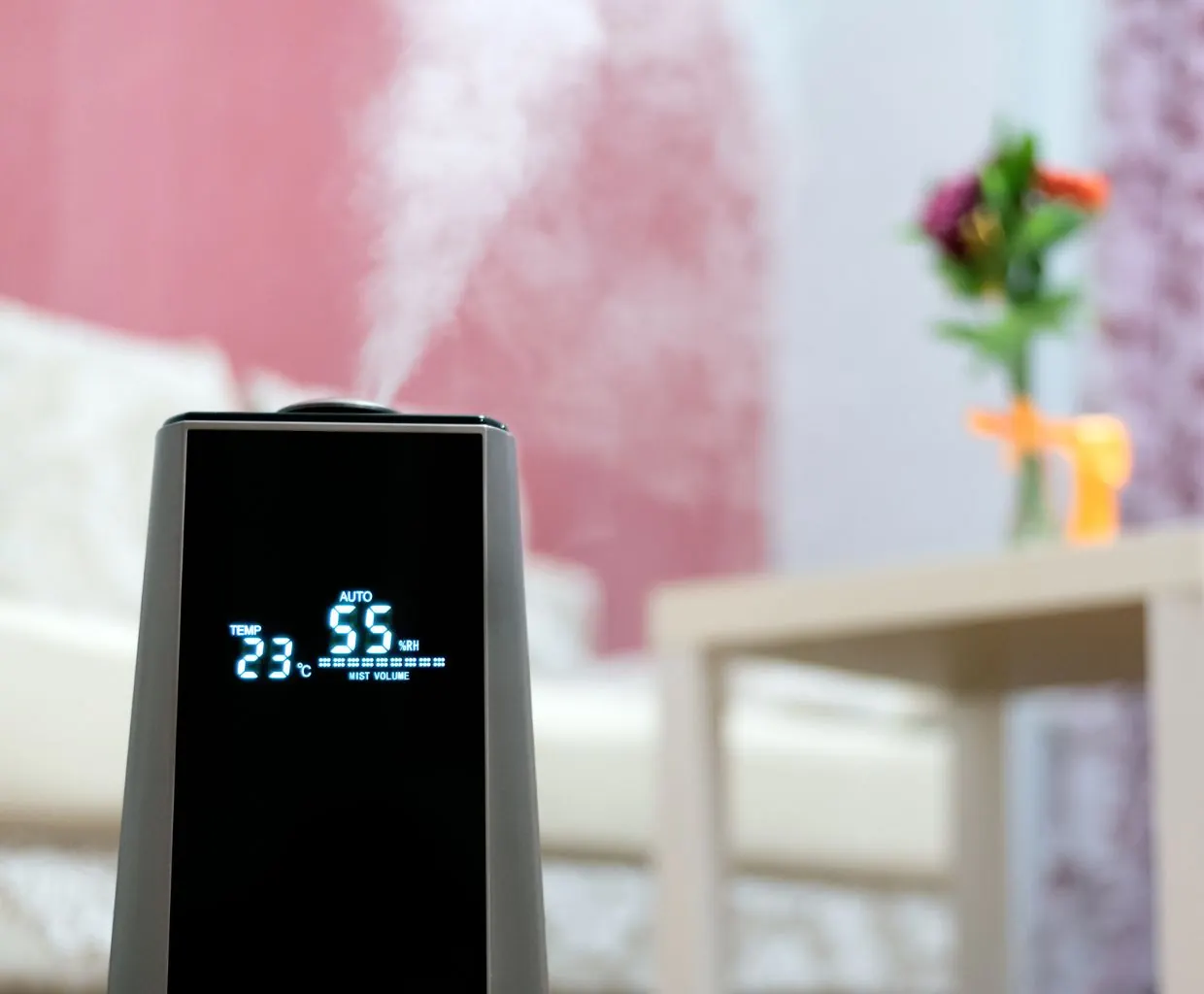
Example: a 70 °F room at 40% RH has a dew point of about 44.6 °F. The display in the photo above (73.4 °F and 55% RH) works out to a dew point of about 56.3 °F.
What is relative humidity?
The NWS defines relative humidity as the amount of moisture in the air relative to the amount that would be there if the air were saturated, expressed in percent. Because that saturation amount depends on temperature, the NWS points out that RH alone does not tell you the actual amount of moisture present.
That is why RH can mislead. The NWS La Crosse office gives two examples: air at 30 °F with a 30 °F dew point is at 100% RH, while air at 80 °F with a 60 °F dew point is only at about 50%. The 80 °F air holds far more water and feels far more humid, even though its RH is half as high.
If you want the actual amount of water in grams per cubic meter, that is absolute humidity. Our absolute humidity calculator works it out from temperature and RH.
Same dew point, different humidity: RH by temperature
The table below holds the dew point fixed and changes only the air temperature. All values are calculated with the Magnus formula (Alduchov and Eskridge coefficients, as used in our dew point calculator), not measured. The last column shows that the actual amount of water barely moves while RH swings by more than half.
| Air temperature | RH at 45 °F dew point | RH at 50 °F dew point | RH at 55 °F dew point | Water vapor at 50 °F dew point |
|---|---|---|---|---|
| 55 °F | 69% | 83% | 100% | 9.3 g/m³ |
| 60 °F | 58% | 70% | 84% | 9.2 g/m³ |
| 65 °F | 48% | 58% | 70% | 9.1 g/m³ |
| 68 °F | 44% | 53% | 63% | 9.1 g/m³ |
| 70 °F | 41% | 49% | 59% | 9.0 g/m³ |
| 72 °F | 38% | 46% | 55% | 9.0 g/m³ |
| 75 °F | 34% | 41% | 50% | 8.9 g/m³ |
| 80 °F | 29% | 35% | 42% | 8.9 g/m³ |
| 85 °F | 25% | 30% | 36% | 8.8 g/m³ |
Calculated: RH = 100 × es(dew point) / es(air temperature), with es = 6.1094 × exp(17.625 × T / (243.04 + T)) and T in °C. Water vapor (absolute humidity) uses the ideal gas law; it dips slightly with temperature only because warmer air at the same vapor pressure is less dense.
Two things stand out. A thermostat change alone moves RH a lot: the same air reads 58% at 65 °F and 41% at 75 °F. And a room can sit inside EPA’s 30–50% range at 75 °F but drift above 60% in a cooler bedroom down the hall, with no change in moisture at all.
How dew point relates to comfort
The NWS La Crosse office publishes a simple summer comfort scale based on dew point. We added what each dew point means in RH at two room temperatures, calculated with the same formula.
| Dew point | NWS La Crosse description (summer) | RH at 75 °F (calculated) | RH at 85 °F (calculated) |
|---|---|---|---|
| 55 °F or lower | Dry and comfortable | 50% or lower | 36% or lower |
| 55 to 65 °F | Becoming sticky, with muggy evenings | 50–71% | 36–51% |
| 65 °F or higher | Lots of moisture, becoming oppressive | 71% or higher | 51% or higher |
The scale describes outdoor summer weather, not a health limit or an indoor standard. Other weather outlets use slightly different cutoffs, so we’ve only included the one the NWS office publishes.
Which number should you watch for comfort?
Indoors, set your equipment by relative humidity. EPA’s guidance is written in RH: keep indoor humidity below 60%, ideally between 30% and 50%. EPA’s humidifier fact sheet adds that you shouldn’t humidify above 50%, and the CPSC gives the same 30–50% range. Your humidistat and hygrometer both read in RH, so that is the number you can act on directly. Our guide to ideal indoor humidity covers each agency’s range and the winter limits.
Outdoors, or when you’re comparing indoor and outdoor air, use dew point. In our view it is the better forecast number for whether a summer day will feel sticky, because it doesn’t swing up and down with the daily temperature the way RH does.
Dew point also explains dry winter air. Outdoor air at 30 °F and 70% RH has a dew point of about 21 °F. Heat that same air to 70 °F indoors and the dew point stays at 21 °F, but RH drops to about 16% (calculated). Nothing dried the air; it just got warmer. On hot, humid days, the heat index calculator shows how much warmer that moisture makes the air feel.
Which number predicts condensation on windows?
The dew point. National Research Council Canada explains that condensation forms on an inside window surface whenever the surface temperature falls below the dew point of the room air. Windows are usually the coldest surface in a heated room, so in winter they set the practical upper limit on indoor humidity.
That gives you a direct test: compare the glass temperature with the dew point. In a 70 °F room:
- At 40% RH, the dew point is about 44.6 °F. Glass colder than that fogs.
- At 50% RH, the dew point is about 50.5 °F. Even moderately cold glass gets wet.
- If the glass measures 45 °F, the room can hold at most about 41% RH before it condenses (calculated).
An RH reading alone can’t tell you this, because the answer depends on how cold the glass is. We’d measure the inside of the pane with an infrared thermometer and enter it in the dew point calculator, which tells you the highest RH that surface can stay dry at. Our guide to condensation on windows has the full winter tables by outdoor temperature and glazing type.
Tip: If water appears on windows, walls or pictures while a humidifier is running, EPA says to move the humidifier, lower its humidistat setting or use it less.
Which number matters for mold?
Relative humidity, for the room as a whole. EPA says the key to mold control is moisture control and recommends keeping indoor humidity below 60%. The CPSC warns that above 60%, moisture may build up and condense on surfaces where bacteria and fungi can settle and grow.
Dew point still matters at cold spots. A cold surface raises the humidity right next to it, because the air there is cooler than the room. Take a 70 °F room at 50% RH (dew point about 50.5 °F). The air touching a 60 °F exterior wall corner or closet wall is at about 71% RH (calculated), well above the 60% EPA wants room air to stay under, even though the hygrometer in the middle of the room reads a comfortable 50%.
In our view, the practical rule is simple: keep room RH in EPA’s range, and treat any surface that stays damp as a moisture problem to fix. EPA advises drying condensation quickly and reducing the source, and drying water-damaged areas within 24 to 48 hours to prevent mold growth. Our guide on how to reduce humidity in the house covers ventilation, dehumidifiers and air conditioning.
Important: If you have mold and health symptoms, or a large area of growth, talk to your doctor and follow EPA’s cleanup guidance rather than relying on humidity numbers alone.
Do you need both numbers?
For most homes, yes, but you only need to measure two things.
We’d use them like this:
- Read RH to decide whether to humidify or dehumidify (aim for 30–50%).
- Convert to dew point when windows fog, when one room feels damper than another, or when you compare indoor air with the outdoor forecast.
- Compare the dew point with the coldest surface in the room (usually the window) before raising a humidifier’s setting in winter.
What to do first
Start with a reading you trust. Our guide on how to check humidity in your house explains where to put a hygrometer and how far off cheap gauges can be. Then put the temperature and RH into the dew point calculator to see your condensation limit, and use the relative humidity calculator to see what your current air will read in a warmer or cooler room.
How we calculated the numbers
Every calculated value on this page uses the Magnus formula with the coefficients Alduchov and Eskridge (1996) recommended (a = 17.625, b = 243.04 °C), as published by Lawrence (2005) in the Bulletin of the American Meteorological Society. With these coefficients, the saturation vapor pressure error stays under 0.4% between −40 °C and 50 °C (−40 °F to 122 °F). These are the same formulas our calculators use, so you can reproduce any number in the tables there.
Frequently asked questions
Is dew point or humidity more important?
It depends on the job. Dew point is the better measure of how much moisture the air holds and of whether a cold surface will get wet. Relative humidity is the number EPA's indoor guidance and your humidistat use, so it is the one to set your humidifier or dehumidifier by.
What is a comfortable dew point?
For summer weather, the National Weather Service office in La Crosse calls a dew point of 55 °F or lower dry and comfortable, 55 to 65 °F sticky with muggy evenings, and 65 °F or higher oppressive.
What dew point is too high indoors?
No agency sets an indoor dew point limit; EPA uses relative humidity and says to stay below 60%, ideally 30–50%. In a 70 °F room, 60% RH is a dew point of about 55.5 °F and 50% RH is about 50.5 °F (calculated with the Magnus formula).
Why does relative humidity drop when the temperature rises?
Warmer air can hold more water vapor before it saturates. If the amount of moisture stays the same, the same vapor fills a smaller share of that capacity, so relative humidity falls while the dew point stays put.
What dew point causes condensation on windows?
Water condenses on any surface at or below the room air's dew point. In a 70 °F room at 40% RH, the dew point is about 44.6 °F, so glass colder than that will fog.
Related guides
Guides
Condensation on Windows Inside: Why It Happens and How to Stop It
Water on the inside of your windows means the glass is colder than the room air's dew point. When it's normal, when humidity is too high and how to fix it.
7 min read

Guides
Humidifier vs Dehumidifier: Which One Does Your Home Need?
A humidifier adds moisture to dry air; a dehumidifier pulls it out of damp air. A hygrometer and EPA's 30% to 50% range tell you which one you need.
6 min read

Guides
Air Purifier vs Dehumidifier: Particles vs Moisture, and Which One You Need
An air purifier filters particles; a dehumidifier pulls moisture out of the air. Here's which one helps with mold, allergies and damp basements, and when you need both.
6 min read

Guides
How to Reduce Humidity in Your House: 10 Steps That Work
Measure first, then vent moisture outdoors, run the AC or a dehumidifier and cut indoor moisture sources until humidity stays between 30% and 50%.
7 min read