Best Air Purifiers for Mold in 2026: Spores, Musty Odor and What to Fix First
An air purifier can catch airborne mold spores and musty odors, but it won't stop mold growing. Five HEPA + carbon picks, and the moisture fixes that come first.
By Clean Air Guides editorial teamUpdated 14 min read
Our picks at a glance
- Top pickCheck price
Best overall
True HEPA plus a carbon-pellet filter for musty smells, rated for a 392 sq ft room.
- CADR 253 smoke (Winix)
- 392 sq ft
- Carbon pellets
- Check price
Best for basements and large rooms
AHAM-verified for about 606 sq ft, with a carbon-pellet filter and no advertised ionizer.
- CADR 394 smoke (AHAM)
- 606 sq ft
- ENERGY STAR
- Check price
Most carbon for musty odor
About 15 lb of carbon and zeolite behind 60 sq ft of HEPA media.
- ~15 lb carbon + zeolite
- 60 sq ft HEPA
- No AHAM CADR
- Check price
Premium pick
HyperHEPA filtration, a 5 lb carbon and alumina cartridge and long filter life.
- 5 lb gas media
- 40-300 cfm airflow
- No AHAM CADR
- Check price
Best for small rooms
An AHAM-listed bedroom-size unit with carbon, for around $90 to $100.
- CADR 139 smoke (AHAM)
- 215 sq ft (AHAM)
- Carbon stage
Prices change often; Amazon shows the current price. As an Amazon Associate, Clean Air Guides earns from qualifying purchases.
In this article
- Fix the moisture first
- How we chose
- Mold air purifiers compared
- What does each mold pick cost per year?
- The best air purifiers for mold
- Best overall: Winix 5520
- Best for basements and large rooms: Levoit Core 600S-P
- Most carbon for musty odor: Austin Air HealthMate HM400
- Premium pick: IQAir HealthPro Plus XE
- Best for small rooms: Levoit Core 300-P
- Models we considered and left out
- What to look for in a mold air purifier
- Types of house mold: does it matter?
- Mold, health and pregnancy
- What an air purifier can’t do
An air purifier can help with mold, but only with the part that’s in the air. EPA says some air cleaners remove airborne mold spores, fragments and musty odors, yet they won’t stop mold growing or rid a house of it. So fix the moisture first, then add a purifier with a HEPA-grade filter and real activated carbon. Our pick is the Winix 5520, which pairs True HEPA with a carbon-pellet filter for rooms up to 392 sq ft.
Fix the moisture first
EPA is blunt: the key to mold control is moisture control (our guide on how to reduce humidity in the house goes step by step). Before you spend money on a purifier, work through its basics:
- Find and fix the water. If you clean mold but don’t fix the leak or condensation, it will likely come back.
- Dry fast. Dry water-damaged areas and items within 24 to 48 hours to prevent growth.
- Keep humidity down. EPA recommends indoor humidity below 60%, ideally 30% to 50%, using a dehumidifier or air conditioner when needed. Our guide to ideal indoor humidity shows how to measure it.
- Remove, don’t just kill. Dead mold can still cause allergic reactions, so it has to be cleaned off. EPA doesn’t recommend routine use of biocides such as chlorine bleach.
- Know your limit. A moldy area under about 10 sq ft (roughly 3 ft x 3 ft) can usually be cleaned by the homeowner. Bigger areas, or a lot of water damage, call for more involved remediation.
- Check the HVAC. EPA says not to run your heating and cooling system if you know or suspect it is contaminated with mold, because it can spread spores through the house.
Basements are the classic problem spot. Our basement air purifier guide covers dehumidifiers and why radon needs a different fix.
How we chose
We don’t test purifiers. The picks come from manufacturer pages and manuals, the AHAM Verifide directory, the CARB certified list and ENERGY STAR, checked in October 2026 (see how we research). Each pick has a HEPA-grade filter for spores and an activated-carbon stage for musty odor, because EPA says HEPA filters alone can’t remove gases or odors. We favored carbon pellets or a heavy carbon bed over thin carbon sheets, mechanical filtration over ionizers, and AHAM-verified CADR where it exists.
Mold air purifiers compared
| Model | Smoke CADR / room size | Carbon | Ionizer | Filter life |
|---|---|---|---|---|
| Winix 5520 | 253 / 392 sq ft (Winix) | Carbon pellets | PlasmaWave, can be switched off | About 12 months |
| Levoit Core 600S-P | 394 / 606 sq ft (AHAM) | Carbon pellets | None advertised | 6 to 12 months |
| Austin Air HM400 | No CADR or airflow published | About 15 lb carbon + zeolite | None | Up to 5 years |
| IQAir HealthPro Plus XE | No CADR; up to 300 cfm | 5 lb carbon + alumina | None | About 18 to 48 months by stage |
| Levoit Core 300-P | 139 / 215 sq ft (AHAM) | Carbon layer | None advertised | 6 to 8 months (manual) |
What does each mold pick cost per year?
A purifier for a damp room tends to run every day, so we worked out a yearly figure on one basis: the maker’s filter price and replacement interval, plus top-speed watts for 8 hours a day at the July 2026 US average of 18.31 cents per kWh (EIA). Electricity = watts × 8 × 365 ÷ 1,000 × $0.1831. These are our calculations; lower speeds use less power.
| Model | Filters per year | Electricity, 8 h a day | Total per year |
|---|---|---|---|
| Winix 5520 | Around $50 to $80 (one Filter Q; Winix’s price changed) | About $35 (65 W, Winix manual) | About $85 to $115 |
| Levoit Core 600S-P | Around $60 to $120 (one or two Original filters) | About $36 (67.3 W, AHAM) | About $96 to $156 |
| Austin Air HM400 | About $79 (around $395 per filter, up to 5 years) | Up to about $79 (147 W, Austin’s startup maximum) | Up to about $158 |
| IQAir HealthPro Plus XE | About $153 (three filters rated 18, 24 and 48 months) | About $72 (134 W, IQAir) | About $225 |
| Levoit Core 300-P | About $45 to $80 (a $30 to $40 filter every 6 to 8 months, Levoit manual) | About $29 (53.3 W, AHAM) | About $74 to $109 |
The Austin electricity figure is a ceiling, since Austin Air only gives 147 W as the maximum at startup. Your own hours and rate go into the air purifier electricity cost calculator.
The best air purifiers for mold
Best overall: Winix 5520
Buy it if:
- You have a damp-smelling bedroom, den or finished basement room up to about 392 sq ft.
- You want True HEPA for spores plus carbon pellets for the musty smell.
- An app and Auto mode are useful to you.
Skip it if:
- The only spot for it is the wettest corner, such as a bathroom; the manual warns against places where it may get wet.
- You want no ionizing stage at all; PlasmaWave switches off, but CARB lists the unit as electronic.
Winix lists the 5520 at 253 smoke, 252 dust and 247 pollen CADR, labeled AHAM Verifide, and 392 sq ft. Air passes a washable fine-mesh pre-filter, an AOC carbon filter made with carbon pellets and a True HEPA filter. The HEPA and carbon are replaced together as Filter Q, around $50 about once a year. Dual sensors run Auto mode, and Wi-Fi and the Winix app are included.
The trade-off: PlasmaWave, Winix’s ionizing stage, is CARB-certified as electronic; a button switches it off, and Sleep mode disables it automatically, according to the manual. The manual also warns against placing the unit where it may get wet, such as a bathroom, so keep it out of the wettest corner. For that room, our bathroom air purifier guide covers smaller units and safe placement. It’s around $200 on sale. When we checked again in November 2026, Winix showed around $260 with no sale price, and Filter Q at around $80 instead of $50.
Cost per year (our calculation): about $85 to $115: one Filter Q at around $50 to $80, plus about $35 of electricity at 8 hours a day at the 65 W rating in the manual.
Our pick: Best overallWinix 5520See today's price, ratings and delivery options
Check priceBest for basements and large rooms: Levoit Core 600S-P
Buy it if:
- You need a basement, family room or open area covered, up to about 606 sq ft.
- You want a carbon-pellet filter and no advertised ionizer.
- You’d use the PM2.5 sensor and app, and want an ENERGY STAR listing.
Skip it if:
- You want washable parts; nothing on it is washable.
- You want the lowest filter bill; filters are around $60 to $80 every 6 to 12 months.
The AHAM directory lists the Core 600S at 394 smoke, 398 dust and 433 pollen CADR, and Levoit and AHAM both give about 606 sq ft. Levoit describes its carbon stage as a high concentration of carbon pellets, and sells Original, Toxin Absorber, HEPA-Grade and Smoke Remover filters, rated for 6 to 12 months. It’s on the current ENERGY STAR list, and a laser PM2.5 sensor runs Auto mode through the VeSync app.
The trade-off: filters cost around $60 to $80, and nothing is washable. Levoit advertises no ionizer, but CARB lists one SKU (LAP-C601S-WUSR) as electronic. It draws 65.6 to 67.3 W at full speed per AHAM. It’s around $300 at Levoit.
Cost per year (our calculation): about $96 to $156, from one or two Original filters at around $60 plus about $36 of electricity at 8 hours a day on top speed.
Our pick: Best for basements and large roomsLevoit Core 600SSee today's price, ratings and delivery options
Check priceMost carbon for musty odor: Austin Air HealthMate HM400
Buy it if:
- A strong, lingering musty odor is the problem and carbon capacity matters more than features.
- You want one filter rated for up to 5 years.
- You’d rather have a mechanical unit with no ionizer.
Skip it if:
- You want to size it by CADR or square feet; Austin Air publishes neither.
- It has to be quiet; it’s rated up to 65 dB.
Austin Air publishes no CADR and isn’t in the AHAM directory, and Austin publishes no airflow figure either, so you compare it by sorbent: approximately 15 lb of activated carbon plus zeolite. EPA notes that deeper sorbent beds stay effective longer than thin layers. Filtration ends in 60 sq ft of medical-grade HEPA media. It’s CARB-certified as mechanical, with no ionizer.
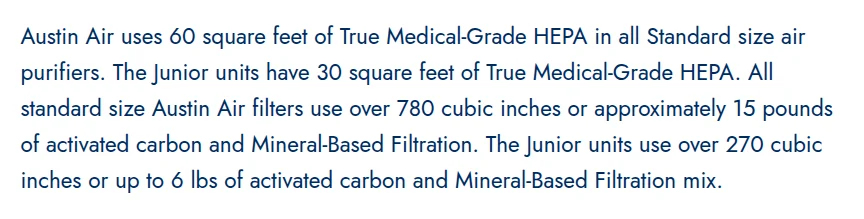
The trade-off: you can’t size it the standard way, and Austin gives no square-footage figure. Noise runs from less than 50 to 65 dB, and it draws up to 147 W at startup. The filter is around $395 but rated for up to 5 years; the unit is around $845.
Cost per year (our calculation): up to about $158: the filter spread over 5 years (about $79 a year) plus at most about $79 of electricity at 8 hours a day, using the 147 W startup maximum as a ceiling.
Our pick: Most carbon for musty odorAustin Air HM400See today's price, ratings and delivery options
Check pricePremium pick: IQAir HealthPro Plus XE
Buy it if:
- You want the longest-lasting filters and a sensor-driven premium unit.
- You want a gas stage whose weight is published: 5 lb of carbon and alumina.
Skip it if:
- You want a room size you can compare with AHAM’s; IQAir’s works out to about two air changes an hour.
- Price or weight rules it out: around $1,200 and 35 lb.
IQAir doesn’t publish a CADR either. It lists airflow from 40 to 300 cfm across six speeds and a HyperHEPA H12/13 final filter. The middle stage, the V5-Cell, holds 5 lb of granular activated carbon and impregnated alumina for gases and odors. IQAir rates the pre-filter for about 18 months, the V5-Cell for about 24 and the HyperHEPA for about 48 (at 10 hours a day on speed 3). The XE adds Wi-Fi, a PM2.5 sensor and Auto mode. Noise is 27 to 59 dB(A).
The trade-off: IQAir’s “up to 1,125 sq ft” works out to about two air changes an hour, so it isn’t comparable with AHAM room sizes. It weighs 35 lb, draws up to 134 W and costs around $1,200. We’d only choose it if long filter life matters more to you than price.
Cost per year (our calculation): about $225: roughly $153 in filters (around $80, $100 and $200, spread over 18, 24 and 48 months) plus about $72 of electricity at 8 hours a day on top speed.
Our pick: Premium pickIQAir HealthPro PlusSee today's price, ratings and delivery options
Check priceBest for small rooms: Levoit Core 300-P
Buy it if:
- It’s for a small bedroom or home office, up to 215 sq ft (AHAM), with a faint musty smell.
- You want an AHAM-listed unit for around $90 to $100.
Skip it if:
- The space is an open basement or any room much over 200 sq ft.
- You want a published carbon weight.
AHAM lists SKU LAP-C302-WUSR, which appears to be the Core 300-P, at 139 smoke CADR and 215 sq ft (Levoit says 222). The cylindrical filter combines a fine pre-filter, a particle filter and activated carbon; the Toxin Absorber version uses Levoit’s ARC carbon. Noise is 24 to 54.5 dB.
The trade-off: this is a small-room unit with a modest carbon layer and no published carbon weight; Levoit’s manual says to replace the filter every 6 to 8 months. AHAM lists the filter as “HEPA-Type”. It’s around $90 to $100. We’d skip it for an open basement or any room much over 200 sq ft.
Cost per year (our calculation): electricity is about $29 at 8 hours a day on top speed (AHAM’s 53.3 W). Filters are around $30 to $40 each, every 6 to 8 months per Levoit’s manual, so about $45 to $80 more, for about $74 to $109.
Our pick: Best for small roomsLevoit Core 300-PSee today's price, ratings and delivery options
Check priceModels we considered and left out
These came up in our research for damp rooms and mold. Each has one reason it isn’t a pick, with its source.
| Model | Why it’s not a pick | Source |
|---|---|---|
| Medify MA-112 PRO | Strong on particles, but Medify publishes no carbon weight and the filters last only 4 to 5 months | medifyair.com |
| Medify MA-112 | Discontinued; Medify sells the MA-112 PRO instead | medifyair.com |
| Austin Air HealthMate Plus HM450 | Austin markets it for VOCs and formaldehyde; for musty odor, the HM400 already has about 15 lb of sorbent | Austin Air |
| Coway AP-1512HH Mighty | Stock was unclear in October 2026 and it has a switchable ionizer; its manual also warns against damp placement | cowaymega.com, manual |
| GermGuardian AC4825E | Relies on UV-C, which EPA says home units don’t dose enough to reliably deactivate airborne microbes; AHAM lists only 99 smoke CADR | EPA, AHAM |
| Airfree P3000 | A filterless heat sterilizer with no CADR and very low passive airflow; its germ-kill claims cite unnamed labs | Airfree, CARB |
| Afloia Q10 | A small purifier and mini dehumidifier combo with no published CADR, and it appears to be discontinued | Afloia manual, afloia.com |
| Enerzen O-777 | An ozone generator, not CARB certified; EPA says ozone is generally ineffective at levels that don’t exceed health standards | CARB, EPA |
What to look for in a mold air purifier
- Enough CADR for the room. Spores are particles, so size by smoke CADR: at least two-thirds of the floor area with an 8 ft ceiling, or use our air purifier size calculator. A 600 sq ft basement needs at least 400 cfm.
- Real carbon for musty odor. No standard rates odor removal. EPA says thin carbon-impregnated layers saturate quickly and can release what they captured, so pellets or a deep bed are better. Our HEPA vs carbon filter guide explains why.
- No ozone. Ozone generators are sold as air cleaners, and no federal agency has approved them for occupied spaces. EPA says ozone is generally ineffective indoors at levels that don’t exceed health standards and can damage the lungs. Read our guide to air purifier side effects before buying anything with an ionizer.
- Skip UV as the main feature. EPA’s technical summary says home UV units don’t deliver enough dose to reliably deactivate most airborne microbes and should supplement filtration, not replace it.
- A dry spot. Manuals for the Winix 5520 and Coway AP-1512HH warn against placing units where they can get wet. Put the purifier in the room, not next to a sump pit or leaking pipe.
Types of house mold: does it matter?
CDC says the most common indoor molds are Cladosporium, Penicillium and Aspergillus. It also says you don’t need to know the type, doesn’t recommend sampling to identify it, and that whatever type is present, it needs to be removed. EPA agrees that sampling is usually unnecessary when you can see mold growth, though it can help confirm that a professional cleanup worked. In other words, color and species don’t change the plan: dry it, clean it, keep humidity down.
Mold, health and pregnancy
EPA says mold produces allergens and irritants, and that touching or inhaling spores may cause allergic reactions in sensitive people. CDC says some people get a stuffy nose, sore throat, coughing, wheezing, burning eyes or a rash, while others have no effects. People with asthma or mold allergies may react severely, and people with weakened immune systems or chronic lung disease can get lung infections.
We found no EPA or CDC guidance specific to mold in a basement during pregnancy. EPA’s general advice applies: if you have health concerns, consult a health professional before starting cleanup. If you’re pregnant, talk to your doctor or midwife, and in our view it makes sense to let someone else do the scrubbing.
What an air purifier can’t do
A purifier won’t dry a wall, stop a leak or remove mold growing on a surface. EPA says no air cleaner removes all pollutants and none replaces source control (our guide on how to improve indoor air quality covers the full order). We’d treat it as the last step: once moisture is fixed and visible mold is gone, it can catch the spores and smell that remain. For persistent smells after cleanup, our best air purifier for odor picks lean even harder on carbon.
Frequently asked questions
Do air purifiers get rid of mold?
No. EPA says some air cleaners can remove airborne mold spores, fragments and moldy odors, but they won't prevent mold growth or rid a house of mold. You have to remove the growth and fix the moisture that feeds it.
What kind of air purifier is best for mold spores?
A HEPA-grade purifier with enough smoke CADR for the room catches airborne spores, and an activated-carbon stage helps with musty odor. Avoid ozone generators: EPA says ozone is generally ineffective at levels that don't exceed health standards.
Should I run an air purifier while cleaning mold?
It can help catch spores stirred up during cleanup, but it is no substitute for the cleanup itself. EPA says areas over about 10 sq ft need more involved remediation, and you shouldn't run your HVAC system if you suspect it is contaminated with mold.
What humidity stops mold?
EPA recommends keeping indoor humidity below 60%, ideally between 30% and 50%, and drying water-damaged areas within 24 to 48 hours. A dehumidifier or air conditioner does that job; an air purifier doesn't lower humidity.
Do I need to test what type of mold I have?
Usually not. CDC says you don't need to know the type of mold and doesn't recommend sampling to find out: whatever the type, it needs to be removed. EPA says sampling is usually unnecessary when mold is visible.
Update log
- : Added Levoit's 6 to 8 month filter interval to the Core 300-P cost figures
- : Added cost per year, buy/skip notes and a left-out list; added Winix's November 2026 prices for the 5520 and Filter Q
Related guides
Air Purifiers
Best Basement Air Purifiers in 2026: Musty Smells, Mold and Radon Facts
Five basement air purifiers sized for open floor plans, plus what to do first about humidity, mold and radon, which no purifier removes.
15 min read
Air Purifiers
Best Air Purifiers of 2026: Research-Backed Picks for Every Room
Seven current air purifiers for every room and budget, chosen on verified CADR, HEPA filtration, ozone status, noise and filter cost.
27 min read
Air Purifiers
Best Air Purifiers for Pets in 2026: Hair, Dander and Odor
Seven current air purifiers for homes with dogs and cats, picked on verified CADR, washable pre-filters for hair, carbon for odor and real filter costs.
19 min read
Air Purifiers
Best Air Purifiers for Allergies in 2026: Pollen, Dust Mites and Dander
Six current air purifiers for pollen, dust mite and dander allergies, picked on verified pollen CADR, HEPA-grade filters, room size and ionizer status.
15 min read