Do Air Purifiers Work? What They Remove, What They Can't and When They're Worth It
Yes, for particles in the air: smoke, pollen, pet dander and dust. Here's what EPA and AHAM say purifiers can and can't do, and how to size one so it works.
By Clean Air Guides editorial teamUpdated 7 min read
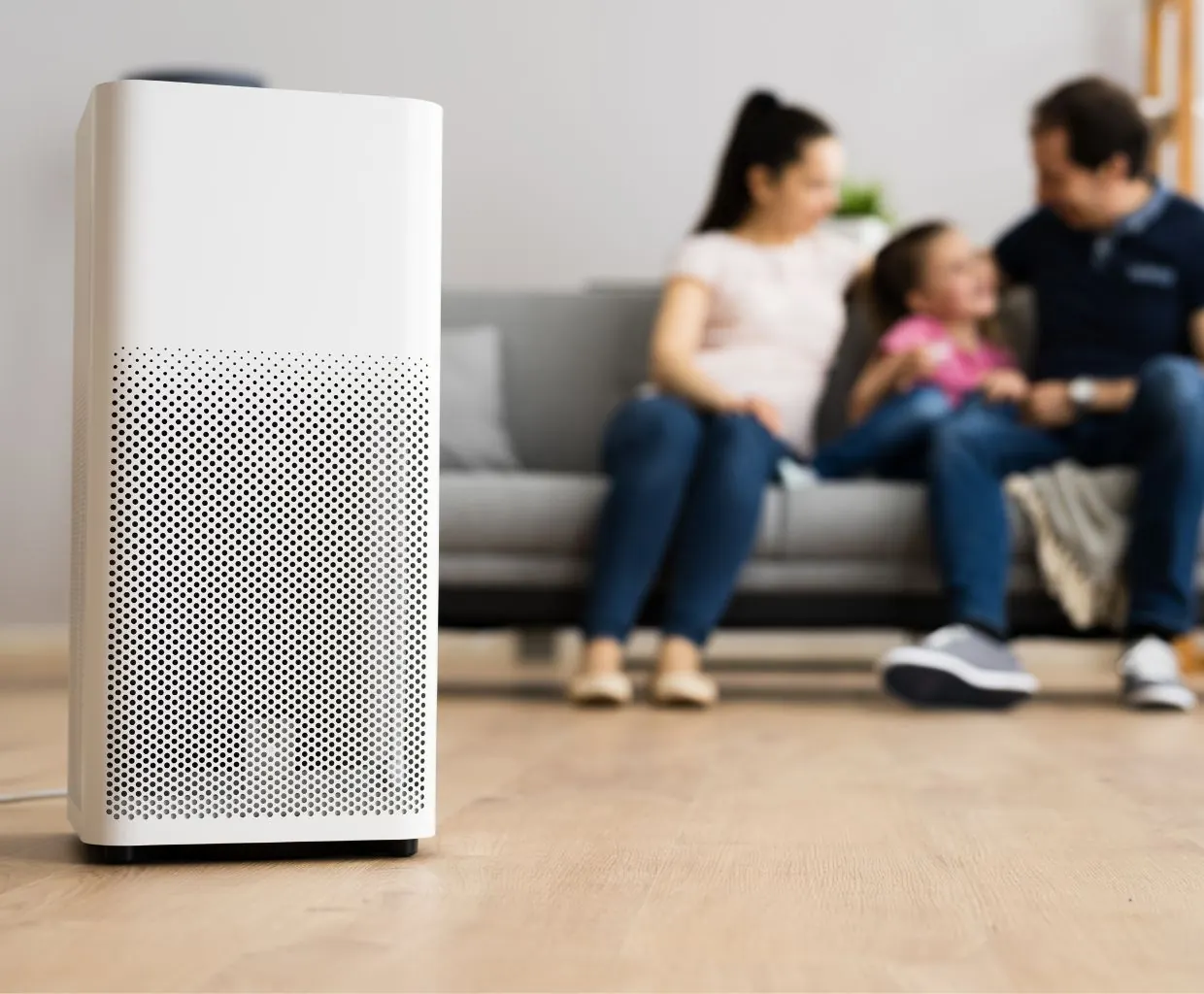
Yes, air purifiers work, but only on part of the problem. A filter-based purifier that is the right size for the room can remove a large share of airborne particles such as smoke, pollen, pet dander and fine dust. It does much less, or nothing, for gases, settled dust, mold growing on a wall, radon or carbon monoxide. Whether one is worth it for you depends on which of those you’re dealing with and on buying enough clean-air capacity for the room.
What the evidence says purifiers remove
EPA’s position is measured: portable air cleaners and HVAC filters can reduce indoor air pollution, but no air cleaner removes all pollutants, and filtration doesn’t replace controlling sources and ventilating. Most filters target either particles or gases, not both.
For particles, the performance is well defined. AHAM’s test standard (ANSI/AHAM AC-1-2020) measures a Clean Air Delivery Rate (CADR) in cubic feet per minute for three test particles:
| CADR test | Particle size | Stands for |
|---|---|---|
| Smoke | about 0.1 to 1 micron | Fine particles: smoke, cooking and combustion particles |
| Dust | 0.5 to 3 microns | Medium particles: fine household dust |
| Pollen | 5 to 11 microns | Large particles: pollen and similar |
CADR is measured as how much faster particles disappear with the unit running than with it off, so it rates the whole machine, not just its fan. The filter behind most good CADRs is HEPA. By the US Department of Energy definition, a true HEPA filter captures at least 99.97% of 0.3-micron test particles, and EPA says that size is the worst case, so larger and smaller particles are caught even better. EPA adds that “HEPA” on consumer products has no widely accepted performance definition, though HEPA-labeled home filters usually remove 99% or more of the particle sizes tested.
How well they work depends on size
A purifier doesn’t make a room’s air perfectly clean. It lowers particle levels while outdoor air and new particles keep coming in. AHAM’s January 2026 white paper shows how much the result depends on clean-air delivery, expressed as equivalent air changes per hour (eACH):
| eACH from the purifier | Steady-state particle reduction (AHAM) |
|---|---|
| 1 | about 45% |
| 2 | about 62% |
| 4 | about 77% |
| 4.8 (AHAM room size) | about 80% |
| 7.5 (AHAM wildfire rule) | about 86% |
AHAM’s own example makes the point: a purifier with a 100 cfm smoke CADR suits a 155 sq ft room, where it delivers about 4.8 eACH and an 80% reduction. Put the same unit in a 750 sq ft room and it delivers only about 1 eACH, roughly a 45% reduction. In our view, this is the main reason people conclude purifiers “don’t work”: the unit was too small for the room.
How to size one so it works
- AHAM rule of thumb: smoke CADR at least two-thirds of the floor area. A 10 x 12 ft room (120 sq ft) needs at least 80 cfm.
- EPA chart: 100 sq ft needs 65 cfm, 200 sq ft 130, 300 sq ft 195 and 400 sq ft 260, assuming an 8 ft ceiling. Go bigger for higher ceilings.
- Wildfire smoke: AHAM recommends a smoke CADR at least equal to the room area, which gives about 7.5 eACH.
Our air purifier size calculator does this math for your room and ceiling height. One more catch: EPA notes that the CADR on the box is usually measured at the top fan speed, and CADR at quieter settings is often not published and can be much lower. We’d buy more CADR than the minimum so the purifier can do its job on a lower, quieter speed. Placement matters too; our guide on where to put an air purifier covers it.
What air purifiers don’t remove
This is where most disappointment comes from. A purifier is the wrong tool, or only a partial one, for these:
- Gases and odors. EPA says particle-only air cleaners, including HEPA units, can’t control gases or chemical odors. For those you need activated carbon or another gas filter, and no rating like CADR exists for gas removal. EPA also says thin carbon-impregnated layers saturate quickly and can release what they captured, and that carbon isn’t especially effective against formaldehyde. Our HEPA vs carbon filter guide explains the trade-offs.
- Settled dust. A purifier only catches particles while they’re airborne. Dust on floors, shelves and bedding still needs cleaning. If dust keeps coming back, see why is my house so dusty and our best air purifier for dust picks.
- Mold growth. EPA says some air cleaners can remove airborne mold spores and moldy odors, but they won’t prevent mold growth or rid a house of mold. That takes removing the growth and fixing the moisture. Our air purifier for mold guide covers both sides.
- Radon. EPA does not recommend air cleaning to reduce radon risk. It recommends testing, and fixing the home if radon is 4 pCi/L or higher, usually with active soil depressurization.
- Carbon monoxide. EPA notes that ozone generators aren’t effective against carbon monoxide, and none of the sources we rely on rate any home purifier for it. We’d never treat a purifier as protection against CO; that’s a job for venting fuel-burning appliances and a CO alarm.
Do ionizers and “filterless” purifiers work?
Much less well than filters, based on the data EPA compiled. Published studies typically measured fine and ultrafine particle CADRs under about 20 cfm for ionizers and PCO (photocatalytic) units, compared with about 150 to 300 cfm for many HEPA and electrostatic precipitator units. EPA also says ionizers and electrostatic units don’t remove gases or odors, and that ionizers, electrostatic precipitators, some UV lights and plasma units may emit ozone, a lung irritant.
Ozone generators are worse: EPA concludes ozone at levels within public health standards is generally ineffective at cleaning indoor air, and that ozone generators don’t remove particles such as dust and pollen. We’d skip both and buy a CARB-certified filter unit. Our guide to air purifier side effects covers ozone in detail.
When an air purifier is worth it
In our view, a purifier earns its place in these situations:
- Wildfire smoke or outdoor smoke getting in. EPA advises a smoke CADR of at least two-thirds of the room area, running continuously on the highest setting with doors and windows closed, and only CARB-certified units. Our best air purifier for smoke picks are sized for this.
- Pollen and pet dander. These are airborne particles that a HEPA filter can capture, so a purifier can reduce them in the room where you spend the most time, usually the bedroom. Our best air purifier for allergies guide compares models by pollen CADR. It doesn’t treat allergies or asthma; talk to your doctor about symptoms.
- Airborne viruses as one layer. CDC suggests aiming for 5 or more air changes per hour of clean air in occupied rooms, counting ventilation, filtration and air cleaning together. It calls this a rough guide that doesn’t guarantee safe air.
- Cooking or tobacco particles you can’t vent. A purifier helps with the particles; for the smell, it needs real carbon.
It’s less worth it when the main problem is humidity, mold on surfaces, a gas like radon, or dust that has already settled. EPA’s order of priorities is source control first, then ventilation, then air cleaning, and our guide on how to improve indoor air quality follows the same order.
What it costs to run
ENERGY STAR says a standard room air cleaner running nonstop uses about 394 kWh a year. At the July 2026 US average electricity price of 18.31 cents per kWh (EIA), that’s about $72 a year. ENERGY STAR-certified models are more than 50% more efficient. Add the yearly filter cost on top, and check your own model in the air purifier electricity cost calculator.
If you decide to buy one
Look for three things: a published CADR, ideally listed in the AHAM Verifide directory; a filter you can actually replace on schedule; and CARB certification. These current models from our research database have AHAM-listed CADRs and no advertised ionizer:
- Small bedroom (about 215 sq ft): the Levoit Core 300-P. AHAM lists 139 smoke, 156 dust and 155 pollen CADR for its model code, and it includes an activated carbon stage. AHAM labels its filter “HEPA-Type.” Check the Levoit Core 300-P on Amazon
- Medium room (about 388 sq ft): the Levoit Vital 200S-P, with an AHAM-listed 250 smoke, 254 dust and 289 pollen CADR, a washable pre-filter and activated carbon. Check the Levoit Vital 200S-P on Amazon
- Large room (about 500 sq ft): the Honeywell InSight HPA5300B, with an AHAM-listed 323 smoke, 339 dust and 335 pollen CADR, True HEPA filters and a carbon pre-filter. Check the Honeywell HPA5300B on Amazon
Our take: a correctly sized HEPA purifier does what it promises for airborne particles. Expect it to clean the air you breathe, not the whole house, and pair it with source control and ventilation for everything else.
Frequently asked questions
Do air purifiers really work for allergies?
They can reduce airborne allergens such as pollen and pet dander, because those are particles a HEPA filter captures. They don't remove allergens that have settled on floors and bedding, and they don't treat allergies. Talk to your doctor about symptoms.
Do air purifiers remove dust?
Only dust that is floating in the air. AHAM's dust test uses particles of 0.5 to 3 microns. Dust already on surfaces still needs vacuuming and wiping.
Do air purifiers help with wildfire smoke?
Yes, if the unit is big enough. EPA advises a smoke CADR of at least two-thirds of the room's area in square feet, running continuously on high with doors and windows closed, and a CARB-certified model.
Do air purifiers get rid of odors and VOCs?
Only if they contain activated carbon or another gas filter. EPA says HEPA filters can't control gases or odors, and that thin carbon layers saturate quickly. Carbon is also not especially effective against formaldehyde.
Do ionic and filterless air purifiers work?
Poorly, by the numbers. Studies compiled by EPA measured fine-particle CADRs under about 20 cfm for ionizers and PCO units, against about 150 to 300 cfm for many HEPA units. Some ionizers also emit ozone.
Related guides
Guides
What Is CADR? Clean Air Delivery Rate Explained, With the 2/3 Rule
CADR is how many cubic feet of particle-free air a purifier delivers per minute. Here's how AHAM tests it, how to size a room with it, and what it can't tell you.
7 min read
Guides
How Long to Run an Air Purifier: Per Day, Overnight and 24/7
Run it whenever you're in the room, ideally all the time on Auto or low. A well-sized unit clears a closed room in about 30 to 40 minutes on high.
7 min read

Guides
How to Improve Indoor Air Quality: 9 Steps in the Order That Works
Cut pollution at the source, bring in outdoor air, then filter what's left. Nine EPA-based steps, from humidity and mold to purifiers and radon.
7 min read
Guides
Air Purifier vs Dehumidifier: Particles vs Moisture, and Which One You Need
An air purifier filters particles; a dehumidifier pulls moisture out of the air. Here's which one helps with mold, allergies and damp basements, and when you need both.
6 min read
Guides
Wildfire Smoke Indoors: How to Protect the Air in Your Home
Close up the house, set up one cleaner air room and run a CARB-certified air purifier sized for smoke on high. Here's EPA's plan, step by step.
7 min read
Guides
Air Scrubber vs Air Purifier: What's the Difference?
"Air scrubber" means a job-site HEPA machine or an in-duct HVAC gadget, depending on who is selling it. Here's how both compare with a home air purifier.
5 min read