What Is CADR? Clean Air Delivery Rate Explained, With the 2/3 Rule
CADR is how many cubic feet of particle-free air a purifier delivers per minute. Here's how AHAM tests it, how to size a room with it, and what it can't tell you.
By Clean Air Guides editorial teamUpdated 7 min read
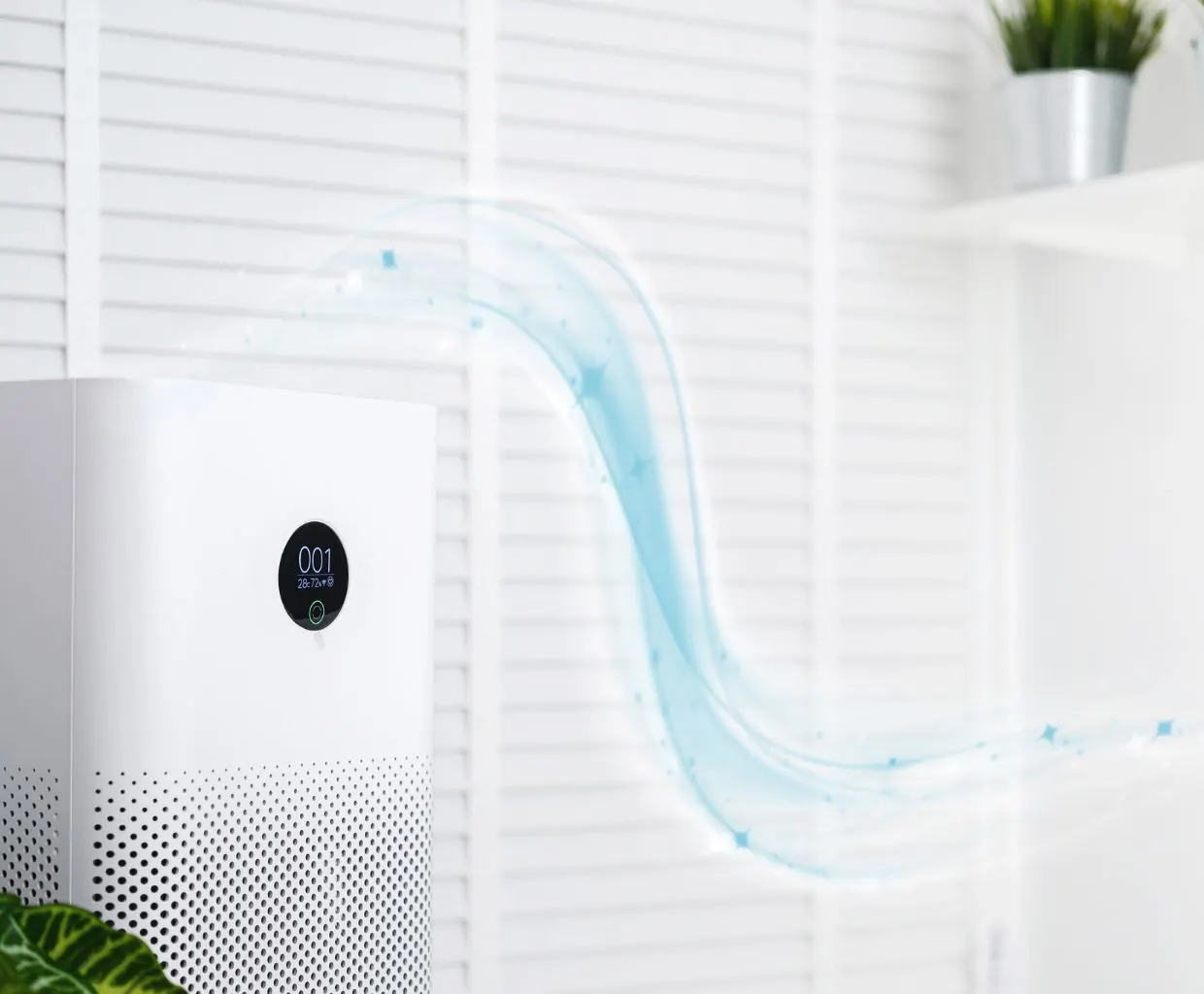
CADR, short for Clean Air Delivery Rate, is the number of cubic feet of particle-free air a portable air purifier delivers per minute (cfm). It’s measured under AHAM’s standard test for three kinds of particles: smoke, dust and pollen. The higher the CADR, the faster the purifier cleans a room and the bigger the room it can handle. For sizing, the number that matters most is the smoke CADR: AHAM recommends one at least two-thirds of your room’s floor area in square feet.
What CADR measures
The current US test method is ANSI/AHAM AC-1-2020. A purifier runs inside a 1,008 cu ft test chamber (10.5 x 12 x 8 ft) filled with a test contaminant. CADR is the rate at which particles disappear with the unit running, minus the rate at which they settle out naturally with it off, multiplied by the chamber volume.
That definition matters: CADR rates the complete machine, fan and filter together, not just how much air the fan moves. A fan pushing air through a leaky or weak filter can have big airflow and a small CADR.
AHAM rates three CADRs, one for each test contaminant:
| CADR | Test particle | Size range | Stands for |
|---|---|---|---|
| Smoke | Engineered cigarette smoke | about 0.1 to 1 µm | Small particles: smoke, cooking, combustion |
| Dust | Fine test dust | 0.5 to 3 µm | Medium particles: fine household dust |
| Pollen | Paper mulberry pollen | 5 to 11 µm | Large particles: pollen and similar |
Smoke covers the smallest particles, and it’s the CADR AHAM uses to calculate room size.
Test limits
Under AC-1-2020, the test can measure CADRs from 10 to 600 cfm for smoke and dust, and from 25 to 450 cfm for pollen. Precision is about ±10 cfm for smoke and dust and ±25 cfm for pollen. A brand quoting more than 600 cfm is using its own figure, not an AHAM-verified one. Medify, for example, publishes factory figures above 700 cfm for its MA-112 PRO, while the AHAM directory lists it at the 600 cfm ceiling for smoke and dust.
How to size a room with CADR: the 2/3 rule
AHAM’s consumer rule of thumb: smoke CADR should be at least two-thirds of the room’s floor area in square feet, assuming an 8 ft ceiling. A 10 x 12 ft room (120 sq ft) needs a smoke CADR of at least 80.
Turned around, AHAM’s suggested room size is smoke CADR x 1.55. A 100 cfm purifier suits about 155 sq ft; a 200 cfm one about 310 sq ft. That room size is the largest room in which the purifier keeps smoke particles at least 80% below their starting level, assuming 1 air change per hour of outdoor air leaking in.
EPA’s chart lands on the same numbers:
| Room area (8 ft ceiling) | Minimum CADR (EPA) |
|---|---|
| 100 sq ft | 65 cfm |
| 200 sq ft | 130 cfm |
| 300 sq ft | 195 cfm |
| 400 sq ft | 260 cfm |
| 500 sq ft | 325 cfm |
| 600 sq ft | 390 cfm |
For a taller ceiling, size for a bigger room. Multiplying the floor area by your ceiling height divided by 8 gives the equivalent area: a 200 sq ft room with a 10 ft ceiling sizes like 250 sq ft. Our air purifier size calculator does this math for you, ceiling included.
For wildfire smoke, AHAM goes further and recommends a smoke CADR at least equal to the room area (CADR = sq ft). EPA’s wildfire guidance sticks with the two-thirds rule, run continuously on high with windows and doors closed, using a CARB-certified unit. We’d size up for smoke; our best air purifier for smoke guide compares models by smoke CADR.
CADR vs air changes per hour (ACH)
CADR is a flow rate; air changes per hour describes what that flow does in your room. CDC/NIOSH gives the formula:
ACH = CADR x 60 / room volume (cu ft)
A 200 cfm purifier in a 300 sq ft room with an 8 ft ceiling (2,400 cu ft) gives 200 x 60 / 2,400 = 5 air changes per hour. AHAM calls this “equivalent ACH” (eACH) because the purifier is cleaning air, not swapping it with outdoor air. Our air changes per hour calculator does this math for any room and any number of purifiers.
AHAM’s room size works out to about 4.8 eACH. Its January 2026 white paper shows how much the result depends on that figure:
| eACH from the purifier | Steady-state particle reduction (AHAM) |
|---|---|
| 1 | about 45% |
| 2 | about 62% |
| 4 | about 77% |
| 4.8 (AHAM room size) | about 80% |
| 6 | about 83% |
| 7.5 (AHAM wildfire rule) | about 86% |
CDC suggests aiming for 5 or more air changes per hour of clean air in occupied rooms to reduce airborne viruses, counting ventilation, filtration and air cleaning together. It calls that a rough guide, not a guarantee.
Why brands advertise much bigger room sizes
Many brands print a second, much larger room size based on 1 or 2 air changes per hour instead of AHAM’s 4.8. Same purifier, very different number:
| Purifier | Smoke CADR | Room size at 4.8 ACH | Brand’s 1-ACH claim |
|---|---|---|---|
| Levoit Vital 200S-P | 250 (AHAM) | 388 sq ft | 1,862 sq ft |
| Coway Airmega AP-1512HH | 233 (Coway) | 361 sq ft | 1,748 sq ft |
| Honeywell InSight HPA5300B | 323 (AHAM) | 500 sq ft | 2,423 sq ft |
The 1-ACH figure is technically a room the purifier can filter once an hour, but AHAM’s example shows what that means in practice: a 100 cfm smoke CADR purifier suits a 155 sq ft room, where it cuts particles by about 80%. In a 750 sq ft room it delivers only about 1 eACH and roughly a 45% reduction. In our view, a 1-ACH room size is close to meaningless for comparison. We’d always compare purifiers by smoke CADR, or by the 4.8 ACH room size, which is the same thing.
What CADR doesn’t tell you
- Gases and odors. CADR covers particles only. EPA says HEPA and other particle-only filters can’t control gases or chemical odors, and no widely used rating like CADR exists for gas removal. For smells and VOCs, look at how much activated carbon a unit holds; our HEPA vs carbon filter guide explains why.
- Quiet settings. EPA notes the CADR on the box is usually measured at the top fan speed. CADR at lower, quieter settings is often not published and can be much lower. We’d buy more CADR than the minimum so the purifier can do its job on a speed you’ll actually leave on.
- Real-room performance. A purifier may not reach its rated CADR in a real room, where particles settle on surfaces and outdoor air leaks in, though CADR still lets you compare units fairly. Placement helps; see where to put an air purifier.
- Ionizers and filterless units. Studies compiled by EPA typically measured fine-particle CADRs under about 20 cfm for ionizers and PCO units, against about 150 to 300 cfm for many HEPA units. Our explainer on the ionic air purifier covers the ozone issue too.
- Whole-house filters. Furnace filters and in-duct media cabinets have no CADR, so you can’t compare them with portables on this number. They’re rated by MERV instead; our MERV rating chart shows what each rating captures.
- Running time. CADR assumes the purifier is on. Our guide on how long to run an air purifier covers how long to leave it on; AHAM’s room-size math describes a purifier running steadily.
Where to find a verified CADR
AHAM’s Verifide program lists tested models in its online directory, and ENERGY STAR publishes CADRs for certified models. Some brands, including Coway, Rabbit Air and Blueair, aren’t in the AHAM directory and publish their own CADR figures instead. We’d treat a CADR from the AHAM directory or ENERGY STAR as the most reliable, and a manufacturer-only figure as a claim.
As an example of what to look for, the Levoit Vital 200S-P has an AHAM-listed CADR of 250 smoke, 254 dust and 289 pollen, for a 388 sq ft room, with a washable pre-filter and activated carbon.
Check the Levoit Vital 200S-P on Amazon
Our take: CADR is the single most useful number on an air purifier box. Match the smoke CADR to your room with the 2/3 rule, size up for smoke or high ceilings, and ignore room sizes that don’t say how many air changes they assume. If your room is big, our best air purifier for large room guide compares bigger units by smoke CADR.
Frequently asked questions
What is a good CADR for an air purifier?
It depends on the room. AHAM's rule of thumb is a smoke CADR of at least two-thirds of the floor area in square feet, so a 120 sq ft room needs at least 80 cfm and a 300 sq ft room at least 200 cfm, with an 8 ft ceiling.
Which CADR number matters most: smoke, dust or pollen?
Smoke. It covers the smallest particles, about 0.1 to 1 micron, and it's the number AHAM uses to calculate the suggested room size (smoke CADR x 1.55).
Is CADR the same as airflow in cfm?
No. CADR measures how fast the purifier removes particles in a test chamber, so it rates the whole unit, fan and filter together. A fan that moves a lot of air through a weak filter can have high airflow and a low CADR.
Does CADR include odors and VOCs?
No. CADR covers particles only. EPA says no widely used rating like CADR exists for gas removal, which depends on activated carbon or another gas filter.
What is the maximum CADR?
Under ANSI/AHAM AC-1-2020, the test can measure up to 600 cfm for smoke and dust and 450 cfm for pollen. Higher brand figures aren't AHAM-verified.
How do I convert CADR to air changes per hour?
Multiply the CADR by 60 and divide by the room volume in cubic feet. A 200 cfm purifier in a 300 sq ft room with an 8 ft ceiling gives 200 x 60 / 2,400 = 5 air changes per hour.
Related guides
Guides
Do Air Purifiers Work? What They Remove, What They Can't and When They're Worth It
Yes, for particles in the air: smoke, pollen, pet dander and dust. Here's what EPA and AHAM say purifiers can and can't do, and how to size one so it works.
7 min read
Guides
How Long to Run an Air Purifier: Per Day, Overnight and 24/7
Run it whenever you're in the room, ideally all the time on Auto or low. A well-sized unit clears a closed room in about 30 to 40 minutes on high.
7 min read
Guides
Do Air Purifiers Use a Lot of Electricity? Watts, Yearly Cost and How to Cut It
Not much. Most current purifiers draw under 80 W even on top speed, so running one 24/7 costs roughly $10 to $125 a year at the US average rate.
7 min read
Guides
MERV Rating Chart: What MERV 11, 13 and 16 Filters Actually Capture
A MERV rating chart built from ASHRAE 52.2 minimums, plus how MERV compares with HEPA and MPR, which rating suits smoke, allergies and pets, and when your HVAC can't take it.
7 min read
Free tool
Air Changes per Hour Calculator: Is Your Room Getting Enough Clean Air?
Enter your room and your air purifier's CADR to see how many air changes per hour you get, how that compares with CDC and AHAM targets, and how fast airborne particles clear.
Free calculator