Wildfire Smoke Indoors: How to Protect the Air in Your Home
Close up the house, set up one cleaner air room and run a CARB-certified air purifier sized for smoke on high. Here's EPA's plan, step by step.
By Clean Air Guides editorial teamUpdated 7 min read
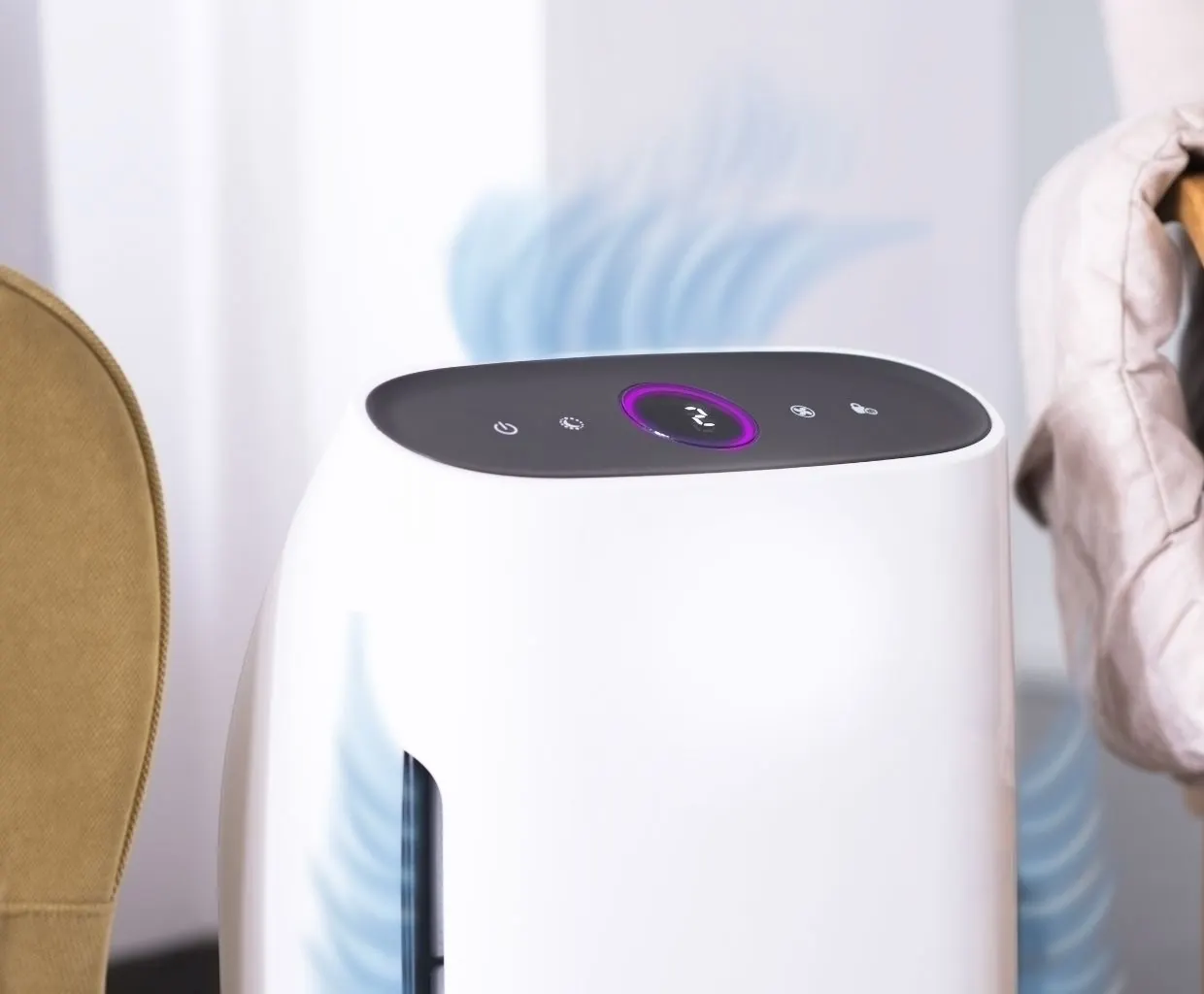
When wildfire smoke reaches your area, keep it out and filter what gets in. EPA’s plan is simple: close windows and doors, set up one “cleaner air room,” and run a CARB-certified portable air cleaner on its highest setting, sized so its smoke CADR is at least two-thirds of the room’s floor area. If your HVAC system can take it, add a MERV 13 filter and run the fan.
Why smoke gets inside, and who needs extra care
Homes leak. Outdoor air comes in through gaps, open windows, fresh-air intakes and some air conditioners, and smoke comes with it. Smoke particles are small: AHAM’s smoke test for air cleaners uses particles of about 0.1 to 1 micron, the smallest of its three test sizes.
EPA says a cleaner air room helps anyone who can safely stay indoors, and matters most for:
- People with heart or lung disease
- Older adults
- Children
- Pregnant women
If you have heart or lung disease, EPA advises asking your health care provider what to do during smoke events. If you have asthma, keep your asthma action plan up to date, and avoid strenuous activity while it’s smoky.
Step 1: Check the air and keep smoke out
Watch outdoor conditions on AirNow.gov, your state air quality website or local news. When officials advise staying indoors, EPA recommends:
- Close windows and doors, while keeping the room easy to leave in an emergency.
- Central HVAC: switch to recirculate mode or close the outdoor air intake damper.
- Window air conditioner: close its outdoor damper. If you can’t, don’t use it during smoke events.
- Portable air conditioner: use a single-hose unit sparingly; seal the window kit of a two-hose model tightly.
- Evaporative cooler: cover the outside intakes with MERV 13 filters if you safely can, or use it sparingly.
Heat is the catch. EPA says to use fans and air conditioning to stay cool with the windows shut, and to find shelter elsewhere if you can’t stay cool.
Step 2: Set up a cleaner air room
You don’t have to clean the air in the whole house. EPA’s “cleaner air room” approach focuses on one room everyone can use, ideally a bedroom with an attached bathroom. Close it up, filter the air and spend as much time there as you can.
Then cut indoor sources of particles. EPA lists smoking and vaping, burning candles or incense, aerosol sprays, gas, propane or wood-burning stoves and furnaces, and frying or broiling. Vacuum only with a HEPA-filter vacuum, and pick up settled dust with a damp cloth or mop.
Tip: Buy the air cleaner, spare filters and a few N95 respirators before fire season. EPA suggests keeping N95 masks and at least a 5-day supply of food and medication on hand as part of your emergency supplies.
Step 3: Size a portable air cleaner for smoke
The number that matters is the smoke CADR (Clean Air Delivery Rate) from AHAM, in cubic feet per minute. Our guide to what CADR means explains the three ratings. For wildfire smoke there are two rules:
- EPA: smoke CADR at least two-thirds of the floor area in sq ft. With an 8 ft ceiling, that works out to 5 air changes per hour.
- AHAM: for wildfire events, smoke CADR at least equal to the floor area. That gives 7.5 equivalent air changes per hour and about an 86% continuous reduction of smoke particles, versus 80% at AHAM’s normal room-size rating.
| Room size (8 ft ceiling) | Example room | EPA minimum smoke CADR (2/3 of area) | AHAM wildfire smoke CADR (= area) |
|---|---|---|---|
| 120 sq ft | 10 x 12 ft bedroom | 80 cfm | 120 cfm |
| 200 sq ft | 10 x 20 ft bedroom | 134 cfm | 200 cfm |
| 300 sq ft | 15 x 20 ft living room | 200 cfm | 300 cfm |
| 400 sq ft | 20 x 20 ft living room | 267 cfm | 400 cfm |
| 500 sq ft | Open kitchen and family room | 334 cfm | 500 cfm |
Values are rounded up. For ceilings above 8 ft, AHAM says to choose a unit rated for a larger room. Our air purifier size calculator does this math for your room, and the air changes per hour calculator shows what a given CADR delivers. In our view, if you’re buying specifically for smoke season, aim for the AHAM number, not the minimum.
Run it on high. EPA says to run the air cleaner continuously on its highest fan setting, and its technical summary explains why: the CADR on the box is usually measured at top speed, and CADR at quieter settings is often unpublished and can be much lower. Give the unit room to breathe; EPA says air should be able to flow freely around it. Our guide to where to put an air purifier covers placement, and if you worry about the power bill, the air purifier electricity cost calculator puts a number on running it 24 hours a day.
For specific models with high smoke CADRs, see our picks for the best air purifier for smoke. Smoke also carries gases and odor that a HEPA filter can’t catch; EPA says particle-only filters don’t control gases, which is where activated carbon comes in.
Use only CARB-certified air cleaners: no ozone
EPA’s wildfire guidance says to use only CARB-certified air cleaners because they produce little or no ozone, a harmful air pollutant. California requires every air cleaner sold there to be certified as emitting no more than 0.050 ppm (50 ppb) of ozone, and CARB keeps a public list of certified devices. CARB also says certification doesn’t mean a device is effective, so check the smoke CADR as well.
Important: Don’t use an ozone generator to “clear” smoke. EPA says ozone generators should not be used in occupied spaces, that ozone is generally ineffective at controlling indoor air pollution at levels that don’t exceed public health standards, and that inhaled ozone can damage the lungs. EPA also says electronic air cleaners are not recommended for smoke, and that PCO, hydroxyl generators and UV devices may produce ozone or other harmful pollutants.
We’d stick to a plain mechanical filter unit for smoke season. If you’re looking at a model with an ion feature, our guide to the ionic air purifier explains the trade-offs.
Your three filtering options compared
EPA lists three ways to filter the air during smoke events. You can combine them.
| Option | What EPA recommends | Watch out for |
|---|---|---|
| Central HVAC filter | MERV 13 or higher, snug fit; set the thermostat fan to On instead of Auto | Only filters while the fan runs; high-efficiency filters can cut airflow in systems not built for them, so ask an HVAC technician |
| Portable air cleaner | Smoke CADR at least 2/3 of floor area; CARB-certified; highest setting, running continuously | Rated CADR is at top speed; check and change filters when dirty |
| DIY box fan air cleaner | MERV 13 or higher filters, tight seal, filter arrows in the airflow direction, fan made after 2012 with UL or ETL logo | Performance varies; often louder; never leave an older fan running unattended |
MERV 13 is the dividing line because, under ASHRAE 52.2, it’s the first rating required to catch at least 50% of particles in the smallest size group, 0.3 to 1 micron. Our MERV rating chart lists every level. EPA says bypass air around a poorly fitted filter greatly reduces its effect, so check that it sits snugly in its slot.
EPA notes that DIY designs with more filters, thicker filters and a cardboard shroud tend to be more cost-effective, but it still recommends buying a commercial unit if you can.
Keep it running: filters, airing out and cleanup
Smoke loads filters quickly. EPA says to check filters often, change them when they look dirty or start to smell, and keep spares on hand. We’d order a spare set of filters the day you buy the purifier. Our guide on how long to run an air purifier covers running it around the clock.
When outdoor air quality improves, even briefly, EPA recommends airing out: open windows or the HVAC fresh-air intake and run kitchen and bathroom exhaust fans. Close up again when the smoke returns.
After the fire, ash cleanup brings its own risks. EPA says to keep children, older adults and people with heart or lung disease out of cleanup work, to wear gloves, protective clothing and an N95 respirator, and to mist surfaces before sweeping, using wet mopping and HEPA vacuums where possible.
Note: No air cleaner removes every pollutant. EPA says filtration reduces indoor pollution but doesn’t replace keeping smoke out and limiting indoor sources. If you or a family member has heart or lung disease, ask your doctor what to do before the next smoke event.
Wildfire smoke checklist
In our view, the households that cope best are the ones that prepare before the first smoky day:
- Pick your cleaner air room and measure it.
- Buy a CARB-certified air cleaner with a smoke CADR of at least two-thirds of that room’s area, ideally equal to it.
- Stock spare filters, a MERV 13 HVAC filter if your system can take one, and N95 respirators.
- Learn how to set your HVAC to recirculate and your thermostat fan to On.
- Bookmark AirNow.gov and know how you’ll get emergency alerts and evacuation information.
Frequently asked questions
Do air purifiers help with wildfire smoke indoors?
Yes. EPA recommends a portable air cleaner as one of three ways to filter smoke indoors, run continuously on its highest setting in the room where you spend the most time, with windows and doors closed. Use only CARB-certified models.
What size air purifier do I need for wildfire smoke?
EPA says the smoke CADR should be at least two-thirds of the room's floor area in square feet, so a 300 sq ft room needs a smoke CADR of at least 200. AHAM's stricter wildfire advice is a smoke CADR equal to the floor area, or 300 for the same room.
Should I run my HVAC system during wildfire smoke?
If your system can take it, EPA recommends a snug-fitting MERV 13 or higher filter, recirculate mode or a closed outdoor air intake, and the thermostat fan set to On instead of Auto. Ask an HVAC technician which filter your system can handle.
Can I use an ionizer or ozone generator to clear smoke?
EPA says electronic air cleaners are not recommended for smoke and that ozone generators should not be used in occupied spaces. It advises using only CARB-certified air cleaners, which produce little or no ozone.
When can I open the windows after wildfire smoke?
EPA says to air out your home when outdoor air quality improves, even briefly. Check current conditions on AirNow.gov or your state air quality website first.
Does a DIY box fan air cleaner work for smoke?
EPA lists a DIY air cleaner as a lower-cost option when a portable unit isn't available or affordable, but says performance varies and commercial units are preferable. Use MERV 13 or higher filters and a box fan made after 2012 with a UL or ETL logo.
Related guides
Guides
Do Air Purifiers Work? What They Remove, What They Can't and When They're Worth It
Yes, for particles in the air: smoke, pollen, pet dander and dust. Here's what EPA and AHAM say purifiers can and can't do, and how to size one so it works.
7 min read

Guides
How to Improve Indoor Air Quality: 9 Steps in the Order That Works
Cut pollution at the source, bring in outdoor air, then filter what's left. Nine EPA-based steps, from humidity and mold to purifiers and radon.
7 min read
Guides
What Is CADR? Clean Air Delivery Rate Explained, With the 2/3 Rule
CADR is how many cubic feet of particle-free air a purifier delivers per minute. Here's how AHAM tests it, how to size a room with it, and what it can't tell you.
7 min read
Guides
Why Is My House So Dusty? Causes and Fixes That Work
Most house dust blows in, gets tracked in or is shed indoors. Here is where yours likely comes from and the fixes in the order that pays off most.
8 min read