How to Clean a Humidifier: Daily Rinse, Descaling and Disinfecting
Empty and dry it daily, descale and disinfect it every third day, and follow your manual. Step-by-step, with brand notes for HoMedics, Crane, Dyson and more.
By Clean Air Guides editorial teamUpdated 10 min read
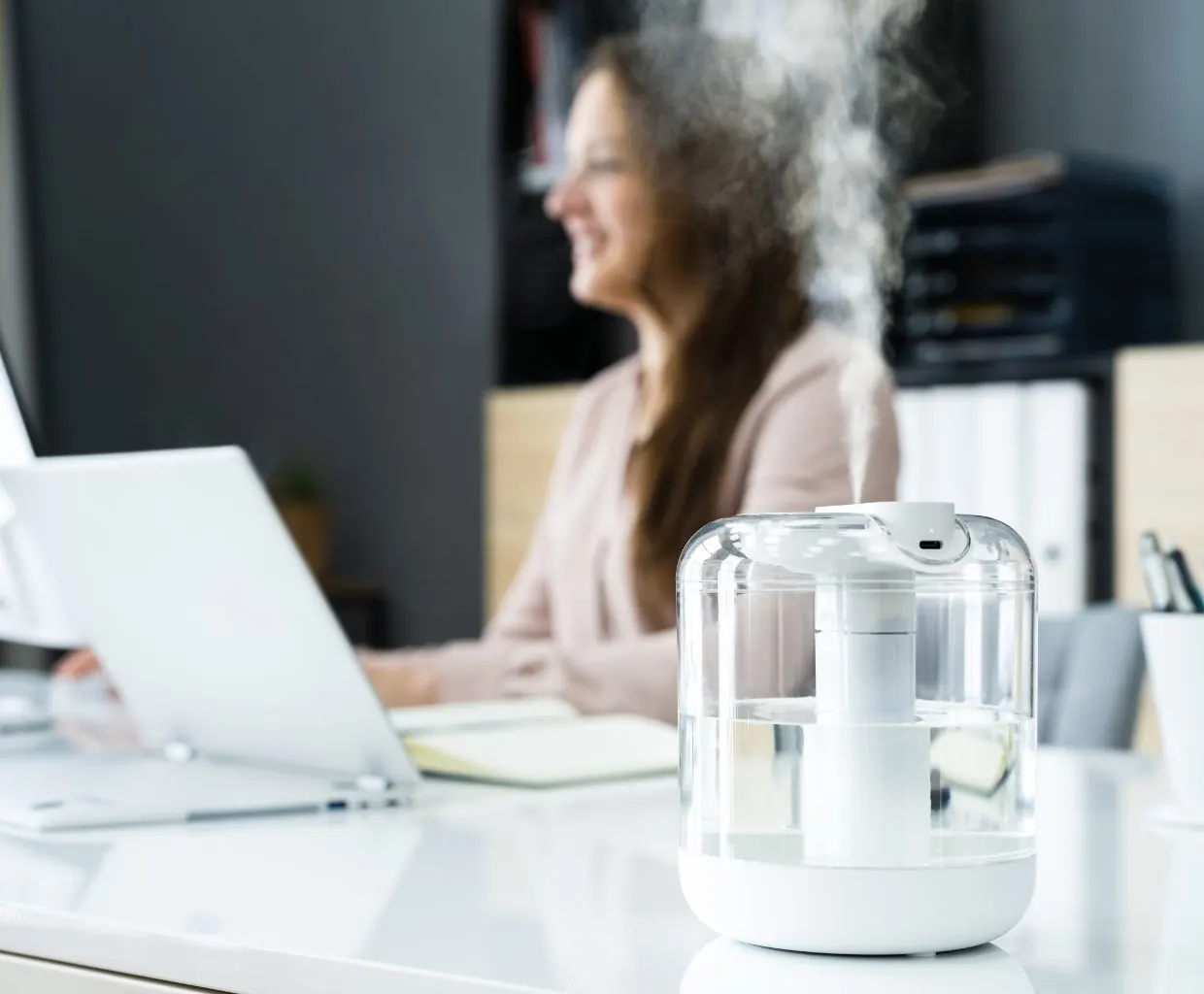
To clean a humidifier, empty, rinse, dry and refill it every day, then descale it with white vinegar and disinfect it every third day. That is the EPA’s schedule for portable units. Your own manual comes first: it tells you how much vinegar to use, whether bleach or hydrogen peroxide is allowed, and which parts must never get wet. Never mix vinegar and bleach.
Why cleaning a humidifier matters
A humidifier is a tank of standing water, and germs grow in it. The Consumer Product Safety Commission (CPSC) found that bacteria and fungi often grow in humidifier tanks and can be released in the mist. It says breathing dirty mist may cause lung problems ranging from flu-like symptoms to serious infection, a special concern for people with allergies or asthma. The CDC agrees that germs can live in humidifiers and spread through the mist. Its Legionella control toolkit, written for building water-management programs, lists humidifiers among the devices that may grow Legionella and says to empty and clean their tanks daily.
The EPA adds that ultrasonic and impeller (“cool mist”) humidifiers generally disperse the most microorganisms and minerals, and that breathing mist containing these pollutants has been implicated in a certain type of lung inflammation. The young, the elderly and people with lung disease or respiratory allergies may be particularly susceptible. This is often called “humidifier lung”, a form of hypersensitivity pneumonitis. In one published case report, symptoms started two months after continued use of an ultrasonic humidifier whose water was contaminated with bacteria, fungi and endotoxin. That is a single case, not a measure of how common the problem is.
Important: If you have coughing, breathlessness or other respiratory symptoms you associate with your humidifier, the EPA says to stop using it and contact a physician.
Scale matters too. The EPA calls crusty mineral deposits a breeding ground for microorganisms, so descaling is about hygiene, not just looks.
The cleaning schedule at a glance
| When | What to do | Who says so |
|---|---|---|
| Every day | Unplug, empty the tank and base, wipe or air-dry, refill with fresh water | EPA, CDC, CPSC |
| Every third day | Empty, scrub, remove scale and film, disinfect, rinse, dry | EPA, Mayo Clinic |
| At least weekly | Vinegar descale of tank and base | HoMedics, Crane, Levoit Classic 300S manuals |
| When the unit prompts you | Clean the transducer, run a Deep clean cycle, or change the wick | HoMedics, Dyson, Levoit, Honeywell manuals |
| End of season | Clean, dry completely, discard used cartridges and filters, store dry, clean again before use | EPA, CPSC |
MedlinePlus is stricter still: drain and clean daily. In our view, the manual’s interval is the minimum and the EPA’s every-third-day routine is the target whenever the humidifier runs every day.
Daily: empty, rinse, dry, refill
- Unplug the humidifier.
- Pour out all the water in the tank and the base. Crane says water left in the tank more than a day or two can grow bacteria.
- Rinse the tank, cap and base with clean water and wipe them dry, or let them air-dry. Crane suggests leaving the tank cap off until the next use.
- Refill with fresh water just before you run it.
The water you use changes how fast scale builds up. Our guide to what kind of water to use in a humidifier explains why the EPA and CPSC prefer distilled water for ultrasonic models.
Every third day: how to clean a humidifier step by step
You need white vinegar, 3% hydrogen peroxide (or plain household bleach, only if your manual allows it), a soft-bristle brush, cotton swabs and a soft cloth. A small soft-bristle cleaning brush reaches the corners of the base that a cloth misses.
- Unplug it and let it cool. Vicks says to wait 20 to 30 minutes after using a warm mist model.
- Empty everything and take out removable parts: the wick or filter on evaporative units, and the float, filter and small parts your manual lists. When pouring water from a Levoit base, hold the float down so it doesn’t fall out.
- Descale with white vinegar. Almost every manual we reviewed uses it (Dyson uses citric acid), but the amounts differ, from a 50/50 vinegar-water mix (HoMedics) to 3 cups of undiluted vinegar (Levoit Classic 300S). Most soak for 15 to 30 minutes. We’d use your own manual’s amount; the brand notes below list several.
- Scrub and rinse. Brush scale off with the soft brush, clean the transducer or heating element (see below), and rinse out the vinegar.
- Disinfect as a separate step, with the product your manual names.
- Rinse again with several changes of tap water, which is the EPA’s advice, until there is no vinegar, bleach or peroxide smell. CPSC warns that leftover cleaner can be breathed in when the unit runs.
- Dry and reassemble, then refill.
Disinfecting: hydrogen peroxide or diluted bleach
- If your manual names a disinfectant, use it. That is what both the EPA and CPSC say.
- If it gives no instructions, the EPA’s default is a 3% hydrogen peroxide solution on all surfaces that touch water. The Levoit LV600HH manual also allows 3% hydrogen peroxide in place of vinegar.
- Bleach only where the manual allows it. Vicks, Honeywell, TaoTronics, AIRCARE and Vornado manuals use 1 teaspoon of bleach per gallon of water (Honeywell writes it as 1/2 teaspoon per 1/2 gallon), usually for about 20 minutes. Vicks, Honeywell and TaoTronics say more bleach than that can damage the humidifier.
- Vinegar-only brands: the HoMedics, Crane and Levoit Classic 300S manuals mention no bleach or peroxide at all. We’d stick to vinegar on those models.
Important: Never mix vinegar and bleach. Honeywell and TaoTronics tell you to descale and disinfect as separate steps, and Levoit says never to mix hydrogen peroxide and vinegar. Bleach mixed with an acid such as vinegar can release chlorine gas.
Wicks, filters, transducers and heating elements
Evaporative wicks and filters
Wicks are consumables. Honeywell’s HEV685 manual says never to clean the wicking filter with vinegar, soap, bleach or chemicals; flip it at each refill and replace it every 30 to 60 days. AIRCARE also says every 30 to 60 days of operation, and Vornado says its wicks last about 4 to 8 weeks and should be replaced when they turn hard. Levoit’s Superior 6000S is an exception: its wicks can be rinsed with water and brushed, and Dry Mode dries them to prevent mold. Take the wick out before you descale or disinfect the base. Our guide to the best humidifier for a large room compares evaporative and ultrasonic designs.
Ultrasonic transducers
The transducer (also called the nebulizer or ultrasonic membrane) is the small disc in the base that turns water into mist. HoMedics says never to touch it with your fingers, because skin oils can damage it, never to use detergent on it and never to scrape it with a hard object. Wipe it with a cotton swab dipped in 50/50 white vinegar and water, then with a damp swab, or soak it for 5 minutes and brush gently with a soft brush. Scale on the transducer can reduce mist or stop it entirely; if that has happened, see our guide to a HoMedics humidifier not misting, which applies to most ultrasonic units.
Warm mist heating elements
The Vicks V750 manual says to soak the heating element in vinegar for 15 to 20 minutes and scrub it gently with a soft brush, never with hard brushes or steel wool. For stubborn scale, the VWM845 manual says to wrap it in a vinegar-moistened paper towel for 30 minutes, and not to rinse the element or mist chimney under running water.
Note: Never submerge the base of a humidifier. The HoMedics, Crane, Levoit, Vicks, Honeywell and TaoTronics manuals all say so, and Honeywell says doing it voids the warranty.
Brand-specific cleaning notes
How to clean a HoMedics humidifier
HoMedics manuals (UHE-CM65, UHE-CM18, UHE-CMTF91) use white vinegar only: weekly, a 50/50 mix of white vinegar and lukewarm water in the tank, plus the membrane cleaning above. On the UHE-CM18, a CLEAN light comes on after 60 hours of use; reset it by holding the clean button for 3 seconds. Replace a UHE-HDC4 demineralization cartridge every 30 to 40 fillings, sooner with very hard water.
How to clean a Crane humidifier
Crane’s Drop manual (EE-5301): fill the tank halfway with warm water plus 2 tablespoons of white vinegar, shake, and leave 30 minutes; fill the base with warm water plus 1 tablespoon of vinegar for 30 minutes, pouring it out away from the fan outlet. Then wipe the nebulizer with a damp cloth or cotton swab. Crane warns that detergent leaves a film that can interfere with output.
How to clean a Dyson humidifier
The Dyson Purifier Humidify+Cool (PH01, PH03, PH04) uses a Deep clean cycle, prompted on its screen or in the app. Dyson’s support page calls it monthly; hard water may need it more often. Dissolve 150 g of citric acid in the tank, half-filled with cold tap water, put the evaporator in, top up to Max and start the cycle. Afterwards, rinse the evaporator and tank under a cold tap. Keep the tank cap dry: it contains power connections and must not be washed.
How to clean a Levoit humidifier
Classic 300S: 3 US cups (710 mL) of distilled white vinegar in the tank, seated on the base for 15 to 20 minutes so it drains into the base chamber; soak the float, water filter and noise silencer too. No detergents or dishwasher. The LV600HH asks for a 1-hour soak (3 cups in the tank, 1 cup in the inner chamber) and a deep clean every 2 weeks.
How to clean a TaoTronics humidifier
TaoTronics is largely defunct, and its TT-AH001 manual survives only on a third-party site. It says to fill the tank half full, add 1 teaspoon of white vinegar, shake for 15 seconds and stand it on the base for 15 to 20 minutes, then wipe the atomizer and float. Disinfect separately with no more than 1 teaspoon of bleach per gallon. Afterwards, check that the rubber ring, rubber cap and spring on the tank cap are back in place, or it may leak.
Vicks and Honeywell humidifiers
Both are made by Kaz (Helen of Troy). Their manuals descale with vinegar (2 cups for 15 to 20 minutes on the Honeywell HUL520) and then disinfect with bleach at 1 teaspoon per gallon. Vicks says not to use vinegar or bleach on the scent pad heater area.
Black or pink slime, mold and film
CPSC says film or scum on the water, tank or motor parts may indicate bacteria or fungi. Whatever the color, the fix is the same: a full clean with a brush, paying attention to the cap, seals, float and corners of the base, then disinfecting as your manual allows. We’d replace a wick that is discolored or hard rather than try to rescue it. Mayo Clinic advises replacing an old humidifier whose mineral buildup can’t be removed.
To stop it coming back, change the water daily, dry the parts, use low-mineral water and keep the room from getting damp. The EPA says not to humidify above 50% relative humidity, because higher levels may encourage biological growth. See our guide to the ideal indoor humidity.
Why does my humidifier smell?
- Stale water: HoMedics says to empty, clean and refill the unit.
- A new unit: HoMedics says to leave the tank open in a cool, shady place for 12 hours. Dreo says to clean it and leave it to dry with the cover off for 12 hours.
- A new wick: Vornado suggests soaking it in 2 teaspoons of white vinegar per gallon of water for 20 to 30 minutes, then rinsing without wringing.
- Vinegar or bleach smell after cleaning: keep rinsing until it’s gone.
- A musty wick: replace it.
Don’t mask odors with essential oils in the tank. HoMedics says even a few drops will damage the unit, and Crane says it voids the warranty. Oils are also a concern for pets; see are humidifiers safe for dogs.
End-of-season storage
The EPA says to clean the humidifier at the end of the season, dry every part, store it in a dry place and throw away used demineralization cartridges, cassettes or filters. CPSC adds that you should clean it again after summer storage, and HoMedics says to fill the tank only just before you run it again. AIRCARE says to discard the wick and not store the unit in an attic or other hot area. Dyson recommends an extra Deep clean cycle before and after long periods without humidifying.
A unit packed away damp gives germs all summer to grow, so we’d leave the parts out to air-dry for a full day before boxing them up. If your humidifier also drips or pools water, see why is my humidifier leaking.
Frequently asked questions
How often should you clean a humidifier?
EPA says to empty, dry and refill a portable humidifier every day and to clean it every third day. Many manuals (HoMedics, Crane, Levoit Classic 300S) ask for a vinegar descale at least weekly, so treat the manual's interval as the minimum.
Can I clean a humidifier with vinegar?
Yes. White vinegar is the descaler almost every manufacturer specifies, though the amount varies by model. For disinfecting, EPA's default is a 3% hydrogen peroxide solution unless your manual names a different product.
Can you put bleach in a humidifier?
Only to clean it, only if your manual allows bleach, and only at its ratio. Vicks, Honeywell and TaoTronics manuals say no more than 1 teaspoon per gallon of water. Rinse until the smell is gone, and never mix bleach with vinegar.
Can I run my humidifier with vinegar in it?
Generally no. Pure Enrichment, for example, says not to run its humidifier with vinegar inside. The one exception we found is the Levoit LV600HH, whose manual has a deep-clean cycle that runs a vinegar solution outdoors for an hour.
What is the pink or black slime in my humidifier?
CPSC says film or scum on the water, tank or motor parts may indicate bacteria or fungi. Empty the unit, scrub it, descale and disinfect it as your manual allows, and change the water daily so it doesn't come back.
Can humidifier parts go in the dishwasher?
Only if your manual says so. Levoit and the Honeywell HEV685 manual say no dishwasher, while the Vicks V745 manual allows the medicine cup, tray and mist chimney on the top rack without detergent.
Related guides
Humidifiers
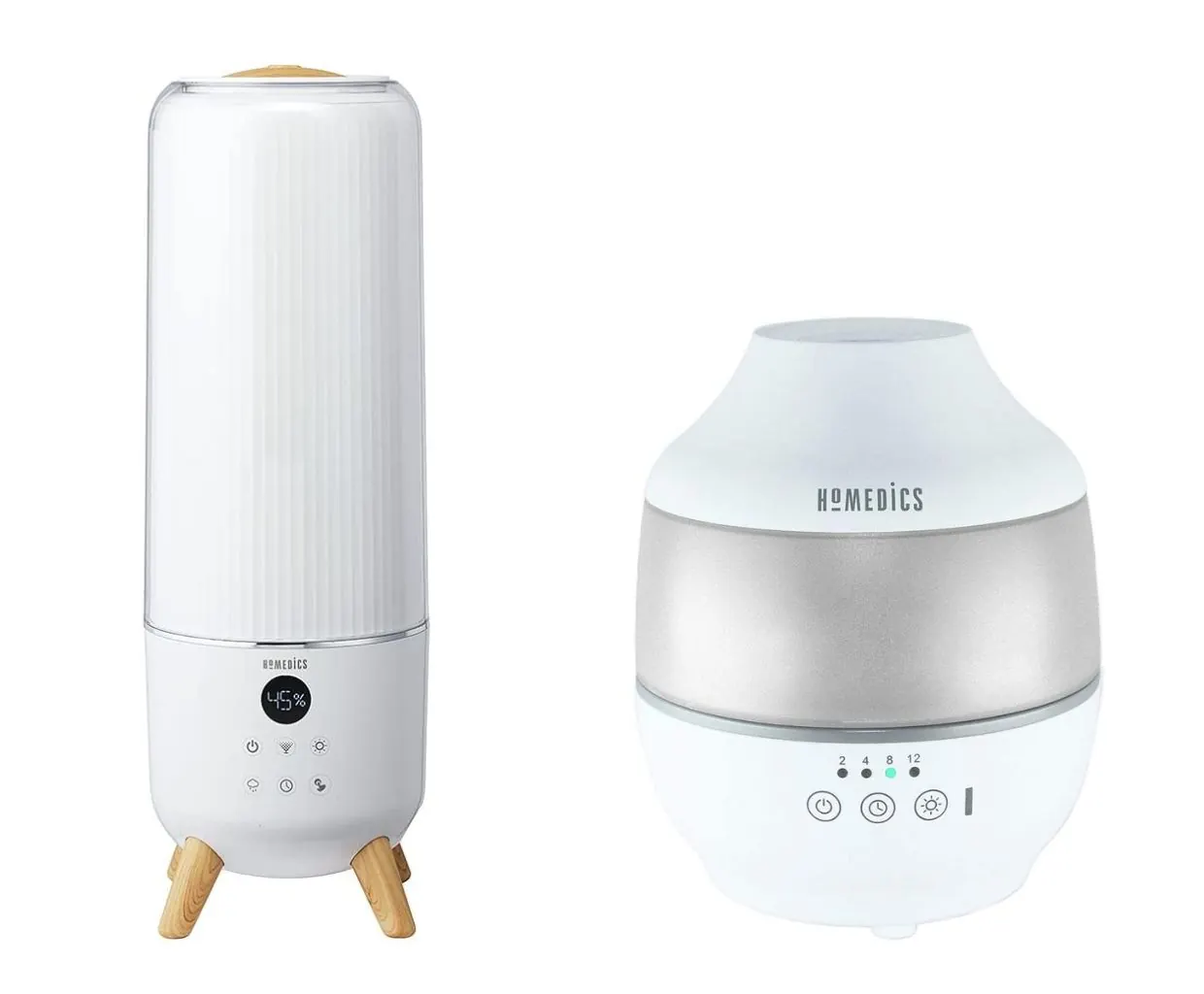
HoMedics Humidifier Not Misting? Fixes From the Manuals
Low water, a loose tank, the humidistat or a scaled-up transducer: how to get a HoMedics humidifier misting again, and why humidifiers keep turning off.
7 min read
Humidifiers
Best Humidifiers for Large Rooms in 2026: Output, Wicks and Whole-House Options
Six humidifiers for rooms over 500 sq ft, picked from maker specs and manuals, plus when a whole-house unit on your furnace makes more sense.
13 min read
Humidifiers
What Kind of Water to Use in a Humidifier: Distilled, Tap or Boiled?
Distilled water is the best choice for ultrasonic humidifiers. Many evaporative and steam models are fine with tap water. Here is what the EPA and manuals say.
6 min read
Humidifiers
Why Is My Humidifier Leaking? Causes, Fixes and When to Stop
A loose cap seal, a cracked tank, moving it while full or mist set too high: how to find where your humidifier is leaking and fix it safely.
7 min read