Ultrasonic vs Evaporative Humidifier: White Dust, Noise, Wicks and Upkeep
Ultrasonic humidifiers are quiet but spread tap-water minerals; evaporative ones leave the minerals in a wick. How they compare on dust, noise, upkeep and power.
By Clean Air Guides editorial teamUpdated 9 min read
Our picks at a glance
- Top pickCheck price
Ultrasonic, quietest rating
Cool mist with a published rating under 28 dB, a 2.6-gallon tank and an Auto mode you can set from 40% to 80%.
- Under 28 dB (maker)
- 350 mL/h max
- 300-600 sq ft (maker)
- Check price
Ultrasonic, larger rooms
Dreo Smart Humidifier 735S (HM735S)
An 11 L tank, a 700 sq ft claim and a 26 dB sleep-mode rating, at a 32 W power rating.
- 26 dB sleep mode (maker)
- 2.9-gallon tank
- Up to 700 sq ft (maker)
- Check price
Evaporative, big spaces
Up to 1,500 mL per hour, a 6-gallon tank and washable wicks, and Levoit says tap water is fine.
- 1,500 mL/h (manual)
- 6-gallon tank
- Up to 3,000 sq ft (maker)
- Check price
Evaporative, mid-size
Dreo Smart Evaporative Humidifier 774S (HM774S)
A published 800 mL per hour, a 15 W rating and a Dry Mode that helps the wick last.
- 800 mL/h (maker)
- 32 dB (maker)
- 15 W
Prices change often; Amazon shows the current price. As an Amazon Associate, Clean Air Guides earns from qualifying purchases.
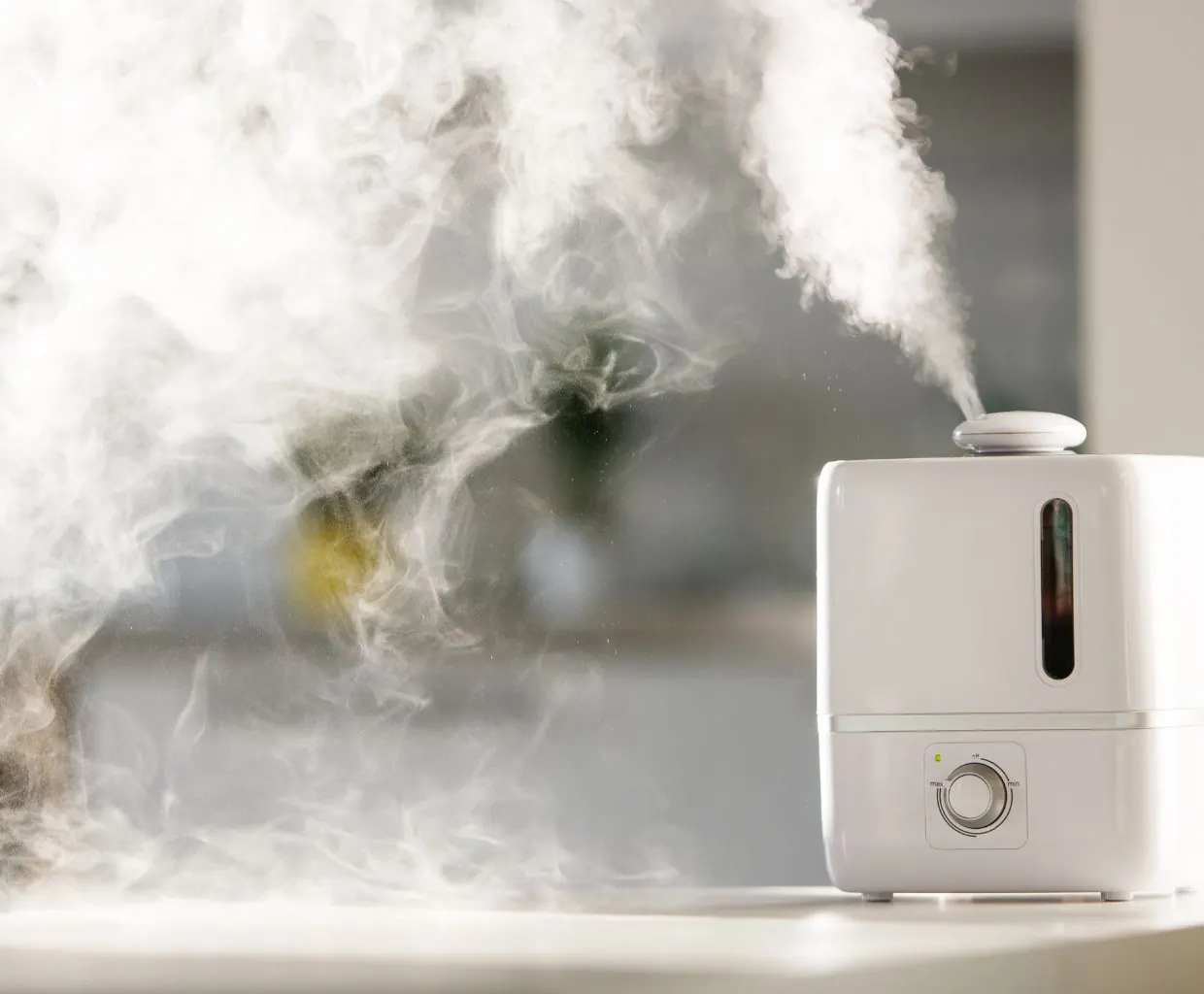
An ultrasonic humidifier shakes water into a fine visible mist with a vibrating plate; an evaporative humidifier uses a fan to blow air through a wet wick, so the moisture leaves as invisible vapor. Both are cool-moisture types. The real trade-off is minerals against wicks: ultrasonic units are usually the quietest but spread tap-water minerals as white dust unless you use distilled water, while evaporative units keep the minerals in a wick you have to replace. We’d pick evaporative for hard water and bigger rooms, and ultrasonic for a quiet bedroom where you don’t mind buying distilled water.
Ultrasonic vs evaporative at a glance
| Ultrasonic | Evaporative | |
|---|---|---|
| How it works | Vibrating plate (transducer) turns water into mist | Fan blows air through a wet wick, filter or discs |
| Visible mist | Yes | No |
| White dust from tap water | Yes; EPA says they are very efficient at spreading minerals | Not expected in substantial amounts (EPA) |
| Best water | Distilled (EPA, Levoit, Dreo) | Tap water is usually fine |
| Over-humidifying | Keeps misting until a humidistat stops it | Output drops as the air gets damp (Honeywell) |
| Noise ratings | 26 to 30 dB on the models below | Fan always runs: 28 to 45 dB on the Levoit 6000S |
| Parts to replace | Optional demineralization cartridges | Wicks, every 4 weeks to 6 months |
| Power | Low: 26 to 32 W on the Dreo models | Low: 15 to 30 W on the Dreo and Levoit models |
How each type works
The ultrasonic design uses a small disc in the base, called the transducer, nebulizer or ultrasonic membrane, that vibrates fast enough to break water into a fine mist. A small fan carries that mist out of the nozzle. Whatever is dissolved in the water, minerals included, leaves with it.
The evaporative design is the older one. EPA describes it as a fan blowing air through a wet wick, belt or filter. The wick draws water up from the tank, the moving air evaporates it, and only water vapor leaves. Honeywell says the minerals collect in the wick instead. A few evaporative models skip the wick: the Venta LW45, for example, evaporates water from a stack of rotating discs.
There’s no visible mist from an evaporative unit, which confuses some first-time owners. Honeywell’s HCM-350 manual says the way to confirm it’s working is to watch the tank level drop over 24 hours.
White dust and minerals
This is the biggest practical difference. EPA says ultrasonic and impeller humidifiers are very efficient at dispersing tap-water minerals into the air, and that some people notice a “white dust” on surfaces. Evaporative units and steam vaporizers are not expected to disperse substantial amounts of minerals.
CPSC says the white dust may contain particles small enough to reach the lungs and that the health effects aren’t clear. Some makers call it harmless, but EPA and CPSC don’t say that, so we wouldn’t count on it.
With an ultrasonic unit, there are two ways to cut the dust:
- Distilled water. EPA recommends bottled water labeled “distilled”, and both Levoit and Dreo recommend distilled or purified water for their ultrasonic models. Spring and mineral water aren’t substitutes. Our guide to what water to use in a humidifier compares the options.
- Demineralization cartridges. EPA says their ability to remove minerals may vary widely, and white dust is the sign they aren’t keeping up. Where tap water is very hard, EPA notes that distilled water may cost less than cartridges.
The minerals also matter inside the machine. EPA calls scale a breeding ground for microorganisms, and Honeywell says minerals on an ultrasonic nebulizer slow it until it can no longer make mist.
Germs in the mist
EPA says ultrasonic and impeller (“cool mist”) humidifiers generally disperse the most microorganisms as well as minerals from the tank. Evaporative units generally disperse less of these pollutants, if any. That doesn’t make an evaporative unit germ-proof: EPA adds that evaporative and steam units can still grow microorganisms if they hold standing water, and CPSC says bacteria and fungi often grow in humidifier tanks.
So the daily routine is the same for both: empty the tank, wipe it dry and refill it every day, and clean every third day (EPA). If you’ve found slime or dark spots in the tank, see our guide to mold in a humidifier.
Over-humidifying
An ultrasonic humidifier keeps putting out mist as long as it’s running. Unless a humidistat switches it off, it can push a room past a healthy level, and a cloud of mist that settles before it evaporates can leave damp patches around the unit. Our article on a humidifier making the room foggy covers why that happens.
Evaporation slows down on its own as the air gets damper. Honeywell’s HCM-350 manual says its evaporative unit puts out little moisture once the room is above 60% humidity, because the air is already saturated. That’s a useful brake, but 60% is still above EPA’s advice not to humidify above 50%. In our view, either type should have a humidistat or sit next to a hygrometer.
Check the default setting, too. Levoit’s OasisMist 1000S Auto mode ships at 60%; we’d set it to 50% or lower. EPA and CPSC suggest 30% to 50%, and in cold weather the dew point calculator shows when your windows will start to sweat.
Noise
Ultrasonic units have the edge because there’s no fan forcing air through a wet wick. Published ratings for the ultrasonic models in this guide run from 26 dB (Dreo 735S in sleep mode) to 30 dB (Dreo 755S), with Levoit rating the OasisMist 1000S under 28 dB.
Evaporative units always run a fan, so noise climbs with the fan speed. Levoit rates the Superior 6000S at 28 to 45 dB, Dreo rates the 774S at 32 dB, and Venta rates its wick-free LW45 at 24, 35 and 45 dB on its three power levels. Many evaporative fans are quiet on low, but for a light sleeper we’d lean ultrasonic.
Wicks vs no wicks: upkeep and running costs
An ultrasonic humidifier has nothing that wears out on a schedule, though some use optional cartridges: HoMedics says to replace its UHE-HDC4 demineralization cartridge every 30 to 40 fillings. The ongoing cost is distilled water, and the chore is keeping the transducer free of scale. Manuals differ on how often: Levoit says every 3 days for the OasisMist 1000S, Dreo says monthly descaling for the 735S.
An evaporative humidifier needs new wicks, and the interval varies a lot by maker:
- Vornado: about 4 to 8 weeks, depending on use and water hardness.
- Honeywell and AIRCARE: every 30 to 60 days.
- Dreo 774S: clean weekly, replace every 3 months.
- Levoit Superior 6000S: about 3 to 6 months, and the wicks can be rinsed and brushed.
Hard water shortens wick life, and Vornado notes that chemically softened water can harden its wicks.
Cleaning
Neither type gets out of regular cleaning. With an ultrasonic unit, the focus is the tank, base and transducer: HoMedics says never to touch the membrane with your fingers or scrape it with anything hard, and to wipe it with a swab dipped in a 50/50 mix of white vinegar and water. With an evaporative unit, you take the wick out first and then descale and disinfect the tank and base; Honeywell’s HCM-350 manual says cleaning with the filter in place destroys it.
The full routine for each type, including vinegar amounts and when bleach is allowed, is in our guide on how to clean a humidifier.
Energy use
This is closer than many buyers expect. Both types are low-power because neither boils water. Dreo rates its ultrasonic 735S at 32 W and 755S at 26 W; on the evaporative side, it rates the 774S at 15 W and Levoit rates the Superior 6000S at 30 W. Vornado says its evaporative EVDC500 can draw as little as 1 W in Energy Smart mode, while bigger consoles run higher (AIRCARE’s manual rates the MA1201 at 80 W).
The jump comes with heat. Levoit rates the warm-mist heater on its LV600HH at 280 W. Our warm mist vs cool mist humidifier comparison covers that trade-off. To see what any of these costs per month, plug the watts and hours into our electricity cost calculator; it works for any appliance.
Room size and output
Coverage figures are the makers’ own “up to” claims, and there’s no verified AHAM sizing chart for portable humidifiers, so we compare published output where we can. Among the models below, the evaporative ones publish much higher maximum output: 1,500 mL per hour for the Levoit Superior 6000S and 800 mL per hour for the Dreo 774S, against 350 mL per hour for the ultrasonic OasisMist 1000S. That’s one reason we’d lean evaporative for open plans.
Models of each type
We chose these from makers’ spec sheets and manuals; we don’t test humidifiers (how we research). All four were listed as current on their makers’ sites in October 2026. For more evaporative options, including wick-free and console models, see our best evaporative humidifier roundup.
Levoit OasisMist 1000S
An ultrasonic, cool-mist-only tower with the lowest noise claim among Levoit’s models here: under 28 dB. The tank holds 10 L (about 2.6 gallons), Levoit gives an effective range of 300 to 600 sq ft, and maximum output is 350 mL per hour. Auto mode holds a target from 40% to 80% in 10% steps. The trade-offs are white dust with tap water (Levoit recommends purified or distilled water) and a cleaning schedule of every 3 days.
Our pick: Ultrasonic, quietest ratingLevoit OasisMist 1000SSee today's price, ratings and delivery options
Check priceDreo HM735S
A larger ultrasonic unit with an 11 L (about 2.9-gallon) tank, a 700 sq ft claim and up to 100 hours of run time, per Dreo. It’s rated at 26 dB in sleep mode and 32 W. Dreo’s marketing says “no white dust”, but its own FAQ says hard water can leave a white film and recommends distilled water. Dreo lists identical headline specs for its 747S, so check the model number before you buy.
Our pick: Ultrasonic, larger roomsDreo HM735SSee today's price, ratings and delivery options
Check priceLevoit Superior 6000S
An evaporative tower for open plans, with the highest published output we found in a tower: up to 1,500 mL per hour, a 6-gallon tank and a 3,000 sq ft effective range. Its humidistat sets 30% to 60% in 5% steps and defaults to 50%. Levoit says tap water is fine. The four wicks can be rinsed and brushed and last about 3 to 6 months, and Dry Mode dries them after use. It’s big (13.2 lb empty) and rated at 28 to 45 dB, louder on high than the ultrasonic picks.
Our pick: Evaporative, big spacesLevoit Superior 6000SSee today's price, ratings and delivery options
Check priceDreo HM774S
A mid-size evaporative unit with a published 800 mL per hour, a 10 L (about 2.6-gallon) tank, a 1,000 sq ft claim and a 32 dB rating. It draws 15 W, the lowest rating among our four picks. Dreo says to clean the wick weekly and replace it every 3 months, and Dry Mode helps it last. We’d pick it if you want no white dust without the size of the Levoit 6000S.
Our pick: Evaporative, mid-sizeDreo HM774SSee today's price, ratings and delivery options
Check priceOur verdict
We’d choose evaporative if your tap water is hard, you’d rather not buy distilled water, or the room is large. We’d choose ultrasonic for a bedroom where the lowest noise rating matters and you’re happy to use distilled water and clean the transducer on schedule. Whichever you buy, keep humidity at or below 50% and change the water daily. If you’re also weighing heat, read warm mist vs cool mist before you decide.
Frequently asked questions
Is an ultrasonic or evaporative humidifier better?
For homes with hard tap water or rooms with dark furniture, evaporative. EPA says ultrasonic units are very efficient at spreading tap-water minerals as white dust, while evaporative units are not expected to spread substantial amounts. Ultrasonic is the better fit if you want the lowest noise rating and will use distilled water.
Do evaporative humidifiers cause white dust?
They are not expected to, according to EPA. The minerals stay behind in the wick instead of leaving with the mist, which is why the wick hardens and needs replacing.
Can you use tap water in an ultrasonic humidifier?
It will run, but EPA recommends bottled water labeled distilled, and Levoit and Dreo recommend distilled or purified water for their ultrasonic models. Tap water leaves white dust on surfaces and more scale inside the unit.
Which is quieter, ultrasonic or evaporative?
Ultrasonic, as a rule, because there is no fan pushing air through a wick. Levoit rates the OasisMist 1000S under 28 dB, while its evaporative Superior 6000S is rated at 28 to 45 dB.
Can an evaporative humidifier over-humidify a room?
It's harder than with an ultrasonic unit. Honeywell says its evaporative units put out little moisture once a room is above 60% humidity, because the air is already saturated. That's still above EPA's 50% ceiling, so a humidistat or hygrometer matters with either type.
Which type uses more electricity?
Neither by much. Both are low-power: the Dreo and Levoit models below that publish a rating draw 15 to 32 W. A heater is what drives power use; Levoit's warm-mist LV600HH heater is rated at 280 W.
Related guides
Humidifiers
Best Evaporative Humidifiers in 2026: Wick and Disc Models Without White Dust
Six evaporative humidifiers picked from maker specs and manuals, plus how wick humidifiers work and how they compare with ultrasonic models.
12 min read
Humidifiers
Best Humidifiers for the Bedroom in 2026: Quiet, Overnight and Easy to Clean
Six bedroom humidifiers picked from maker specs and manuals: published noise levels, overnight runtime, cool or warm mist, white dust and cleaning.
11 min read
Humidifiers
Best Humidifiers for Large Rooms in 2026: Output, Wicks and Whole-House Options
Six humidifiers for rooms over 500 sq ft, picked from maker specs and manuals, plus when a whole-house unit on your furnace makes more sense.
13 min read
Humidifiers
Warm Mist vs Cool Mist Humidifier: Safety, Energy, White Dust and Cleaning
Cool mist is the safer pick for kids and pets and uses far less power. Warm mist puts out little or no white dust from steam. Here's how they compare.
8 min read