Mold in Humidifier: Why It Grows, Pink and Black Slime, and How to Stop It
Standing water, scale and damp parts let mold and bacteria grow in a humidifier. What slime and musty smells mean, the health risks and how to keep it clean.
By Clean Air Guides editorial teamUpdated 9 min read
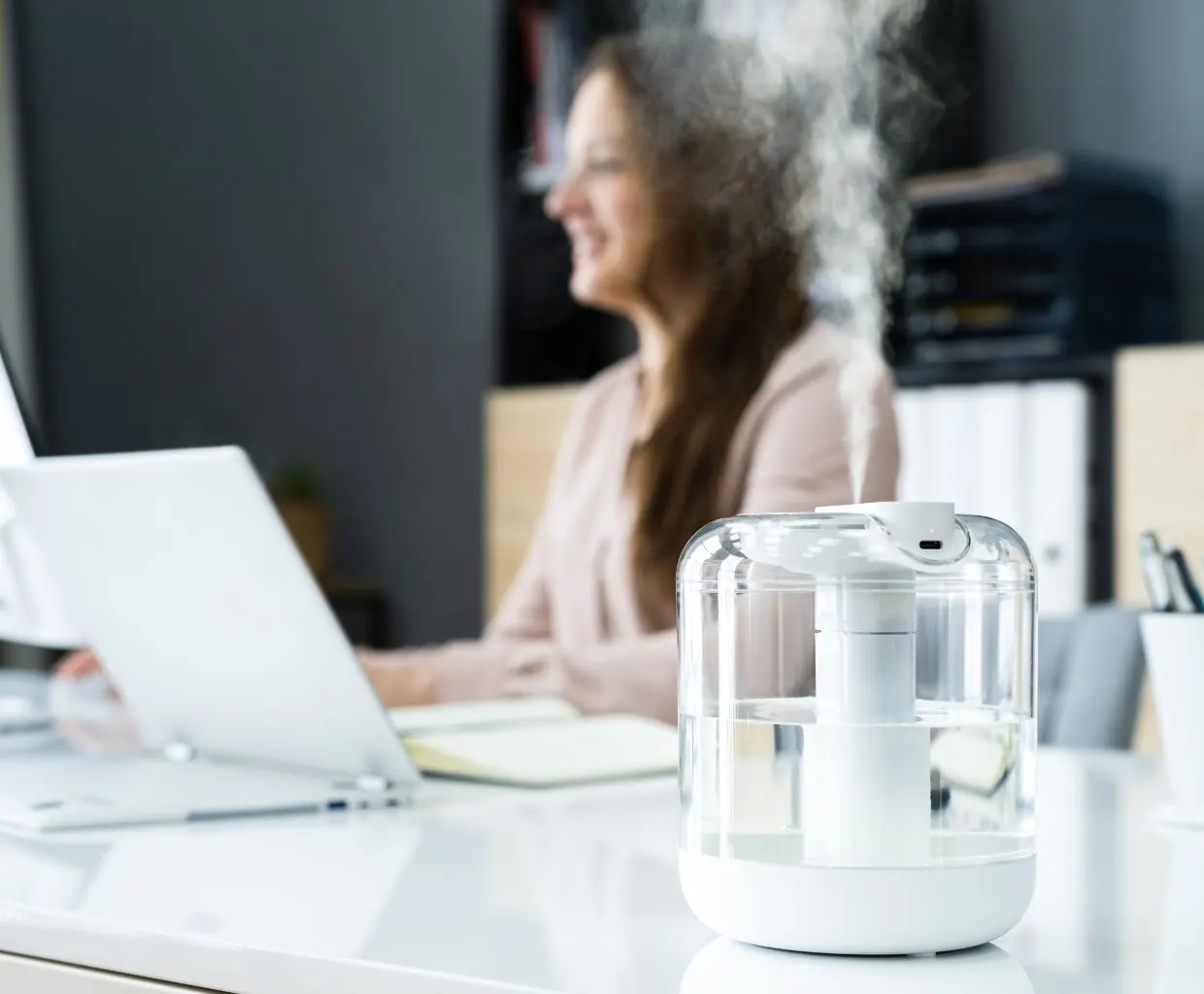
Mold and bacteria grow in a humidifier because it holds standing water, collects mineral scale and stays damp between uses. If you see slime or fuzz, or the unit smells musty, stop using it, empty it, scrub and disinfect it as your manual allows, and replace a moldy wick or filter. To keep it from coming back, empty and dry the humidifier every day, clean it every third day, use low-mineral water and keep room humidity at or below 50%.
Why humidifiers grow mold and bacteria
The Consumer Product Safety Commission (CPSC) found that bacteria and fungi often grow in the tanks of portable and console humidifiers and can be released in the mist. The CDC says germs can live in humidifiers and spread through the mist, and its Legionella control toolkit lists humidifiers among devices that may grow Legionella.
Three things speed it up:
- Water left sitting. Crane says water left in the tank more than a day or two can grow bacteria. Vornado says water left in the base for 8 hours or more with the unit off can grow algae and bacteria. Levoit says not to leave water inside a Classic 300S that won’t be used for a week or more.
- Scale. The EPA calls crusty mineral deposits a breeding ground for microorganisms, and CPSC says scale gives bacteria and fungi a surface to grow on. Hard tap water builds scale fastest.
- Parts that never dry. Wicks, filters, floats, cap seals and the corners of the base stay wet longest. Levoit’s Superior 6000S has a Dry Mode for exactly this reason: it dries the wicks to prevent mold.
Every type can be affected. The EPA says evaporative units and steam vaporizers can still grow microorganisms if they hold standing water, although they generally disperse less of them, if any. Ultrasonic and impeller (“cool mist”) units generally disperse the most microorganisms and minerals into the room, which is why their hygiene matters most.
Pink slime, black spots and white crust: what you’re looking at
Color alone doesn’t identify the organism, and none of the official sources we rely on try to. What they do say:
- Pink or black slime or film. CPSC says film or scum on the water, tank or motor parts may indicate bacteria or fungi. In a published case of “humidifier lung”, doctors found white and pink residue in the tank of a humidifier that had been running 24 hours a day, and the water grew several kinds of bacteria and fungi. Treat any slime as contamination, whatever the color.
- Fuzzy or spotted growth on a wick or filter. Honeywell says to replace a moldy filter; we’d do that rather than try to rescue it.
- White or gray crust is usually mineral scale from the water, not mold. It still matters, because the EPA says scale is where microorganisms like to grow. Vinegar removes it.
- Brown or rust-colored wick. Honeywell says this discoloration on an evaporative filter is mineral deposit. On its own it isn’t proof of mold, but it’s a reminder to check the wick’s replacement date.
- Black specks in a steam vaporizer. On the Vicks V150, Vicks says black particles are charred minerals. That applies to that type of steam unit, not to ultrasonic tanks.
What you see and what to do
| What you see | What it usually is | What to do |
|---|---|---|
| Pink or black slime or film | Bacteria or fungi (CPSC) | Empty, scrub, disinfect and rinse; replace a slimy wick |
| Fuzzy or spotted growth on a wick | Mold | Replace the wick, as Honeywell advises |
| White or gray crust | Mineral scale | Descale with white vinegar; scale is where germs grow (EPA) |
| Brown or rust-colored wick | Mineral deposit (Honeywell) | Check the wick’s replacement date |
| Black specks in a Vicks V150 steam unit | Charred minerals (Vicks) | Clean as the manual says; not a sign of mold on its own |
Why does my humidifier smell bad?
A smell is often the first sign of growth you can’t see yet.
- Musty or swampy: stale water or a dirty wick. Empty and clean the unit, then refill with fresh water. Honeywell says to replace a wick filter that is moldy or smells bad.
- A smell from a brand-new unit: HoMedics says to leave the tank open in a cool, shady place for 12 hours, and Dreo says to clean the unit and leave it to dry with the cover off for 12 hours.
- Vinegar or bleach: leftover cleaner. Keep rinsing until the smell is gone; CPSC warns that leftover cleaner can be breathed in when the unit runs.
Don’t cover a musty smell with essential oils in the tank: HoMedics says even a few drops will damage its units.
Is mold in a humidifier dangerous?
It can be, mainly because the humidifier turns the contamination into something you breathe. CPSC says breathing dirty mist may cause lung problems ranging from flu-like symptoms to serious infection, a special concern for people with allergies or asthma. The EPA says breathing mist containing microorganisms and minerals has been implicated in a certain type of lung inflammation, and that the young, the elderly and people with lung disease or respiratory allergies may be particularly susceptible.
That inflammation is hypersensitivity pneumonitis. MedlinePlus lists “humidifier lung” as one of its alternative names and fungi or bacteria in humidifiers as a cause, and says most symptoms go away when exposure is avoided or limited. In the case report mentioned above, a man developed fever, cough and low blood oxygen about two months after he started running an ultrasonic humidifier around the clock, and he improved after he stopped using it. The authors note humidifier lung is rare, about 4.3% of hypersensitivity pneumonitis cases in Japan. Uncommon, then, but a good reason not to run a dirty unit.
Important: If you have coughing, breathlessness, fever or other breathing symptoms you associate with your humidifier, the EPA says to stop using it and contact a physician. Talk to your doctor before running a humidifier for someone with asthma, a lung condition or a weakened immune system.
How to get rid of mold in a humidifier
Our guide on how to clean a humidifier has the full routine with brand-by-brand amounts. For a unit that already has slime or mold, the short version is:
- Turn it off and unplug it. Let a warm mist unit cool first.
- Pour out all the water in the tank and the base. Don’t refill it with the old water.
- Take out the wick or filter and replace it if it is moldy, slimy or smells bad, as Honeywell advises. Wicks are consumables.
- Scrub every wet surface with a soft brush: the tank, the inside of the cap, the seal, the float and the corners of the base. CPSC says to avoid damaging the motor or scratching the inner surface.
- Descale with white vinegar at the amount your manual gives, then rinse.
- Disinfect as a separate step. Use the product your manual names. If it names none, the EPA’s default is 3% hydrogen peroxide on all surfaces that touch water. Use bleach only if your manual allows it, at its ratio; Vicks, Honeywell and TaoTronics manuals use no more than 1 teaspoon per gallon.
- Rinse with several changes of water until no cleaner smell remains, then let every part dry completely.
A small brush reaches the corners of the base and the cap threads that a cloth misses.
Available on AmazonSoft-bristle cleaning brushesSee today's price, ratings and delivery options
Check priceImportant: Never mix vinegar and bleach, or vinegar and hydrogen peroxide. Levoit says never to mix hydrogen peroxide and vinegar, and Honeywell says to descale and disinfect in order to avoid harmful chemical interactions. Never submerge the base.
If the slime comes back within days, the problem is usually the routine, not the cleaner: water is sitting too long, or a part isn’t drying.
When to replace parts or the whole humidifier
- Wick or filter: when it is moldy, smells bad, turns hard or reaches its interval. Honeywell says every 30 to 60 days for its wicks, and Vornado says its wicks last about 4 to 8 weeks.
- Demineralization cartridge: HoMedics says every 30 to 40 fillings, sooner with very hard water. The EPA says to throw away used cartridges at the end of the season.
- The whole unit: Mayo Clinic advises replacing an old humidifier whose mineral buildup can’t be removed. We’d also replace one that still smells musty after a full clean and a new wick, or one with slime in places you can’t reach with a brush.
How to keep mold out of your humidifier
Prevention is mostly routine:
- Empty, dry and refill every day. That’s the EPA’s advice for portable humidifiers, and the CDC says to let them air-dry. Crane suggests leaving the tank cap off between uses.
- Clean every third day, the EPA’s schedule, or at least as often as your manual says.
- Use low-mineral water. The EPA recommends distilled water for ultrasonic and impeller units, mainly because less scale means fewer places for germs to grow. The CDC also suggests distilled or boiled and cooled water to reduce germ growth. Our guide to what kind of water to use in a humidifier compares the options. Distilled water doesn’t make a dirty tank safe, though; germs grow in any standing water.
- Dry the wicks. If your evaporative humidifier has a Dry Mode, as the Levoit Superior 6000S does, use it before you switch off for the day.
- Only the additives your maker names. AIRCARE recommends its own EPA-registered bacteriostat treatment at each refill for its evaporative units, and says never to use treatments made for ultrasonic humidifiers. HoMedics and Levoit say to add nothing to the water. Follow your own manual.
- Store it dry. At the end of the season, the EPA says to clean it, dry every part and store it in a dry place, and CPSC says to clean it again before you use it next winter.
Mold around the humidifier, not in it
If you see mold on the wall, window sill or ceiling near the humidifier, the room is too damp. The EPA says not to humidify above 50% relative humidity, because higher levels may encourage biological growth, and CPSC says that above 60%, moisture can condense on surfaces where bacteria and fungi grow. Turn the humidistat down, move the unit away from walls and windows, or run it less. Our guide to the ideal indoor humidity explains the target range, and how to use a humidifier covers settings and placement.
For the mold itself, the EPA says the key is moisture control: clean up the mold, fix the moisture problem and dry wet areas within 24 to 48 hours. It says a patch under about 10 square feet can usually be cleaned by the homeowner. An air purifier can capture airborne spores and musty odors but won’t stop mold growing; see our guide to the best air purifier for mold for what one can and can’t do. If the wet patches start on cold windows, read our guide to condensation on windows.
Frequently asked questions
Can mold in a humidifier make you sick?
It can. CPSC says breathing mist from a dirty humidifier may cause lung problems ranging from flu-like symptoms to serious infection, and MedlinePlus lists fungi or bacteria in humidifiers as a cause of hypersensitivity pneumonitis. If you have breathing symptoms you link to your humidifier, stop using it and see a doctor.
Is it safe to run a humidifier that has mold in it?
No. Turn it off, empty it and give it a full clean and disinfection as your manual allows before you use it again. Replace a moldy wick or filter rather than cleaning it.
What is the pink or black slime in my humidifier?
CPSC says film or scum on the water, tank or motor parts may indicate bacteria or fungi. The color alone doesn't tell you which, and the fix is the same: a full scrub, descale and disinfection.
Does vinegar kill mold in a humidifier?
Most manuals use white vinegar to remove scale, which is where germs like to grow. For disinfecting, the EPA's default is a 3% hydrogen peroxide solution unless your manual names a different product, such as diluted bleach.
Does distilled water stop mold in a humidifier?
Not on its own. Distilled water means less scale, and the EPA calls scale a breeding ground for microorganisms, but germs can still grow in any standing water. You still need to empty the tank daily and clean it regularly.
Why does my humidifier smell musty?
Usually stale water or a dirty wick. Empty it, clean it and refill it with fresh water. Honeywell says to replace a wick filter that is moldy or smells bad.
Related guides
Humidifiers
How to Clean a Humidifier: Daily Rinse, Descaling and Disinfecting
Empty and dry it daily, descale and disinfect it every third day, and follow your manual. Step-by-step, with brand notes for HoMedics, Crane, Dyson and more.
10 min read
Humidifiers
How to Use a Humidifier: Setup, Settings, Water and Daily Care
Set it on a flat, waterproof spot, fill it with the right water, aim for 30–50% humidity and empty it every day. A step-by-step guide from setup to storage.
8 min read

Humidifiers
Humidifier White Dust: What It Is and How to Stop It
White dust is tap-water minerals thrown into the air by ultrasonic and impeller humidifiers. Here is what the EPA and CPSC say and how to stop it.
7 min read
Humidifiers
Best Humidifiers for a Baby in 2026: Cool Mist, Quiet and Easy to Keep Clean
Four cool-mist and evaporative humidifiers for a nursery, picked from maker specs and manuals, plus the humidity range, water, cleaning and placement rules.
9 min read