Humidifier White Dust: What It Is and How to Stop It
White dust is tap-water minerals thrown into the air by ultrasonic and impeller humidifiers. Here is what the EPA and CPSC say and how to stop it.
By Clean Air Guides editorial teamUpdated 7 min read
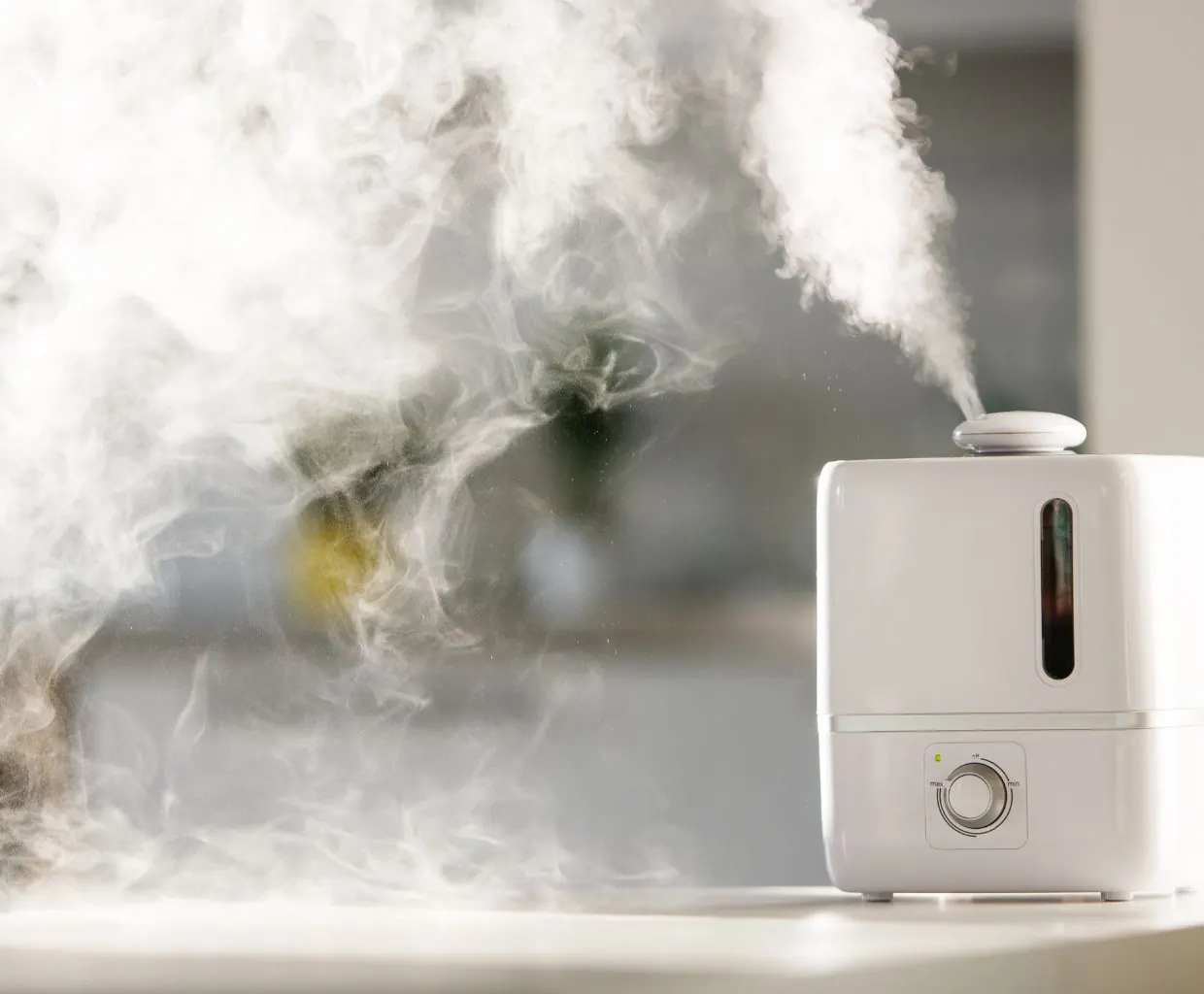
Humidifier white dust is the mineral content of your tap water. Ultrasonic and impeller (“cool mist”) humidifiers turn water into a fine mist, minerals and all, and when the droplets dry, the minerals settle on furniture, floors and electronics as a white powder. The fix is to take the minerals out before they reach the tank: distilled water works best, a demineralization cartridge is a second choice, and an evaporative or steam humidifier avoids the problem almost entirely.
What white dust is and where it comes from
Tap water carries dissolved minerals, mostly calcium and magnesium. According to the U.S. Geological Survey, those two minerals are what make water “hard”. An ultrasonic humidifier uses a vibrating disc to shatter water into droplets, and an impeller unit uses a spinning disc to fling it into the air. Neither one separates the water from what’s dissolved in it.
The EPA says ultrasonic and impeller humidifiers are very efficient at dispersing tap-water minerals into the air, and that some people are bothered by a “white dust” that may appear on surfaces when these units run. Manufacturers say the same thing in their own words:
- HoMedics calls white dust mineral residue from hard water and says it is not a defect.
- Vicks says impeller and ultrasonic humidifiers release water minerals with the visible mist, and that how much dust you get depends on how hard your water is.
- Crane says white dust from its ultrasonic units comes from the minerals in tap water.
So white dust isn’t a sign your humidifier is broken. It’s a sign of what’s in your water. If you also see a haze hanging in the air, that’s a related problem; our guide to a humidifier making the room foggy covers it.
Why your water matters: hardness levels
The harder your water, the more white dust you’ll see. The USGS classifies water hardness by the amount of dissolved calcium and magnesium, measured as calcium carbonate:
| Hardness (mg/L as calcium carbonate) | USGS classification | What to expect in an ultrasonic unit |
|---|---|---|
| 0 to 60 | Soft | Least mineral content of the four classes |
| 61 to 120 | Moderately hard | More minerals in the mist and in scale |
| 121 to 180 | Hard | More again |
| Above 180 | Very hard | Most minerals; HoMedics says to replace its cartridge sooner |
If you use a water softener, don’t assume the problem is solved: HoMedics recommends distilled water for its UHE-CM65 both in hard-water areas and in homes with a softener.
Is humidifier white dust harmful?
The honest answer is that nobody knows for sure. The CPSC says the minerals released in the mist settle as a fine white dust that may contain particles small enough to enter the lungs. It adds that the health effects are not clear and depend on the types and amounts of minerals.
The EPA groups minerals with microorganisms when it talks about ultrasonic and impeller units: these types generally appear to disperse the most of both. It says breathing mist containing these pollutants has been implicated in a certain type of lung inflammation, and that the young, the elderly and people with lung disease or respiratory allergies may be particularly susceptible.
Some manufacturers, including Crane and Vicks, call the dust harmless. That’s their claim; the EPA and CPSC don’t make it. In our view, the cautious reading is the sensible one: you don’t need to panic about a dusty shelf, but there’s no reason to keep breathing it when the fix is cheap.
Important: The EPA says that if you have respiratory symptoms you associate with your humidifier, stop using it and contact a physician. If anyone in your home has asthma or another lung condition, talk to your doctor about humidifier use.
Which humidifiers make white dust?
The humidifier type matters more than the brand. The EPA’s fact sheet and Honeywell’s support pages describe where the minerals end up:
| Type | How it adds moisture | White dust? | Where the minerals go |
|---|---|---|---|
| Ultrasonic | A vibrating disc (nebulizer) makes mist | Yes, the EPA’s highest-dispersal group | Into the air, plus scale on the nebulizer |
| Impeller | A spinning disc throws water into the air | Yes, the EPA’s highest-dispersal group | Into the air, plus scale in the unit |
| Evaporative | A fan blows air through a wet wick | Not expected in substantial amounts | Trapped in the wick, which needs replacing |
| Steam / warm mist | Water is heated into vapor | Not expected in substantial amounts | Built up on the heating element |
Honeywell notes the trade-offs. In an ultrasonic unit, minerals collect on the nebulizer and slow it until it can no longer make mist. In an evaporative unit, the wick captures minerals and should be replaced every 30 to 60 days. In a warm-mist unit, buildup on the heating element may cause it to overheat and shut off.
If you have very hard water and you’re shopping anyway, we’d look at an evaporative model first. Our best evaporative humidifier guide compares them, and the warm mist vs cool mist humidifier guide explains the other trade-offs, including burn risk around children.
How to stop humidifier white dust
Work through these in order. The first one solves the problem for almost everyone.
1. Switch to distilled water
The EPA recommends bottled water labeled “distilled”. It notes that distilled water still contains some minerals, but likely fewer than most tap water, and that distillation is the most effective way to remove them. The CPSC also says to use distilled or demineralized water, not tap water. Our guide on what kind of water to use in a humidifier compares every option in detail.
Not every bottle works:
- Distilled: the best choice for ultrasonic and impeller units.
- Deionized or reverse osmosis: the EPA says these remove most minerals but, on average, fewer than distillation.
- “Purified”: may be made by any of the methods above, so check the label.
- Spring, artesian or mineral water: the EPA says these have not been treated to remove minerals. They’re not a substitute.
- Boiled tap water: the EPA says boiling won’t remove salts and most other dissolved chemicals, so the minerals stay in.
2. Use a demineralization cartridge, if your unit takes one
Some ultrasonic humidifiers come with a cartridge, cassette or filter meant to catch minerals. The EPA lists these as the second choice after distilled water, if they’re supplied with or recommended for your model. It also cautions that their ability to remove minerals may vary widely. Its simple test: if white dust appears, the device isn’t removing the minerals.
HoMedics gives specific replacement guidance for its UHE-HDC4 cartridge: replace it every 30 to 40 fillings, sooner with very hard water or whenever white dust increases. If the dust persists with a new cartridge, it says to switch to distilled water. The EPA adds that where tap water is very hard, distilled water may cost less than cartridges. We’d treat a cartridge as a convenience for moderately hard water, not a cure for very hard water.
Tip: Write the date on a new cartridge or count your refills. Once white dust starts creeping back, the cartridge is due, even if it looks fine.
3. Consider a different type of humidifier
If buying distilled water every week isn’t realistic, an evaporative or steam humidifier sidesteps white dust because the minerals stay inside the machine. You trade dust for maintenance: wicks to replace and heating elements to descale.
Clean out the scale, too
White dust in the air and crusty scale inside the tank come from the same minerals. The EPA calls slowing scale growth the most compelling reason to avoid tap water, because scale can be a breeding ground for microorganisms. The USGS notes that vinegar dissolves mineral buildup, and most manufacturers use it for descaling:
- HoMedics UHE-CM65: weekly, a 50/50 mix of white vinegar and lukewarm water in the tank, and on the membrane and reservoir for 5 minutes, then a soft brush and a rinse.
- Crane ultrasonic units: weekly, warm water with white vinegar in the tank and base for 30 minutes, then wipe the nebulizer.
- Levoit Classic 300S: weekly, 3 US cups (710 mL) of distilled white vinegar soaked for 15 to 20 minutes.
Follow the method in your own manual, and never immerse the base. The EPA’s general routine is to empty, wipe dry and refill portable units every day and clean them every third day. Our step-by-step guide on how to clean a humidifier covers the full routine. Scale on the nebulizer is also a common reason a unit stops misting; see HoMedics humidifier not misting for that fix.
Don’t over-humidify while you’re at it
More mist means more minerals in the air. The EPA says not to humidify above 50% relative humidity, and the CPSC recommends keeping your home between 30% and 50% if possible. A hygrometer tells you when you’ve reached that range, so you can turn the unit down instead of running it flat out. Our guide on how to check humidity in your house explains how to read one, and the ideal indoor humidity guide covers the targets by season.
If you run an air purifier in the same room, our guide to using an air purifier and humidifier together covers placement and humidity. In our view, distilled water plus a sensible humidity target is the simplest fix: it stops the dust, slows scale and keeps the mist cleaner.
Frequently asked questions
What is the white dust from my humidifier?
It's the minerals dissolved in your tap water. Ultrasonic and impeller humidifiers break the water into a fine mist, and when the droplets dry, the minerals settle on furniture and floors as a white powder.
Is humidifier white dust harmful?
The CPSC says the dust may contain particles small enough to reach the lungs, and that the health effects are not clear and depend on the types and amounts of minerals. Some manufacturers call it harmless, but the EPA and CPSC don't. If you have breathing symptoms you link to your humidifier, stop using it and talk to your doctor.
Does distilled water stop white dust?
It's the most effective fix. The EPA says distillation is the most effective way to remove minerals from water, so distilled water leaves far less behind than tap water.
Do demineralization cartridges work?
They can help, but the EPA says their ability to remove minerals may vary widely. If white dust appears with a cartridge in place, it isn't removing the minerals, and you should replace it or switch to distilled water.
Do evaporative humidifiers make white dust?
The EPA says evaporative and steam humidifiers are not expected to disperse substantial amounts of minerals. The minerals stay behind on the wick or heating element instead, so those parts need more frequent cleaning or replacement with hard water.
Does boiling tap water prevent white dust?
No. Boiling kills germs, but the EPA says it doesn't remove dissolved salts and minerals, so boiled tap water still leaves white dust in an ultrasonic humidifier.
Related guides
Humidifiers
What Kind of Water to Use in a Humidifier: Distilled, Tap or Boiled?
Distilled water is the best choice for ultrasonic humidifiers. Many evaporative and steam models are fine with tap water. Here is what the EPA and manuals say.
6 min read
Humidifiers
How to Clean a Humidifier: Daily Rinse, Descaling and Disinfecting
Empty and dry it daily, descale and disinfect it every third day, and follow your manual. Step-by-step, with brand notes for HoMedics, Crane, Dyson and more.
10 min read
Humidifiers
Why Is My Humidifier Making the Room Foggy? Causes and Fixes
A little mist above the nozzle is normal. A haze that fills the room means too much output, air near its dew point or tap-water minerals. Here's the fix.
6 min read
Humidifiers
Warm Mist vs Cool Mist Humidifier: Safety, Energy, White Dust and Cleaning
Cool mist is the safer pick for kids and pets and uses far less power. Warm mist puts out little or no white dust from steam. Here's how they compare.
8 min read