Using an Air Purifier and Humidifier Together: How to Set Them Up
Yes, you can run both in one room. Keep humidity at 50% or below, give each machine its own space, and keep the humidifier clean.
By Clean Air Guides editorial teamUpdated 7 min read
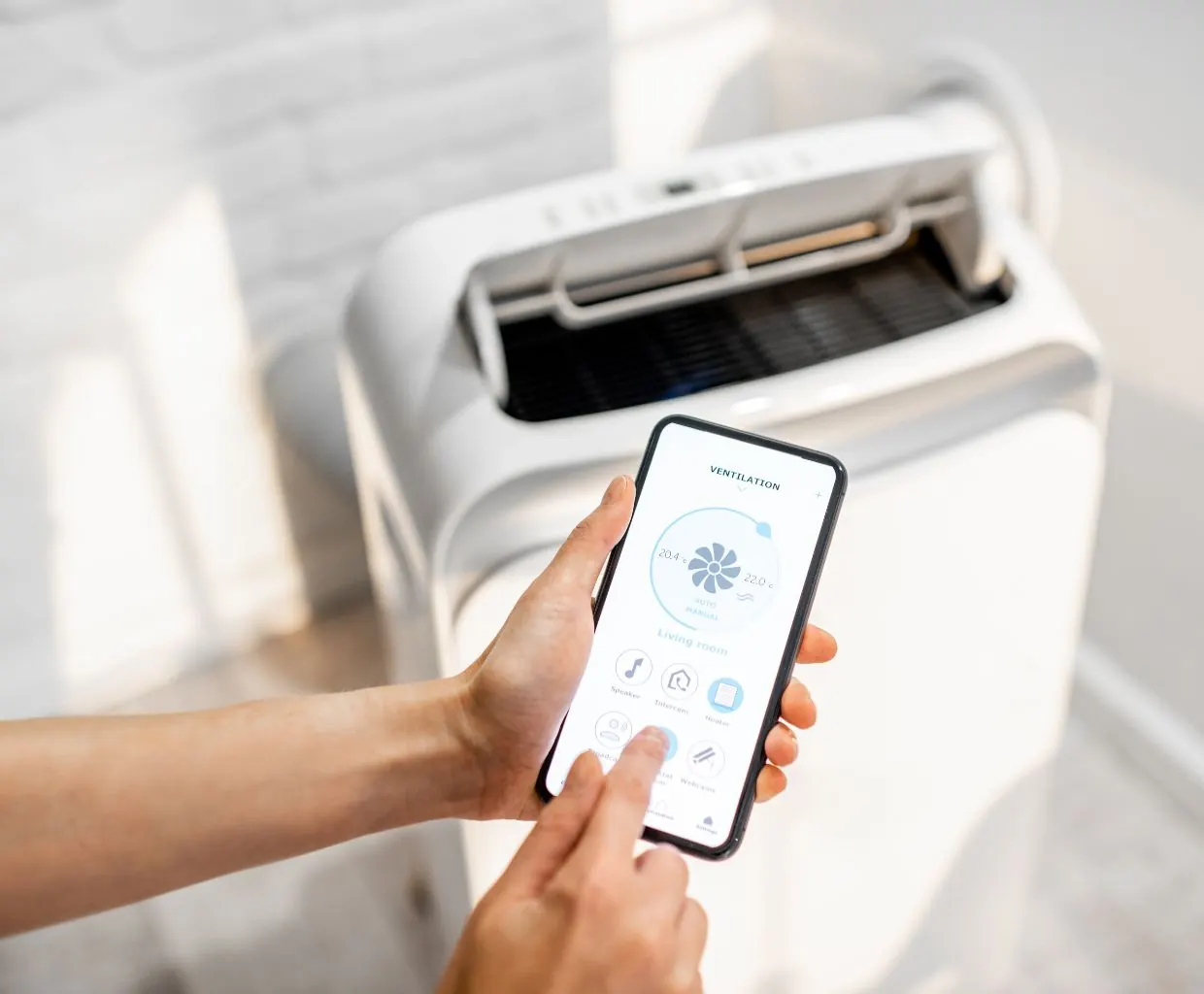
Yes, you can run an air purifier and a humidifier together, and in a dry winter it’s a sensible pair. The purifier filters particles such as dust, pollen and pet dander; the humidifier adds moisture. To make them work well side by side, keep humidity between 30% and 50%, give each machine its own space, choose a humidifier that doesn’t throw minerals into the air, and stick to a cleaning schedule.
Why the two machines work well together
An air purifier and a humidifier solve different problems, which is why they don’t compete. Our air purifier vs humidifier comparison covers each one in detail. In short:
- The purifier moves room air through filters. EPA says portable air cleaners are rated by CADR for smoke, dust and pollen, and that particle filters don’t remove gases unless the unit also has activated carbon.
- The humidifier raises relative humidity (RH). It doesn’t clean the air, and CPSC warns that a dirty one can release bacteria and fungi from its tank in the mist.
None of the EPA, CPSC or manufacturer guidance in our research warns against running both in one room. The risks come from the humidifier side: too much moisture, dirty water and mineral dust. Handle those and the pair is straightforward.
Step 1: Set a humidity ceiling
EPA recommends keeping indoor humidity ideally between 30% and 50%, and its humidifier fact sheet says not to humidify above 50%, because higher levels may encourage biological growth. MedlinePlus suggests setting a humidifier to 40% to 50%.
- Use a humidifier with a built-in humidistat, or a separate hygrometer, so the unit stops at your target.
- If water condenses on windows, walls or pictures, EPA says to move the humidifier, lower its setting or run it less.
- If you or someone at home is allergic to dust mites, stay well under 50%; see our guide to dust mites and humidity for why.
One extra reason not to overdo it: EPA’s technical summary notes that activated carbon adsorbs gases better at lower temperature and humidity. If you rely on your purifier’s carbon filter for odors, that’s another point in favor of a moderate setting. We’d start around 40% in winter and only go higher if the air still feels dry and the windows stay clear. Our guide on how to check humidity in your house explains how to get a trustworthy reading.
Step 2: Place them apart
No agency gives a required distance between a purifier and a humidifier, so the practical rules come from humidifier manuals and health guidance:
- Firm, flat, waterproof surface. HoMedics says to use a firm, flat surface with a waterproof mat underneath, never a rug or carpet.
- Space from walls and furniture. Vicks says to place its units 1 to 3 feet from walls, furniture and curtains, out of the way of foot traffic.
- Off the floor. Crane recommends at least 2 feet off the ground so mist can disperse before it falls.
- Aim the output into open air. Honeywell’s manual says not to aim it at people, walls or furniture.
- Away from the bed. MedlinePlus suggests several feet (about 2 meters) from the bed.
- Keep the area dry. EPA says not to let carpets, drapes or tablecloths around a humidifier get damp.
We’d put the two machines on opposite sides of the room, with the humidifier’s mist pointed away from the purifier’s intake. We haven’t found a manufacturer statement either way on what mist does to a purifier filter, so the simple precaution is to keep the purifier out of the damp zone, the same way you would furniture. Our guides to where to put a humidifier and where to put an air purifier cover each machine in more depth.
Tip: Keep the hygrometer out of the mist plume too. Levoit’s manual says a humidifier’s humidity reading can be wrong if moisture builds up on its sensor, and suggests pointing the nozzle away from it.
Step 3: Choose a humidifier that won’t add mineral dust
Humidifier type matters more when a purifier is running in the same room, because you’re trying to lower particles, not add them. EPA says ultrasonic and impeller humidifiers generally disperse the most minerals and microorganisms from the tank, and some users notice a “white dust” on surfaces. CPSC says that dust may contain particles small enough to enter the lungs, and that the health effects aren’t clear.
EPA says evaporative units and steam vaporizers generally disperse less of these pollutants, if any, and aren’t expected to disperse substantial amounts of minerals. If you use an ultrasonic model, EPA recommends bottled water labeled “distilled.” In our view, an evaporative humidifier is the cleanest match for a room where a purifier is already working. Our guide to humidifier white dust explains the options, including demineralization cartridges.
Important: Warm-mist and steam units can burn. EPA says to keep steam vaporizers out of children’s reach, and MedlinePlus advises cool mist, especially for children. If anyone at home has asthma or allergies, talk to your doctor before adding a humidifier, and stop using it and see a physician if you notice breathing symptoms you link to it, as EPA advises.
Step 4: Keep both machines clean
A clean humidifier is what keeps the pairing safe. CPSC says bacteria and fungi often grow in humidifier tanks and can be released in the mist. Here’s the routine from the sources we rely on:
| Task | How often | Source |
|---|---|---|
| Empty the humidifier tank, wipe dry, refill | Daily (portable units) | EPA; CDC also says to empty humidifiers every day |
| Clean the tank and remove scale or film | Every third day (portable units) | EPA |
| Disinfect water-contact surfaces | With the maker’s cleaner, or 3% hydrogen peroxide if none is specified; rinse well | EPA |
| Replace humidifier wicks | Per the maker; Honeywell says every 30 to 60 days for its evaporative wicks | Honeywell |
| Replace air purifier filters | Per the maker’s interval or filter indicator | Manufacturer manuals |
| End of season | Clean, dry fully, discard used demineralization cartridges, store dry | EPA |
Our step-by-step guide on how to clean a humidifier covers vinegar descaling and disinfecting, and our guide on how often to change an air purifier filter covers the purifier side.
Common mistakes to avoid
Most problems with this setup trace back to a few habits. Each of these comes straight from EPA, CPSC or humidifier manuals:
- Letting the humidifier run without a ceiling. Without a humidistat or hygrometer, it’s easy to pass EPA’s 50% limit, especially in a small, closed room. Honeywell’s manual says to check ventilation in closed or small rooms because excess humidity can cause condensation stains on walls.
- Using spring or mineral water in an ultrasonic unit. EPA says water labeled “spring,” “artesian” or “mineral” hasn’t been treated to remove minerals, so it’s no substitute for distilled water.
- Leaving water standing. CDC says germs can live in humidifiers and spread through the mist, and advises emptying them every day.
- Setting the humidifier on carpet. HoMedics says never to place it on a rug or carpet, and Crane notes that carpet fibers can block the fan vent.
- Adding essential oils to the tank. HoMedics and Levoit manuals both say not to, because oils can damage the unit; Levoit allows them only on the separate aroma pad.
When a 2-in-1 combo makes sense
If floor space or outlets are tight, one machine can do both jobs. The current US combos in our research all humidify by evaporation (a wick, filter or evaporator) rather than spraying visible mist:
| Model | Purifier rating | Humidifier | Humidity control | Worth knowing |
|---|---|---|---|---|
| Sharp KCP110UW | Smoke CADR 347, 538 sq ft (AHAM) | Evaporative, about 0.53 gal tray | Auto mode; no user-set target | Plasmacluster ionizer can’t be turned off |
| Sharp KCP70UW | Smoke CADR 255, 396 sq ft (AHAM) | Evaporative; tank size not published | Auto mode; no target setting stated | Includes a Plasmacluster ionizer |
| Blueair 2-in-1 DH3i | Smoke CADR 232, 360 sq ft (AHAM) | Evaporative wick, 0.79 gal tank | Target humidity set in the app | Filters and wick every 6 months |
| Dyson PH2 De-NOx | No AHAM CADR published | Evaporator with UV-C, 1 gal tank | Auto mode aims for a comfortable humidity | HEPA + K-Carbon filter yearly |
| Afloia Kilo Pro | Maker figure only, not AHAM | Evaporative wick module, 0.5 gal tank | No humidistat | Humidifier can’t run without the purifier |
The trade-off is humidifying power. Afloia rates its module at 150 mL per hour, which works out to about 0.95 gallons a day at maximum, and Sharp’s KCP110UW manual figure converts to about 2.1 gallons a day at maximum. A dedicated humidifier can be sized to the room on its own; our humidifier size calculator helps with that. We’d choose two separate machines for a large or open-plan room and a combo for a bedroom or small living room. Our roundup of the best air purifier and humidifier combos compares these models in detail.
Frequently asked questions
Can you use an air purifier and a humidifier in the same room?
Yes. They do different jobs: the purifier filters particles, the humidifier adds moisture. Keep humidity between 30% and 50%, as EPA recommends, and clean the humidifier on schedule.
How far apart should an air purifier and a humidifier be?
No agency sets a distance for the pair. Humidifier makers give their own spacing, such as Vicks' 1 to 3 feet from walls, furniture and curtains, and we'd keep the mist from blowing toward the purifier, just as Honeywell says not to aim it at walls or furniture.
Will a humidifier damage my air purifier's filter?
We found no EPA, CPSC or manufacturer statement that says it does. The sensible precautions are the ones EPA gives anyway: don't let the area around the humidifier get damp, and don't humidify above 50%.
What humidity should I set when running both?
EPA recommends 30% to 50% indoors and says not to humidify above 50%. If you see condensation on windows, walls or pictures, lower the setting, move the humidifier or run it less.
Is a 2-in-1 combo better than two separate machines?
A combo saves floor space and one plug, and the US combos in our research all humidify by evaporation, without visible mist. Two separate machines let you size each job on its own, which usually matters more in large rooms.
Related guides
Combos
Air Purifier vs Humidifier: What Each Does and Which One You Need
An air purifier removes particles from the air; a humidifier adds moisture. Here's which one helps with allergies, pets, dry air and colds, and how to run both.
7 min read
Combos
Best Air Purifier and Humidifier Combos in 2026: 6 Real 2-in-1s Compared
Six 2-in-1 units sold in the US that both filter and humidify, with verified CADR where it exists, real humidifier output and the trade-offs.
10 min read
Combos
Sharp KCP110UW Review: CADR, Humidifier Output, Plasmacluster and Rivals
A research-based look at the Sharp KCP110UW purifier-humidifier: AHAM CADR, 538 sq ft, real humidifying output, the small tray, Plasmacluster ions, filters and alternatives.
8 min read
Combos
Dyson Purifier Humidify+Cool Review: PH2 De-NOx Specs, Filters and Caveats
A research-based look at the Dyson PH2 De-NOx: filters, 1-gallon tank, UV-C, Deep clean, the numbers Dyson doesn't publish, and how it compares.
9 min read