Where to Put a Humidifier: Best Spot in the Bedroom and Every Room
Put it in the room you use most, on a firm, waterproof surface a few feet from the bed, walls and curtains, with the mist aimed into open air. Here's what manuals say.
By Clean Air Guides editorial teamUpdated 7 min read
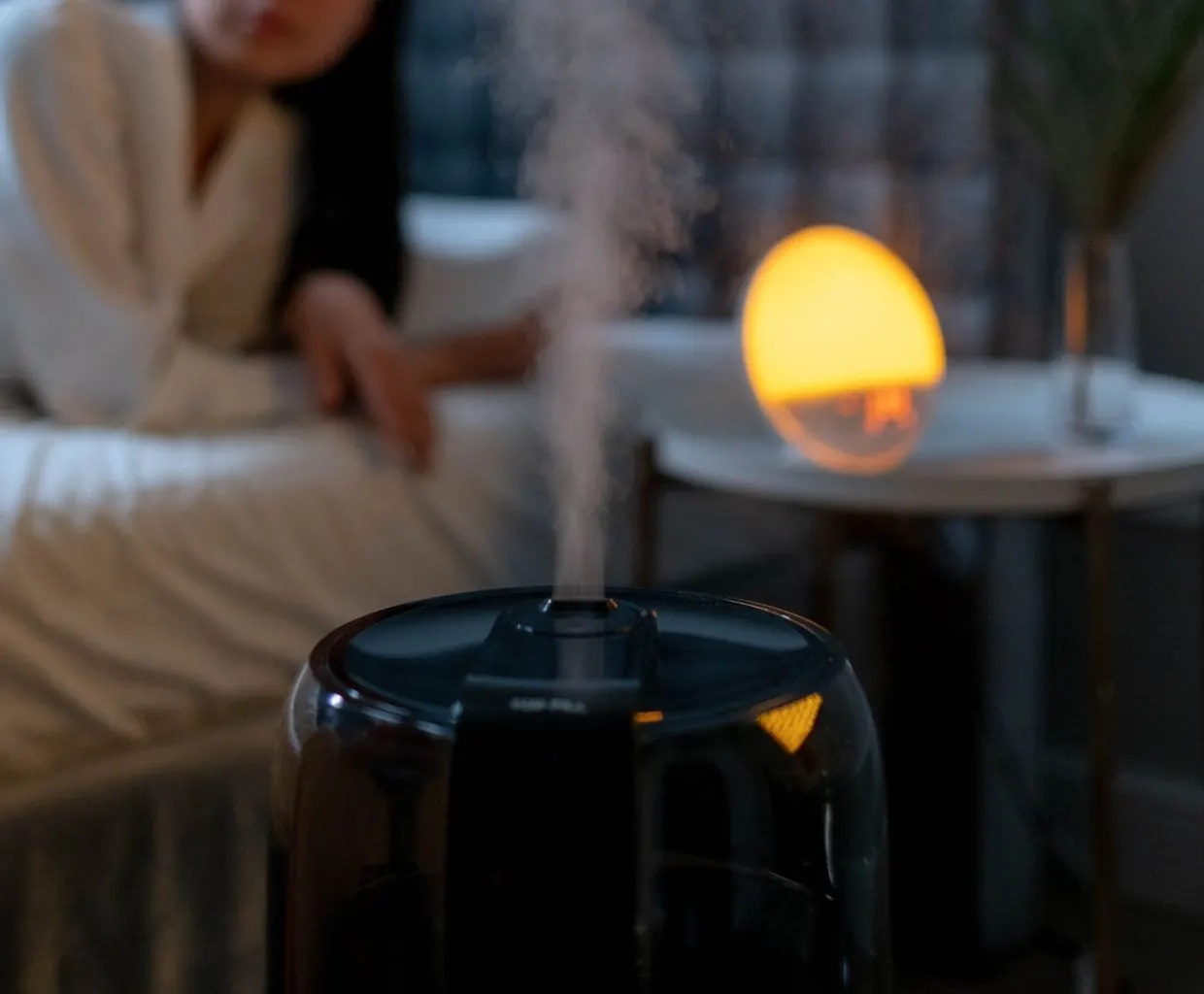
Put your humidifier in the room where you spend the most time, usually the bedroom, on a firm, flat, waterproof surface. Keep it several feet from the bed and 1 to 3 feet from walls, furniture and curtains, with the mist rising into open air rather than onto anything. Keep it out of reach of children and pets, off carpet, and away from electronics, books and wood finishes. Your manual has the final word, because makers disagree on details like height.
Quick placement checklist
- Room: the one you use most, usually the bedroom, and sized to the unit’s stated coverage.
- Distance from the bed: several feet (MedlinePlus); more for warm-mist and steam units.
- Distance from walls, furniture and curtains: 1 to 3 feet (Vicks).
- Surface: firm, flat and level, with a waterproof mat or tray under it; never carpet or a towel.
- Height: follow your manual; Crane says at least 2 feet off the ground.
- Keep away: electronics, paper, books, wood finishes, windows and smoke alarms.
- Kids and pets: out of reach, where the unit and its cord can’t be tripped over or knocked down.
- Check the result: a hygrometer across the room, not in the mist.
Which room should it go in?
A portable humidifier only treats the room it sits in, so start with the room where dry air bothers you most. For most people that’s the bedroom, where a humidifier runs for hours while you sleep. If dry air mainly bothers you in the living room during the day, that’s the better spot.
Match the room to the unit. Manufacturers state an effective range for each model: Levoit lists 215 to 505 sq ft for the Classic 300S, for example, and says a room larger than the range can make the built-in humidity reading wrong. Our humidifier size calculator helps you check whether a unit fits your room. If you’re still shopping, our best humidifier for the bedroom guide compares quiet models by room size.
Closed, small rooms need more care. Honeywell’s HCM-350 manual says to check ventilation periodically in a closed or small room, because too much humidity can cause condensation stains on walls. Crane goes further and says to keep the door cracked for better airflow. We cover the trade-offs in should you close the door when using a humidifier.
How far from the bed, walls and furniture?
Official guidance gives a fairly consistent picture:
| Source | Distance | Surface and other advice |
|---|---|---|
| MedlinePlus | Several feet (about 2 m) from the bed | Use a cool-mist unit, especially for children |
| CHOP | About 3 ft between the humidifier and a child | Cool mist recommended (AAP, as reported by CHOP) |
| Vicks support FAQ | 1 to 3 ft from walls, furniture and curtains | Not where it can be tripped over; out of reach of pets and children |
| Vicks V150 steam vaporizer | At least 4 ft from the bedside | Firm, flat, heat-resistant, waterproof surface |
| Vicks V750 warm mist | At least 12 in from walls | Firm, level spot; don’t move it while running |
| Crane | At least 2 ft off the ground | Not directly on wood; waterproof barrier underneath |
| HoMedics manuals | Not on furniture (UHE-WM130, UHE-CMTF91) | Firm, flat surface; waterproof mat; never on rug or carpet |
Why the space matters: mist that lands on a nearby wall, curtain or headboard stays there. The EPA says not to let the area around a humidifier become damp or wet, and not to let carpets, drapes or tablecloths get damp. If they do, it says to turn the output down or run the unit on and off. Honeywell also says not to aim the output at people, walls or furniture.
Tip: Crane’s rule of thumb works for any visible-mist unit: set the output so you can see the mist rise, but not fall back down onto the surface.
How high off the floor?
This is where manufacturers disagree. Crane recommends putting its units at least 2 feet off the ground so the mist can disperse before it falls; too close to the floor and you can end up with a puddle. HoMedics, on the other hand, says in its UHE-WM130 and UHE-CMTF91 manuals not to place the unit on furniture, and to use a waterproof mat on wood floors.
In our view, the safest approach is to follow the manual for your exact model. Both makers agree on the part that matters most: a firm, flat surface with a waterproof barrier under it. If your unit is meant to sit up high, a sturdy table or dresser with a tray or mat works. If it’s meant for the floor, use a hard floor with a mat, not carpet.
What to keep away from a humidifier
- Carpet, rugs and towels. HoMedics says never to place its units on a rug or carpet. Crane and Levoit add that carpet or towel fibers can block the air inlet or fan vent, which can cut mist output.
- Wood furniture and floors. Crane says not to set its humidifiers directly on wood. HoMedics says never on a finish that water can damage.
- Electronics, paper and books. Pure Enrichment says to keep them away from the unit so water particles don’t damage them.
- Windows and cold outside walls. Honeywell lists a unit that’s too close to a wall or window as a cause of condensation. The EPA says that if water condenses on windows, walls or pictures, move the humidifier, lower its humidistat setting or use it less. Our guide to condensation on windows explains why cold glass gets wet first.
- Smoke alarms. Kidde, a smoke alarm maker, says high humidity, steam and condensation can sometimes cause false alarms. If that happens, we’d move the humidifier farther from the alarm rather than touch the alarm itself.
- Its own humidity sensor. Levoit says moisture on the sensor can cause a wrong reading, and to point the nozzle away from it.
Ultrasonic units also leave mineral “white dust” on nearby surfaces when you use tap water, which is one more reason to keep them away from electronics. See our guide to humidifier white dust for fixes.
Keeping the floor and furniture dry
A wet ring around the unit usually comes from placement or settings, not a broken humidifier. Levoit’s manuals say to use a flat, level surface, not to shake the unit, and to wipe excess water off the top and bottom of the base. Crane’s leak FAQ says the mist setting may be too high for the space, and to carry the tank and base separately when moving it. HoMedics says to unplug the unit when filling or moving it, and that a small amount of water in the base is normal.
Pure Enrichment suggests a waterproof mat or tray under the unit, such as a placemat or a pet food mat. We’d use one under any visible-mist humidifier on furniture or a wood floor. If water keeps appearing, our guide to why your humidifier is leaking walks through the causes by brand.
Important: Don’t move a humidifier with a full tank on the base. Crane and TaoTronics manuals say it can leak or overfill the base; Vicks says to unplug a warm-mist unit and wait 20 to 30 minutes before moving it.
Placement with kids and pets
Children and pets change the rules. The EPA says to keep steam vaporizers out of children’s reach because steam and boiling water can cause burns. MedlinePlus and Mayo Clinic advise cool-mist humidifiers for children, and CHOP suggests about 3 feet between the humidifier and the child. Vicks says to keep units out of reach of pets and children and where they can’t be tripped over. Our guide to the best humidifier for a baby covers nursery models.
For dogs and cats, the main placement risks are a knocked-over unit and hot water from warm-mist models. Our article on whether humidifiers are safe for dogs covers this in more detail. If you add scent, read essential oils in a humidifier first: most makers forbid oils in the tank, and several oils are toxic to pets.
We’d also route the cord along a wall so nobody, child or pet, can pull the unit down by it.
Check the humidity, not just the spot
Placement is only half the job. The EPA says not to humidify above 50% relative humidity, and the EPA and CPSC recommend keeping homes between 30% and 50%. A hygrometer, sold at hardware stores, tells you where you stand.
Put the hygrometer away from the humidifier, ideally across the room. A hygrometer sitting in the mist reads the plume, not the room, much like Levoit’s warning about moisture on its own built-in sensor. Our guide on how to check humidity in your house explains how to read one and which targets to aim for by season.
If the reading climbs past 50% or windows start to fog, lower the output or move the unit farther from the glass before you do anything else.
Frequently asked questions
How far should a humidifier be from your bed?
MedlinePlus says to keep it several feet (about 2 meters) from the bed. Vicks says at least 4 feet from the bedside for its V150 steam vaporizer, so warm-mist and steam units need even more room.
Should a humidifier be on the floor or on a table?
It depends on the model, so check your manual. Crane recommends at least 2 feet off the ground so the mist can spread before it falls, while some HoMedics manuals say to keep the unit off furniture and use a waterproof mat on wood floors.
How far should a humidifier be from the wall?
Vicks says 1 to 3 feet from walls, furniture and curtains, and its V750 manual gives at least 12 inches from walls. Honeywell lists a unit placed too close to a wall or window as a cause of condensation.
Can I put a humidifier on carpet?
Most manuals say no. HoMedics says never on a rug or carpet, and Crane and Levoit warn that carpet or towel fibers can block the air inlet or fan vent.
Can I put a humidifier on a wood dresser or nightstand?
Only with a waterproof barrier underneath. Crane says not to set its humidifiers directly on wood and to use a plastic, tile or glass mat, and HoMedics recommends a waterproof mat or pad.
Where should a humidifier go in a child's room?
Out of reach and away from the crib or bed. CHOP advises keeping about 3 feet between the humidifier and the child, and the EPA says to keep steam vaporizers out of children's reach because of burns.
Related guides
Humidifiers
Why Is My Humidifier Making the Room Foggy? Causes and Fixes
A little mist above the nozzle is normal. A haze that fills the room means too much output, air near its dew point or tap-water minerals. Here's the fix.
6 min read
Humidifiers
Why Is My Humidifier Leaking? Causes, Fixes and When to Stop
A loose cap seal, a cracked tank, moving it while full or mist set too high: how to find where your humidifier is leaking and fix it safely.
7 min read
Humidifiers
Should You Close the Door When Using a Humidifier?
Closing the door makes a humidifier work faster but raises the risk of overshooting and wet windows. When to close it, and safe settings for the night.
5 min read
Humidifiers
Best Humidifiers for a Baby in 2026: Cool Mist, Quiet and Easy to Keep Clean
Four cool-mist and evaporative humidifiers for a nursery, picked from maker specs and manuals, plus the humidity range, water, cleaning and placement rules.
9 min read