Dyson Purifier Humidify+Cool Review: PH2 De-NOx Specs, Filters and Caveats
A research-based look at the Dyson PH2 De-NOx: filters, 1-gallon tank, UV-C, Deep clean, the numbers Dyson doesn't publish, and how it compares.
By Clean Air Guides editorial teamUpdated 9 min read
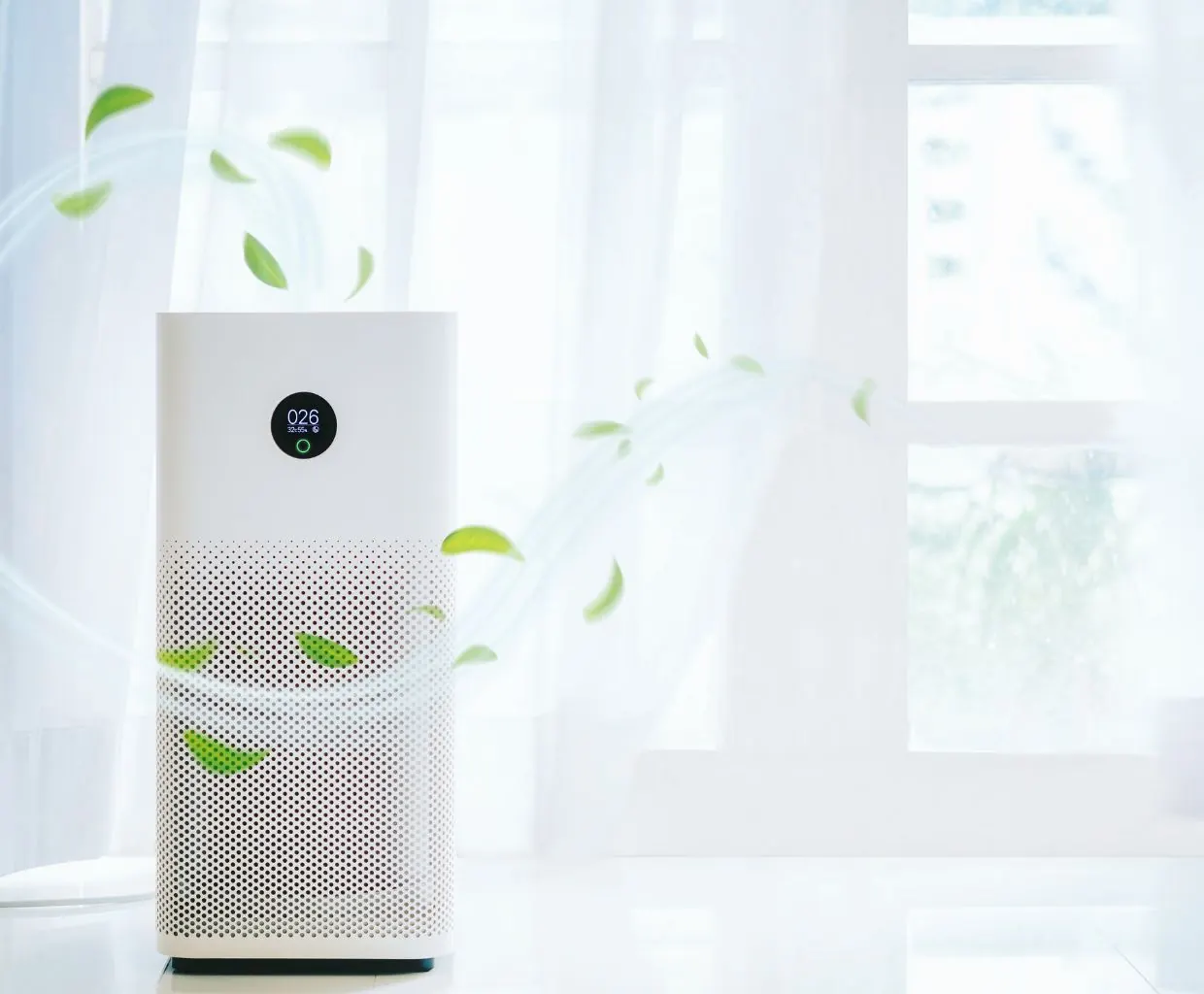
Our picks at a glance
- Check price on Amazon
The Dyson reviewed here
Dyson Purifier Humidify+Cool PH2 De-NOx
Purifier, humidifier and fan in one smart tower, with a sealed HEPA + K-Carbon filter and a UV-C water cleanse.
- No AHAM CADR published
- 1-gallon tank
- Filter every 12 months
- Check price on Amazon
Combo with verified numbers
The largest AHAM-rated room size among the combos in our research, plus a published humidifying output.
- CADR 347 smoke (AHAM)
- 538 sq ft (AHAM)
- About 2.1 gal/day max
- Check price on Amazon
Mid-price combo
Blueair 2-in-1 Purify + Humidify DH3i
AHAM-listed CADR and a humidity target you set in the app, for well under half the Dyson's price.
- CADR 232 smoke (AHAM)
- 360 sq ft (AHAM)
- 3 L tank
Prices change often; Amazon shows the current price. As an Amazon Associate, Clean Air Guides earns from qualifying purchases.
The Dyson Purifier Humidify+Cool PH2 De-NOx is an air purifier, humidifier and cooling fan in one tall tower, and it’s the only humidifier Dyson now sells in the US. It suits people who want one sealed, app-controlled machine and are willing to pay around $1,100 for it. The catch is that Dyson publishes no AHAM CADR, no humidifying output and no room size, so you can’t size it the way you’d size other units. If you want verified numbers, the Sharp KCP110UW or a separate purifier and humidifier give you more for less.
This review is research-based. We didn’t run the machine ourselves: every figure below comes from Dyson’s US product and support pages, Dyson’s user manuals, the AHAM Verifide directory and EPA guidance, checked in October 2026.
Dyson PH2 De-NOx specs at a glance
| Spec | Dyson Purifier Humidify+Cool PH2 De-NOx | Source |
|---|---|---|
| Status | Current; White/Gold and Nickel/Gold | Dyson US shop |
| Price | Around $1,100 list | Dyson US shop |
| CADR | Not published; not in the AHAM directory | AHAM, Dyson |
| Room size | No sq ft figure; Dyson says “whole room” | Dyson |
| Filters | Sealed 360° Combi HEPA + K-Carbon, plus a catalytic formaldehyde filter | Dyson |
| Filter life | HEPA + K-Carbon every 12 months (12 h a day); catalytic filter never | Dyson |
| Humidifying output | Not published | Dyson |
| Tank | 1 gallon, up to 36 hours in fan mode 1 | Dyson |
| Water treatment | UV-C (275 nm) cleanse before the evaporator | Dyson |
| Size and weight | 36.3 in tall, 17.9 lb, 10 fan speeds | Dyson |
| Smart features | MyDyson app, Matter compatible | Dyson |
| Noise | Not published | n/a |
What the PH2 De-NOx does well
A sealed, long-life filter. Dyson describes a fully sealed three-stage system: a 360° Combi HEPA + K-Carbon filter, which it says captures 99.97% of particles at 0.3 micron, plus a catalytic formaldehyde filter that never needs replacing. The main filter lasts 12 months at 12 hours a day, and the screen and app tell you when it’s due.
A gas filter that goes beyond plain carbon. EPA’s technical summary says ordinary activated carbon removes many hydrocarbons and odors but is not especially effective against formaldehyde or nitrogen oxide. Dyson’s answer is two extra stages: carbon impregnated with potassium carbonate (the “K-Carbon” aimed at nitrogen dioxide, or NO2) and the catalytic formaldehyde filter. These are Dyson’s own claims. EPA notes that no widely used rating system like CADR exists for gas removal by portable air cleaners, so there’s no independent number to compare. For the basics of particle and gas filters, see HEPA vs carbon filters.
Three jobs in one footprint. It purifies, humidifies and works as a cooling fan, and you can switch humidification off to run it as a purifier fan in summer. In Auto mode it monitors the room and adjusts airflow to reach what Dyson calls “the most comfortable humidity level”, which it says varies with temperature. A sensor spots an empty tank and the screen prompts a refill.
No mist. Water passes a UV-C (275 nm) cleanse and then an evaporator, so the moisture leaves as vapor rather than a visible mist. Dyson doesn’t use the word “evaporative”, but EPA says evaporative designs are not expected to spread substantial amounts of minerals, unlike ultrasonic units. So you shouldn’t see the white dust that mist humidifiers can leave on furniture. The UV lamp’s 275 nm wavelength is also above the 254 nm-and-below range that EPA says can create ozone unless the lamp is coated.
The numbers Dyson doesn’t publish
Dyson is not in the AHAM Verifide directory (a search for “Dyson” returned no results in October 2026), and it publishes no clean air delivery rate. Its own performance claims use Dyson test methods and EN 1822 / ASTM F3150 particle challenges, which are not CADR. So you can’t put it next to an AHAM-rated purifier and compare, or run it through our air purifier size calculator. Our explainer on what CADR is shows why that number matters for sizing.
The humidifier side has the same gap:
- No output rate. Dyson gives no mL per hour or gallons per day, only a runtime of up to 36 hours on the one-gallon tank in fan mode 1. A runtime at the lowest fan speed is not an output figure, so we don’t convert it into one.
- No room size. Dyson says it “purifies and hygienically humidifies the whole room”, with a footnote that purification coverage was tested in Auto mode. There’s no square-foot figure for either job.
- No humidity target. Auto mode picks the “most comfortable” level for you. Dyson doesn’t publish a percentage you can set.
- No noise rating. Dyson’s product page lists none.
Important: Without a set point, keep an eye on room humidity yourself. EPA advises against humidifying above 50%, and a cheap hygrometer will tell you where you are. Our guide on how to check humidity in your house covers the options.
In our view, the missing CADR is the biggest drawback at this price. A purifier around a tenth of the cost can show you an independently verified number; the Dyson asks you to take its word.
Cleaning and running costs
There’s no wick or humidifier filter to buy. Instead, limescale on the evaporator is removed by a Deep clean cycle that you start from the machine. Dyson’s owner page calls it monthly, but how often depends on the water hardness you set in the MyDyson app: monthly prompts in hard-water areas, fewer in soft-water areas. The PH03 manual (the PH04 has the same text) walks through it:
- Press the Deep clean button and remove the outer covers; the inner door opens.
- Take out the evaporator and place it in the tank.
- Fill the tank halfway to Max with cold tap water, add 150 g of citric acid and stir until it dissolves, then fill to Max.
- Refit the tank until it clicks and press Deep clean when prompted. The screen shows a countdown.
- Rinse the evaporator and tank under a cold tap, wipe out any remaining solution, refill and refit.
The manuals add that you should run an extra cycle before and after long breaks from humidifying, that Dyson recommends filtered water for best performance, and that the tank cap holds power connections, so it must stay dry and never be washed. Dyson also sells a cleaning kit (part 970919-01) made for the cycle. Our step-by-step guide on how to clean a humidifier covers the daily routine EPA recommends for any unit.
Ongoing costs, then, are one HEPA + K-Carbon filter a year plus citric acid. We didn’t find a replacement part number or filter price on the Dyson pages in our research, so check the price before you buy.
Older Dyson models: PH01 to PH04
If you’re shopping secondhand or on clearance, you’ll see older model codes. All of these appear only on Dyson’s US support pages now:
| Model | Name | Status in the US |
|---|---|---|
| PH01 | Pure Humidify+Cool | Support pages only |
| PH02 | Pure Humidify+Cool Cryptomic | Support pages only |
| PH03 | Purifier Humidify+Cool | Support pages only |
| PH3A | Purifier Humidify+Cool Autoreact | Support pages only |
| PH04 | Purifier Humidify+Cool Formaldehyde | Support pages only |
| PH2 De-NOx | Purifier Humidify+Cool | Current (Dyson US shop) |
Dyson says the PH2 De-NOx has “all of the capabilities” of the Formaldehyde models plus the K-Carbon NO2 filter, so it’s effectively the PH04’s successor. There’s no “Autoreact PH2”; the Autoreact code is PH3A. The older models use the same 150 g citric-acid Deep clean. For the PH01, the manual lists a 2-year parts and labor warranty that excludes filters and the evaporator; we didn’t verify the PH2’s warranty terms. We found no CPSC recall for any Dyson humidifier (the only Dyson recall in the database is for heaters in 2014).
We wouldn’t pay close to new-model money for a discontinued PH03 or PH04, since Dyson’s US shop no longer lists them.
How the Dyson compares
| Option | Smoke CADR | Room size | Humidifying output | Price band |
|---|---|---|---|---|
| Dyson PH2 De-NOx | Not published | “Whole room” | Not published | Around $1,100 |
| Sharp KCP110UW | 347 (AHAM) | 538 sq ft (AHAM) | About 2.1 gal/day at max (our conversion) | Around $580 |
| Blueair DH3i | 232 (AHAM) | 360 sq ft (AHAM) | Not published | Around $430 |
| Levoit Vital 200S-P + Superior 6000S | 250 (AHAM) | 388 sq ft (AHAM) | About 9.5 gal/day at max (our conversion) | Around $440 together |
Dyson PH2 De-NOx
Best for: buyers who want one sealed smart tower that also cools in summer, and care about formaldehyde and NO2 filtering.
We’d only choose it if the all-in-one design is the point: you get the sealed filter, UV-C water cleanse and no wick, but no verified way to size it. Check the Dyson PH2 De-NOx on Amazon
Sharp KCP110UW
Best for: larger rooms where you want AHAM-verified purifying and a published humidifying rate.
The AHAM directory lists 347 cfm of smoke CADR and a 538 sq ft room size. Sharp’s manual rates humidifying at 0.70 pints an hour on max under Japan’s JEM1426 test, about 2.1 gallons a day if it ran nonstop (our conversion). The trade-offs: a 0.53-gallon tray that needs daily fresh water, no humidity set point, and Plasmacluster ions that can’t be switched off. Filters last up to 2 years. Our full Sharp KCP110UW review has the details. Check the Sharp KCP110UW on Amazon
Blueair DH3i
Best for: bedrooms and living rooms up to about 360 sq ft on a mid-range budget.
The Blueair 2-in-1 Purify + Humidify DH3i has an AHAM-listed 232 cfm smoke CADR and, unlike the Dyson, lets you set a target humidity in the app. Its tank is 3 L, it’s rated at 24 to 52 dB, and both the filters and the wick are replaced every 6 months, so running costs are higher than the Sharp’s. Blueair’s HEPASilent filtration combines electrostatic charging with a mechanical filter. Check the Blueair DH3i on Amazon
Or buy two machines. A Levoit Vital 200S-P purifier (AHAM 250 smoke CADR, 388 sq ft, around $190) plus a Levoit Superior 6000S evaporative humidifier (1,500 mL/h maximum, 6-gallon tank, around $250) costs well under half the Dyson’s price. See our Levoit Superior 6000S review and the pros and cons of running an air purifier and humidifier together.
Who should buy the Dyson PH2 De-NOx
Buy it if:
- You want one machine that purifies, humidifies and cools, and floor space or looks matter more than price.
- You like app control and smart-home integration (MyDyson, Matter).
- You’d rather run a monthly Deep clean than buy wicks or humidifier filters.
Skip it if:
- You want to size a purifier by CADR or a humidifier by gallons per day.
- You need a humidity set point, or a humidifier for a big, dry room.
- Your budget is under about $600; the combos and two-machine setups above have verified numbers for less.
Our pick for most people is still a combo with an AHAM rating; our roundup of the best air purifier and humidifier combos ranks the Dyson against the rest. Whatever you choose, aim for 30% to 50% indoor humidity, as EPA advises; our guide to ideal indoor humidity explains why.
Frequently asked questions
Is the Dyson Purifier Humidify+Cool worth it?
Only if you value one smart, sealed machine over verified numbers. It costs around $1,100, and Dyson publishes no AHAM CADR, humidifying output or room size, so AHAM-rated combos or a separate purifier and humidifier give you more measurable performance for less.
How big a room does the Dyson Purifier Humidify+Cool cover?
Dyson doesn't give a square-foot figure. It says the machine purifies and humidifies 'the whole room', and the model isn't in the AHAM Verifide directory, so there's no AHAM suggested room size.
How often do you change the Dyson Purifier Humidify+Cool filter?
Dyson says to replace the 360° Combi HEPA + K-Carbon filter every 12 months, based on 12 hours of use a day. The catalytic formaldehyde filter never needs replacing, and the screen and MyDyson app tell you when the main filter is due.
How do you clean a Dyson humidifier?
Run the Deep clean cycle when the machine prompts you, about monthly in hard-water areas. You dissolve 150 g of citric acid in the half-filled tank, put the evaporator in it, top up to Max and let the cycle run, then rinse.
How long does the Dyson tank last?
Dyson says up to 36 hours on a full one-gallon tank in fan mode 1. Higher fan speeds use water faster, and Dyson doesn't publish an output rate.
Which Dyson humidifier models are discontinued?
The PH01, PH02, PH03, PH3A (Autoreact) and PH04 (Formaldehyde) now appear only on Dyson's US support pages. The PH2 De-NOx in two colorways is the only humidifier in Dyson's US shop.
Related guides
Combos
Best Air Purifier and Humidifier Combos in 2026: 6 Real 2-in-1s Compared
Six 2-in-1 units sold in the US that both filter and humidify, with verified CADR where it exists, real humidifier output and the trade-offs.
10 min read
Combos
Sharp KCP110UW Review: CADR, Humidifier Output, Plasmacluster and Rivals
A research-based look at the Sharp KCP110UW purifier-humidifier: AHAM CADR, 538 sq ft, real humidifying output, the small tray, Plasmacluster ions, filters and alternatives.
8 min read
Combos
Using an Air Purifier and Humidifier Together: How to Set Them Up
Yes, you can run both in one room. Keep humidity at 50% or below, give each machine its own space, and keep the humidifier clean.
7 min read
Combos
Air Purifier vs Humidifier: What Each Does and Which One You Need
An air purifier removes particles from the air; a humidifier adds moisture. Here's which one helps with allergies, pets, dry air and colds, and how to run both.
7 min read