How to Use a Humidifier: Setup, Settings, Water and Daily Care
Set it on a flat, waterproof spot, fill it with the right water, aim for 30–50% humidity and empty it every day. A step-by-step guide from setup to storage.
By Clean Air Guides editorial teamUpdated 8 min read
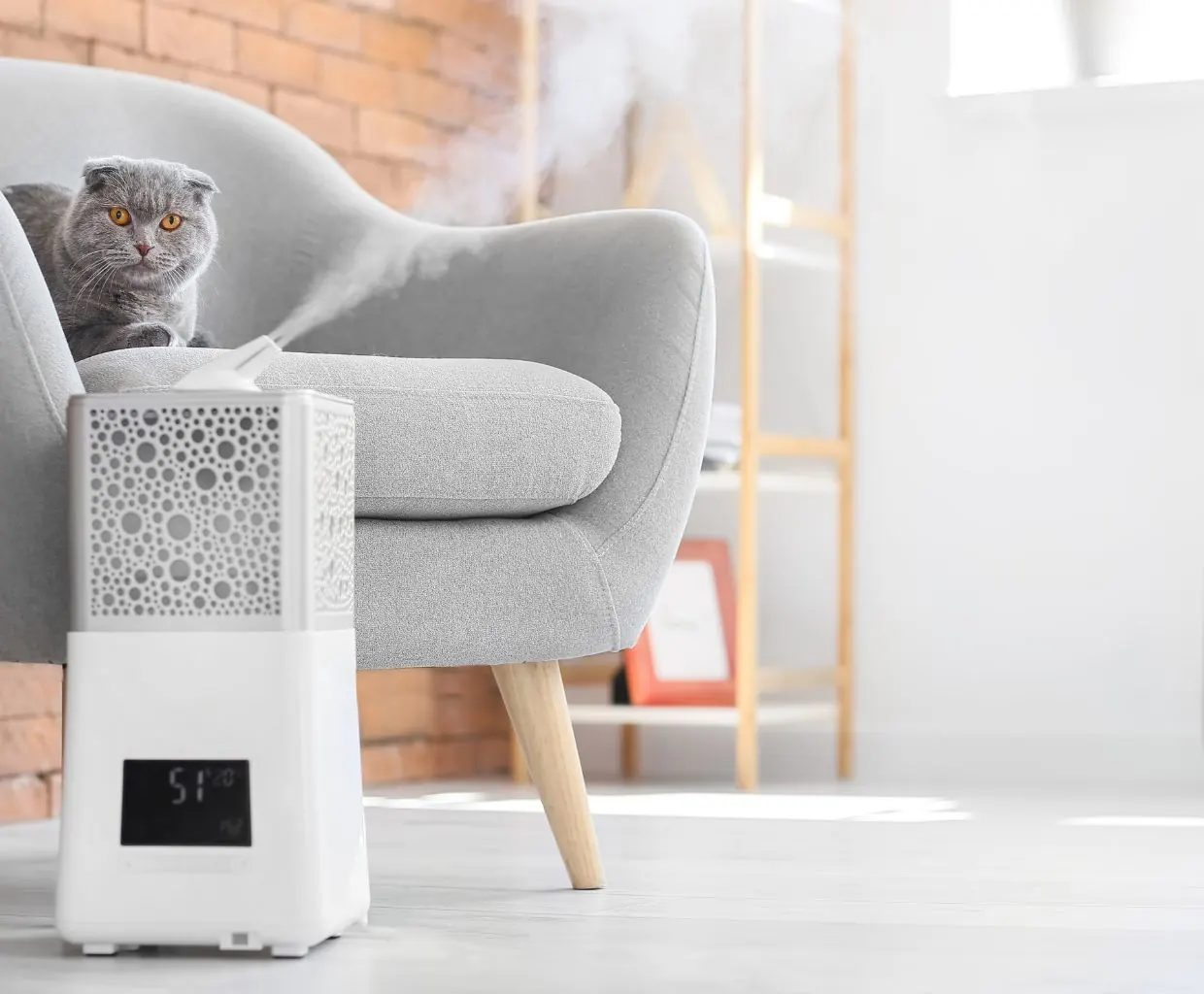
To use a humidifier, set it on a firm, flat, waterproof surface away from the bed and walls, fill the tank with the water your manual asks for, and set the humidistat to somewhere between 30% and 50%. Then empty, dry and refill it every day and clean it every third day. That last part is what keeps a humidifier from turning into a germ sprayer, so treat it as part of using one, not an extra.
The routine at a glance
| Step | What to do | Why (source) |
|---|---|---|
| Water | Distilled for ultrasonic and impeller units; follow the manual for evaporative and steam | Mist units spread tap-water minerals as white dust and scale (EPA) |
| Filling | Unplug, fill the tank (not the base) up to the max line, room-temperature water | Prevents leaks and electrical risk (HoMedics, Levoit, TaoTronics) |
| Placement | Firm, waterproof surface, off the floor, away from walls, curtains and the bed | Lets the mist spread before it settles (Crane, Vicks, MedlinePlus) |
| Setting | Humidistat at 30% to 50%, never above 50% | Higher humidity may encourage biological growth (EPA) |
| Every day | Unplug, empty, wipe dry, refill with fresh water | Reduces microbial growth (EPA) |
| Every third day | Scrub, descale, disinfect, rinse | Scale is a breeding ground for germs (EPA, CPSC) |
Before you start: first-time setup
Read the manual’s quick-start page once; every maker does a few things differently.
- Unpack everything. Dreo’s FAQ says to remove the packing foam from the base and make sure the float faces up and clicks into its brackets. A float that isn’t seated can cause leaks.
- Prepare any cartridge or wick. HoMedics says to soak a new demineralization cartridge in water for 10 minutes before first use. For a new evaporative wick that smells, Vornado suggests soaking it in 2 teaspoons of white vinegar per gallon of water for 20 to 30 minutes, then rinsing it without wringing.
- Air out a new unit. If a brand-new humidifier smells of plastic, HoMedics says to leave the tank open in a cool, shady place for 12 hours.
- Check the cap seal. Most caps have a rubber or silicone ring. Make sure it’s in place before the first fill; our guide to why a humidifier is leaking shows what happens when it isn’t.
Step 1: Choose the right water
The type of humidifier decides how fussy it is about water. The EPA says ultrasonic and impeller (“cool mist”) humidifiers are very efficient at spreading tap-water minerals into the air, which can settle as white dust and build up as scale inside the unit. It recommends bottled water labeled “distilled” for them. Evaporative and steam units are not expected to disperse much in the way of minerals, and some makers, such as Levoit for its Superior 6000S evaporative model, say tap water is fine.
Temperature matters too:
- Not hot. Levoit says room-temperature water, and Crane says not to use hot water. HoMedics’ UHE-CM18 manual says nothing above 86 °F.
- Not ice-cold either. Levoit says very cold water can reduce mist for a while.
- Nothing but water. No essential oils, salt or water treatments in the tank unless your manual specifically asks for one.
Our guide to what kind of water to use in a humidifier compares distilled, filtered, tap and boiled water in detail.
Step 2: Fill it the right way
- Unplug it first. HoMedics says to unplug the unit when filling or moving it.
- Don’t overfill. Levoit says not to fill past the max line, and Crane says not to fill the tank all the way to the rim.
- Fill the tank, not the base. TaoTronics’ manual says never to pour water directly into the base or through the mist nozzle.
- Tighten and seat. Turn the cap until tight, without forcing it, and set the tank firmly on the base. Carry a full tank with both hands.
Step 3: Put it in the right place
- Firm, flat and waterproof. HoMedics recommends a waterproof mat under the unit and says never to place it on a rug, carpet or a finish water can damage. Carpet can also block the air inlet under the base, which Levoit and Crane list as a cause of low mist.
- Up off the floor. Crane suggests at least 2 feet off the ground so the mist can spread before it falls.
- Away from walls and curtains. Vicks suggests 1 to 3 feet from walls, furniture and curtains. Honeywell says not to aim the output at people, walls or furniture.
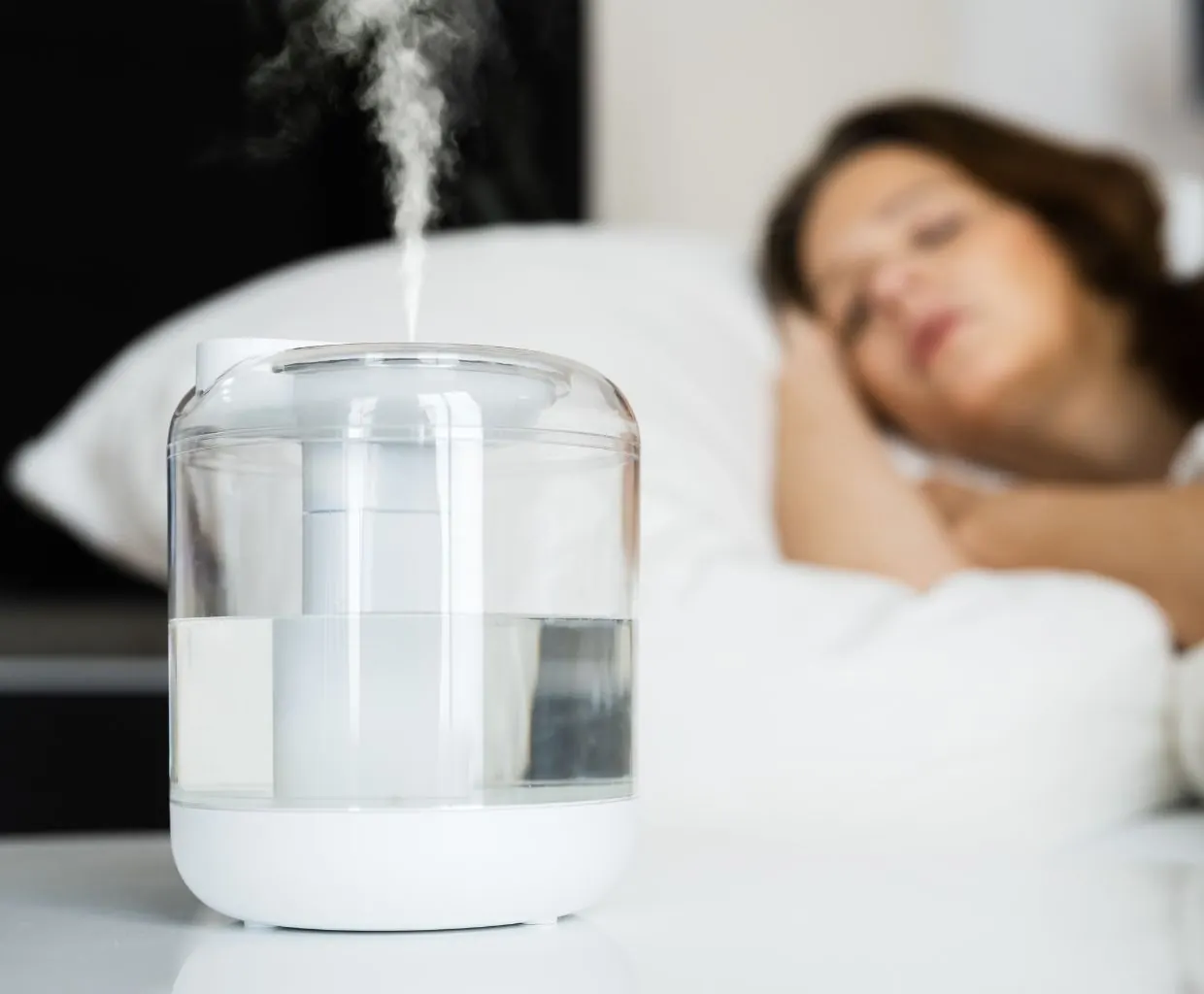
- Away from the bed. MedlinePlus advises keeping it several feet from the bed.
- Out of reach. Keep it where kids and pets can’t knock it over, especially a warm mist model.
Available on AmazonWaterproof humidifier matsSee today's price, ratings and delivery options
Check priceStep 4: Set the humidity, not just the mist
Most modern humidifiers have a humidistat: a sensor that stops the mist when the room reaches the level you set. Use it. A humidifier that runs flat out with no target will keep adding moisture until the windows and walls get wet.
What to set it to: the EPA and CPSC both recommend 30% to 50% relative humidity, and MedlinePlus suggests 40% to 50%. The EPA’s humidifier fact sheet says not to humidify above 50%, because higher levels may encourage the growth of biological organisms. Our guide to the ideal indoor humidity explains the range season by season.
Check your model’s default. Some start higher than you might expect: Levoit’s manual for the OasisMist 1000S lists an Auto Mode range of 40% to 80% with a default target of 60%. We’d lower a default like that to 50% or below on day one.
Mist level: Crane’s rule of thumb is to set the mist so you see it rise but not fall back onto the unit or the table. If water collects around the base, the mist is too high for the room.
Don’t rely on the built-in reading alone. Levoit says the display can read wrong if the room is bigger than the unit’s range or if moisture has built up on the sensor. NDSU Extension adds that mechanical hygrometers are frequently off by more than 20%. A separate digital hygrometer on the other side of the room gives you a second opinion.
Available on AmazonDigital hygrometersSee today's price, ratings and delivery options
Check priceNote: Evaporative humidifiers make no visible mist. Honeywell says the way to tell one is working is that the tank level drops over 24 hours.
Step 5: Warm mist? Give it time and space
Warm mist units heat the water before it leaves, so they take a little longer to start. Levoit says its LV600HH takes about 15 minutes to warm up, and HoMedics says about 20 minutes for its UHE-WMTF185. Don’t put your hands or face over the nozzle, and let the water cool before you empty it.
Mayo Clinic and MedlinePlus advise cool mist for children because hot water or steam can cause burns, and CHOP reports that the American Academy of Pediatrics recommends cool mist too. Our comparison of warm mist vs cool mist humidifiers covers the trade-offs.
Step 6: Door open or closed?
A closed door helps a small humidifier reach your target faster, but it also makes it easier to overshoot. Crane says that if the windows fog, the humidifier is working too hard: lower the mist and keep the door cracked. Dreo, on the other hand, says too much ventilation can make the mist seem weak. We’d close the door only when the unit has a working humidistat. The full trade-off is in should you close the door when using a humidifier.
Step 7: Empty it every day, clean it every third day
This is the part people skip. A humidifier tank is standing water, and CPSC found that bacteria and fungi often grow in tanks and can be released in the mist. The EPA’s routine for portable humidifiers:
- Every day: unplug it, empty the tank and base, wipe the surfaces dry and refill with fresh water. Crane also suggests leaving the tank cap off between uses so it can air-dry.
- Every third day: empty it, scrub the tank, remove scale and film, and disinfect with the product your manual names, or 3% hydrogen peroxide if it names none. Rinse with several changes of water.
- Evaporative wicks: Honeywell says to flip its wick at each refill and replace it every 30 to 60 days. Never clean a Honeywell wick with vinegar, soap or bleach.
The full routine, with brand-specific amounts, is in our guide on how to clean a humidifier.
Important: If you notice coughing, breathlessness or other breathing symptoms you associate with your humidifier, the EPA says to stop using it and contact a physician.
Using a humidifier in winter
Winter is when you need a humidifier most and when it’s easiest to overdo it. Cold window glass is the first surface to collect water. NDSU Extension recommends 30% to 40% indoor humidity in winter and says anything above about 40% raises the chance of condensation on windows. A University of Minnesota Extension fact sheet goes further: whatever the gauge says, window condensation is the measure of how much moisture your home can tolerate.
So when it turns bitterly cold outside, lower the setting. If you see water on the inside of the windows, the EPA says to move the humidifier, turn the humidistat down or use it less. Our dew point calculator shows the humidity at which a surface of a given temperature starts to sweat, and our guide to condensation on windows explains what to do about it.
Don’t expect instant results, either. How quickly a room responds depends on its size, air leaks and the unit’s output; how long it takes for a humidifier to work runs through the numbers.
At the end of the season
The EPA says to clean the humidifier, dry every part completely and store it somewhere dry, and to throw away used demineralization cartridges, cassettes or filters. CPSC says to clean it again after summer storage, and HoMedics says to fill the tank only just before you run it again. In our view, a full day of air-drying before you box it up is time well spent.
Frequently asked questions
What should I set my humidifier to?
Aim for 30% to 50% relative humidity, the range the EPA and CPSC recommend. MedlinePlus suggests 40% to 50%. The EPA says not to humidify above 50%, and in a cold snap you may need to go lower if your windows start to fog.
Can I use tap water in a humidifier?
It depends on the type. The EPA recommends distilled water for ultrasonic and impeller models, because they spread tap-water minerals into the air. Evaporative and steam units disperse few minerals, and some makers say tap water is fine. Follow your manual.
How often should I change the water in a humidifier?
Every day. The EPA says to unplug a portable humidifier, empty the tank, wipe the surfaces dry and refill it daily, then clean it every third day.
Is it OK to run a humidifier all night?
Many people do. Use a humidistat set at or below 50%, keep the unit several feet from the bed as MedlinePlus advises, start with fresh water, and check a hygrometer in the morning. Choose cool mist for children's rooms.
Where should I put a humidifier?
On a firm, flat, waterproof surface, never on carpet. Crane suggests at least 2 feet off the floor, and Vicks suggests 1 to 3 feet from walls, furniture and curtains, out of reach of children and pets.
Can I put essential oils in my humidifier?
Not in the tank. HoMedics says even a few drops will damage its units, and Crane says oils can crack the tank and void the warranty. Use only an aroma pad or tray if your model has one.
Related guides
Humidifiers
How to Clean a Humidifier: Daily Rinse, Descaling and Disinfecting
Empty and dry it daily, descale and disinfect it every third day, and follow your manual. Step-by-step, with brand notes for HoMedics, Crane, Dyson and more.
10 min read
Humidifiers
Where to Put a Humidifier: Best Spot in the Bedroom and Every Room
Put it in the room you use most, on a firm, waterproof surface a few feet from the bed, walls and curtains, with the mist aimed into open air. Here's what manuals say.
7 min read
Humidifiers
Why Is My Humidifier Leaking? Causes, Fixes and When to Stop
A loose cap seal, a cracked tank, moving it while full or mist set too high: how to find where your humidifier is leaking and fix it safely.
7 min read
Humidifiers
Best Humidifiers for the Bedroom in 2026: Quiet, Overnight and Easy to Clean
Six bedroom humidifiers picked from maker specs and manuals: published noise levels, overnight runtime, cool or warm mist, white dust and cleaning.
11 min read