Best Air Purifiers of 2026: Research-Backed Picks for Every Room
Seven current air purifiers for every room and budget, chosen on verified CADR, HEPA filtration, ozone status, noise and filter cost.
By Clean Air Guides editorial teamUpdated 14 min read
Our picks at a glance
- Top pickCheck price
Best overall
AHAM-verified CADR for rooms up to 388 sq ft, no ionizer, a washable pre-filter and an app, for around $190.
- CADR 250 smoke (AHAM)
- 388 sq ft (AHAM)
- No ionizer
- Check price
Best smart purifier
Levoit Core 600S (Core 600S-P)
App and voice control, a laser PM2.5 sensor and ENERGY STAR certification, with AHAM-verified CADR for 606 sq ft.
- CADR 394 smoke (AHAM)
- 606 sq ft
- ENERGY STAR
- Check price
Best for large, open rooms
Verified at the top of AHAM's scale for smoke and dust, for open spaces up to 930 sq ft.
- CADR 600 smoke (AHAM)
- 930 sq ft (AHAM)
- No ionizer
- Check price
Best for quiet bedrooms
Coway Airmega Mighty2 AP-1512N
A published low of 19 dB, no ionizer and a filter rated for up to a year.
- CADR 240 smoke (Coway)
- 19-50 dB
- No ionizer
- Check price
Best true HEPA for allergies
Three True HEPA filters, no ionizer and an AHAM-verified 500 sq ft room size.
- CADR 323 smoke (AHAM)
- 500 sq ft (AHAM)
- True HEPA
- Check price
Best budget pick
An AHAM-listed small-room purifier for under $100, with cheap replacement filters.
- CADR 139 smoke (AHAM)
- 215 sq ft (AHAM)
- 24-54.5 dB
- Check price
Best premium heavy-duty
HyperHEPA filtration, 5 lb of gas-phase media and filters rated for up to four years.
- Up to 300 cfm airflow
- 5 lb carbon + alumina
- 27-59 dB(A)
Prices change often; Amazon shows the current price. As an Amazon Associate, Clean Air Guides earns from qualifying purchases.
The best air purifier is one with enough verified CADR for your room, a HEPA-grade filter and no ozone-making extras. For most homes, our pick is the Levoit Vital 200S-P: AHAM verifies it for rooms up to 388 sq ft, it has no ionizer, the pre-filter is washable and it costs around $190. If you need more power, the Levoit Core 600S adds app control and covers 606 sq ft, and the Medify MA-112 PRO handles open-plan spaces up to 930 sq ft.
This is our main buying guide. If you’re shopping for one problem, our specific roundups go deeper: the best air purifier for allergies, the best air purifier for pets and the best air purifier for smoke.
How we chose
We don’t test purifiers ourselves. Every pick comes from manufacturer spec sheets and manuals, the AHAM Verifide directory, the CARB certified list and the ENERGY STAR database, all checked in October 2026 (our research method explains the process). A model had to be sold new in the US, and we gave the most weight to:
- Verified CADR. We prefer numbers from the AHAM directory or the ENERGY STAR list. Where a brand isn’t listed there, we say whose number it is.
- Room size on one basis. AHAM’s room size works out to about 4.8 air changes per hour. Many brands also print 1 or 2 air-change figures that look far bigger; we ignore those.
- A real particle filter. True HEPA or a HEPA-grade main filter, plus activated carbon for odors.
- Ozone. CARB certification and no ionizer, or one you can switch off.
- Running cost. Filter prices and replacement intervals, plus measured watts.
- Noise across the speed range, where the maker publishes it.
We left out discontinued models, such as Honeywell’s HPA100, HPA200 and HPA300 and the Winix 5500-2, even though you’ll still see them on older lists.
The best air purifiers compared
| Model | Smoke CADR | Room size | Ionizer | Price band |
|---|---|---|---|---|
| Levoit Vital 200S-P | 250 (AHAM) | 388 sq ft | None | Around $190 |
| Levoit Core 600S | 394 (AHAM) | 606 sq ft | None advertised | Around $300 |
| Medify MA-112 PRO | 600 (AHAM) | 930 sq ft | None | Around $600 |
| Coway Mighty2 AP-1512N | 240 (Coway) | About 360 sq ft* | None | Around $270 |
| Honeywell InSight HPA5300B | 323 (AHAM) | 500 sq ft | None | Around $320 |
| Levoit Core 300-P | 139 (AHAM) | 215 sq ft | None advertised | Under $100 |
| IQAir HealthPro Plus XE | Not published | 1,125 sq ft at ~2 ACH** | None | Around $1,200 |
*Our math with AHAM’s two-thirds rule; Coway only publishes a 1 air-change figure. **IQAir’s own figure on a 2 air-change basis, not comparable with the AHAM sizes above.
The best air purifiers
Levoit Vital 200S-P
Best for: most bedrooms, home offices and medium living rooms.
The AHAM directory lists the Vital 200S (now sold as the Vital 200S-P) at 250 cfm for smoke, 254 for dust and 289 for pollen, with a 388 sq ft room size. The filter has three stages: a washable pre-filter that catches lint and pet hair, a main particle filter that Levoit rates at 99.97% or better at 0.3 µm, and activated carbon for odors. There’s no ionizer, and CARB lists it as mechanical.
Smart features are included at this price: the VeSync app, Alexa and Google Assistant, an infrared dust sensor with Auto mode, plus Sleep and Pet modes. Levoit rates it at 23 to 54 dB, and AHAM measured 52.4 W at full speed. Replacement filters run from around $50 (standard) to $65 (Smoke Remover), every 6 to 12 months, with Pet Allergy and Toxin Absorber versions in between.
The trade-off: AHAM lists the main filter as “HEPA-Type” rather than true HEPA, so the CADR is the number to trust here, not the filter label. It isn’t ENERGY STAR certified. In our view it’s still the best balance of verified performance, price and running cost for one room.
Our pick: Best overallLevoit Vital 200SSee today's price, ratings and delivery options
Check priceLevoit Core 600S
Best for: a large living room or anyone who wants full app and voice control.
AHAM lists the Core 600S (now sold as the Core 600S-P) at 394 smoke, 398 dust and 433 pollen CADR, with a 606 sq ft room size. It’s on the current ENERGY STAR list, at about 387 to 389 kWh a year. The VeSync app, Alexa and Google Assistant, a laser PM2.5 sensor, a light sensor and Auto mode make it the most complete smart package among our AHAM-verified picks. The filter stacks a pre-filter, a main particle filter and activated carbon in pellet form, and Levoit sells Original, Toxin Absorber, HEPA-Grade and Smoke Remover versions. Noise is rated at 26 to 55 dB.
The trade-off: nothing is washable, and replacement filters cost around $60 to $80 every 6 to 12 months. Levoit advertises no ionizer, but CARB lists one SKU (LAP-C601S-WUSR) as electronic while the others are mechanical. AHAM measured 65.6 to 67.3 W at full speed, more than Levoit’s 49 W rating. It’s around $300. Our best air purifier for large room guide compares it with other big-room options.
Our pick: Best smart purifierLevoit Core 600SSee today's price, ratings and delivery options
Check priceMedify MA-112 PRO
Best for: open-plan living areas, basements and large family rooms.
The AHAM directory lists the MA-112 PRO at 600 cfm for smoke and dust and 450 for pollen, which is the maximum AHAM’s current test method can verify for each, with a 930 sq ft room size. Behind the pre-filter sit H13 HEPA material and a carbon-pellet layer. There’s no ionizer, and CARB lists it as mechanical. Noise runs from 24.6 dBA on speed 1 to 58.1 dBA on speed 4.
The trade-off: it’s big, draws 160 W and has no air-quality sensor or app. The filter set is around $140 and Medify rates it at about 3,000 hours, or 4 to 5 months, so running it around the clock means roughly $400 a year in filters by our math. The unit is around $600. We’d only buy it if your space really is this large.
Our pick: Best for large, open roomsMedify MA-112 PROSee today's price, ratings and delivery options
Check priceCoway Airmega Mighty2 AP-1512N
Best for: bedrooms and nurseries where low noise matters most.
Coway’s March 2026 update to the popular AP-1512HH has a manufacturer CADR of 240 for smoke, 242 for dust and 249 for pollen. Coway rates it at 19 to 50 dB and says it is Quiet Mark certified, the lowest published floor among our picks. A washable pre-filter sits in front of a single Max2 filter that combines activated carbon with HEPA media (Coway claims 99.97% at 0.3 µm), rated for up to a year. CARB lists it as mechanical, and Coway’s page mentions no ionizer, unlike the older AP-1512HH. A laser sensor reads PM1, PM2.5 and PM10 and drives Smart, Sleep and Eco modes. It’s rated at 56 W.
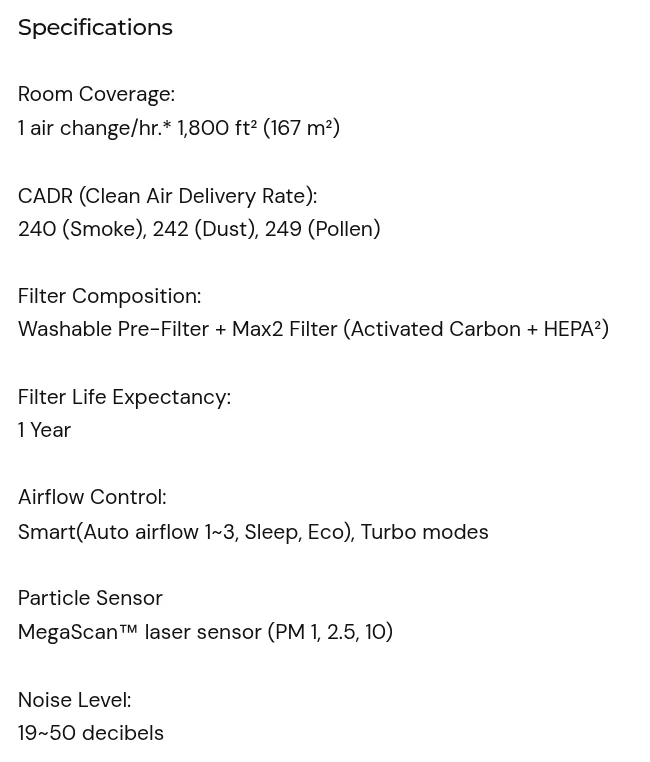
The trade-off: Coway isn’t in the AHAM directory, so these are Coway’s own numbers. It publishes no AHAM-style room size; by the two-thirds rule, 240 smoke CADR suits about 360 sq ft. The filter price isn’t published yet. The unit is around $270. For more bedroom options, see our best air purifier for bedroom picks and the quietest air purifier roundup.
Our pick: Best for quiet bedroomsCoway Mighty2See today's price, ratings and delivery options
Check priceHoneywell InSight HPA5300B
Best for: allergy sufferers who want a true HEPA filter and no ionizer.
AHAM lists the HPA5300B at 323 smoke, 339 dust and 335 pollen CADR, with a 500 sq ft room size. Inside are an activated-carbon pre-filter and three True HEPA R filters, and there’s no ionizer: CARB lists it as mechanical. A VOC sensor with a color air-quality ring drives Auto mode, and there are four cleaning levels, a timer and a dimmer. Honeywell also sells an optional Filter S for extra odor and VOC capacity, in smoke and pet versions.
The trade-off: Honeywell doesn’t publish noise in decibels or maximum watts, so we can’t compare it on those. There’s no app, nothing is washable and the carbon pre-filter needs replacing every 3 months (the HEPA filters every 12). It isn’t on the current ENERGY STAR V3.0 list. It’s around $320. Smaller siblings, the HPA5200B (360 sq ft) and HPA5100B (190 sq ft), use the same design.
Our pick: Best true HEPA for allergiesHoneywell HPA5300BSee today's price, ratings and delivery options
Check priceLevoit Core 300-P
Best for: a small bedroom, dorm room or office on a tight budget.
AHAM lists SKU LAP-C302-WUSR, which appears to be the Core 300-P, at 139 smoke, 156 dust and 155 pollen CADR with a 215 sq ft room size (Levoit says 222). One cylindrical filter combines a fine pre-filter, a particle filter and activated carbon. Replacement filters are cheap: around $30 for the Original and $36 to $40 for the Toxin Absorber, Pet Allergy and Smoke Remover versions. Noise is 24 to 54.5 dB, and the display can be switched off for sleep. AHAM measured 53.3 W at full speed.
The trade-off: AHAM lists the filter as “HEPA-Type”, Levoit publishes no replacement interval and there’s no sensor or app. CARB certifies the “Core 300” as mechanical but lists the LAP-C302-WUSR code as electronic, though Levoit advertises no ionizer and calls it ozone free. It’s under $100. Our best small air purifier and best HEPA air purifiers under $100 guides cover more compact and budget options.
Our pick: Best budget pickLevoit Core 300-PSee today's price, ratings and delivery options
Check priceIQAir HealthPro Plus XE
Best for: people who want maximum filtration and long filter life, and can pay for it.
IQAir doesn’t publish a CADR and isn’t in the AHAM directory, so compare it by airflow: six speeds from 40 to 300 cfm. Its HyperHEPA H12/13 final filter is rated at 99.97% or better at 0.3 µm. Behind a PreMax F8 pre-filter, the V5-Cell cartridge holds 5 lb of granular activated carbon and impregnated alumina for gases and odors. It’s one of the few purifiers whose maker publishes the weight of its gas stage. There’s no ionizer, and CARB lists it as mechanical. IQAir publishes noise at each speed, from 27 to 59 dB(A), and power from 8 to 134 W. The XE version adds Wi-Fi, the AirVisual app, a PM2.5 sensor and Auto mode.
The trade-off: it’s around $1,200 and weighs 35 lb. IQAir rates it for up to 1,125 sq ft, but that’s about 2 air changes per hour at top speed, so it isn’t comparable with AHAM room sizes. The filters are expensive (around $80, $100 and $200), but IQAir rates them at about 18, 24 and 48 months at 10 hours a day on speed 3, which works out to roughly $150 a year by our math. We’d consider it for smoke, odors or someone who wants a “buy once” machine.
Our pick: Best premium heavy-dutyIQAir HealthPro PlusSee today's price, ratings and delivery options
Check priceOthers we considered
- Blueair Blue Pure 211i Max: ENERGY STAR lists 443 smoke CADR and 687 sq ft, Blueair rates it at just 46 W max, and the fabric pre-filter is washable. We left it out of the main picks because its HEPASilent electrostatic charging has no documented off switch; ENERGY STAR measured 2 ppb of ozone. It’s a strong alternative to the Core 600S if that doesn’t bother you.
- Coway Airmega 400S: ENERGY STAR lists the Airmega 400 at 376 smoke CADR and 583 sq ft, and the 400S adds Wi-Fi and the app. It’s good, but at around $750 it costs more than the Core 600S for similar coverage.
- Winix 5520: Winix labels its 253 smoke CADR as AHAM Verifide, but we couldn’t confirm that in the directory, and it has a PlasmaWave ionizer (switchable).
- Coway AP-1512HH Mighty: still listed, but stock was unclear in October 2026 and it has a switchable ionizer. The Mighty2 replaces it.
Air purifier buying guide
Room size and CADR: the two-thirds rule
CADR (clean air delivery rate) is the number that matters most. It measures how much particle-free air a purifier delivers, in cubic feet per minute, and it rates the whole unit rather than just the filter. AHAM rates it separately for smoke (about 0.1 to 1 µm), dust (0.5 to 3 µm) and pollen (5 to 11 µm). Our explainer on what CADR means goes into the test.
AHAM’s rule of thumb: the smoke CADR should be at least two-thirds of the room’s floor area in square feet, assuming an 8 ft ceiling. A 10 x 12 ft bedroom (120 sq ft) needs at least 80 cfm; a 15 x 20 ft living room (300 sq ft) needs at least 200. EPA’s chart says the same thing: 100 sq ft needs 65 cfm, 300 sq ft needs 195 and 500 sq ft needs 325. For vaulted or higher ceilings, size up. Our air purifier size calculator does the math for any room and ceiling height.
Two more things to keep in mind:
- CADR is measured on the top speed. EPA notes that CADR at quieter settings is usually not published and can be much lower. If you plan to run the purifier on low overnight, buy one rated for a bigger room than yours.
- Ignore 1-air-change room sizes. Coway, Levoit, Medify and others also advertise huge figures like 1,800 or 2,909 sq ft. Those assume the air is cleaned once an hour, about a fifth of AHAM’s basis.
For wildfire smoke, AHAM suggests a smoke CADR at least equal to the floor area, so a 300 sq ft room would need 300 cfm.
HEPA vs “HEPA-type”
The US Department of Energy defines HEPA as at least 99.97% efficient at 0.3 µm. EPA adds that there’s no widely accepted definition of HEPA for consumer products, and HEPA-labeled home filters are generally comparable to MERV 16. “HEPA-type” and “HEPA-like” have no federal definition at all. Since CADR rates the whole machine, including any air that leaks around the filter, we’d trust a verified CADR over a filter label every time. That’s why the Vital 200S-P and Core 300-P make our list even though AHAM calls their filters HEPA-Type.
Activated carbon for odors and gases
HEPA filters catch particles, not gases. EPA says a purifier needs activated carbon or another sorbent to tackle odors and VOCs, and that no rating like CADR exists for gas removal. Weight matters: EPA found thin carbon-impregnated layers saturate quickly and have limited odor-removal ability. Most purifiers don’t publish carbon weight. Of our picks, only the IQAir (5 lb) does. Even so, carbon struggles with some gases, including formaldehyde, according to EPA.
Ionizers, UV and ozone
EPA advises avoiding air cleaners that intentionally produce ozone, a lung irritant. It warns that ionizers, electrostatic precipitators, some UV lights and plasma units may emit ozone, and that no federal agency has approved ozone generators for occupied spaces. California requires every air cleaner sold there to be CARB certified at 0.050 ppm (50 ppb) of ozone or less. That’s a useful screen, but certified doesn’t mean zero, and CARB doesn’t check how well a unit cleans. All seven of our picks are CARB certified, and none has an advertised ionizer.
Noise
Most purifiers are quiet on low and loud on high. Look for the published decibel range, not one number: our picks run from 19 dB (Coway, lowest speed) to 59 dB(A) (IQAir, top speed). A purifier sized one step up can do its job on a quieter speed, which matters most in a bedroom.
Running cost: electricity
ENERGY STAR says a standard room air cleaner running nonstop uses about 394 kWh a year, and certified models are more than 50% more efficient. At the July 2026 US average of 18.31 cents per kWh, the Vital 200S-P at full speed around the clock (52.4 W) would cost about $84 a year by our math, and the Medify (160 W) about $257. Lower speeds cost less. Plug your model’s watts and hours into our air purifier electricity cost calculator.
Running cost: filters
Filters often cost more than power. Before you buy, check the replacement price and interval:
- Levoit Core 300-P: around $30 to $40 per filter (no interval published).
- Levoit Vital 200S-P: around $50 to $65, every 6 to 12 months.
- Levoit Core 600S: around $60 to $80, every 6 to 12 months.
- Medify MA-112 PRO: around $140, every 4 to 5 months.
- IQAir HealthPro Plus XE: three filters at around $80, $100 and $200, lasting about 18, 24 and 48 months.
Washable pre-filters (Vital 200S-P, Coway Mighty2) catch hair and lint; true HEPA is never washable.
Smart features
An app, scheduling and voice control are nice to have, but the feature that matters is an air-quality sensor with Auto mode. It lets the purifier idle quietly when the air is clean and ramp up when you cook or open a window. The Vital 200S-P, Core 600S and IQAir XE have apps; the Coway Mighty2 and Honeywell have sensors and Auto mode without an app advertised on their product pages; the Medify and Core 300-P have neither.
Placement
Put the purifier in the room where you spend the most hours, which for most people is the bedroom. Leave clear space around the intake and outlet, and close the door so it’s cleaning one room rather than the whole house. Our guide on where to put an air purifier covers the details.
What an air purifier can’t do
EPA says no air cleaner will remove all pollutants from a home, and that filtration doesn’t replace controlling sources and ventilating. A purifier won’t remove dust that has already settled on floors and furniture, and it won’t fix a moisture problem. EPA says air cleaners can capture some airborne mold spores and moldy odors but won’t prevent mold growth; our best air purifier for mold guide explains what to do first. EPA also doesn’t recommend air cleaning to deal with radon.
In our view, one well-sized purifier in the bedroom or main living area, with the doors closed and the filter changed on time, does more than several small units scattered around the house.
Frequently asked questions
What is the best air purifier for home?
For most bedrooms and living rooms up to about 388 sq ft, we'd pick the Levoit Vital 200S-P: its CADR is AHAM-verified, it has no ionizer and it costs around $190. For a bigger room or a smart-home setup, the Levoit Core 600S covers 606 sq ft, and for open-plan spaces the Medify MA-112 PRO is verified for 930 sq ft.
Is a HEPA air purifier worth it?
Yes, if it's sized for the room. The US Department of Energy defines HEPA as at least 99.97% efficient at 0.3 µm, and EPA says portable air cleaners can reduce indoor pollution. HEPA doesn't remove gases or odors, though, and no air cleaner removes every pollutant, so source control and ventilation still matter.
What size air purifier do I need?
Use AHAM's rule: the smoke CADR should be at least two-thirds of the floor area with an 8 ft ceiling. A 12 x 15 ft room (180 sq ft) needs at least 120 cfm. Choose a bigger unit for higher ceilings, and during wildfire smoke AHAM suggests a smoke CADR equal to the floor area.
Should an air purifier run all the time?
Particles keep coming in from outdoors and from daily life, so a purifier does the most good running continuously, on Auto or a low speed when the air is clean. During wildfire smoke, EPA advises running it continuously on the highest setting with doors and windows closed.
Do air purifiers produce ozone?
Purely mechanical HEPA purifiers don't. EPA says ionizers, electrostatic precipitators, some UV lights and plasma units may emit ozone, a lung irritant, and that ozone generators should be avoided. CARB caps certified air cleaners at 0.050 ppm, which is low but not zero. None of our seven picks advertises an ionizer.
How much does it cost to run an air purifier?
ENERGY STAR says a standard room air cleaner running nonstop uses about 394 kWh a year, roughly $72 at the July 2026 US average of 18.31 cents per kWh. ENERGY STAR certified models are more than 50% more energy-efficient. Filters often cost more than electricity, so check both.
Related guides
Air Purifiers
Best Air Purifiers for Allergies in 2026: Pollen, Dust Mites and Dander
Six current air purifiers for pollen, dust mite and dander allergies, picked on verified pollen CADR, HEPA-grade filters, room size and ionizer status.
10 min read
Air Purifiers
Best Air Purifiers for Large Rooms in 2026: Verified CADR for 500+ sq ft
Six air purifiers with enough verified clean air for living rooms and open plans of 500 sq ft or more, plus how to size one and when two units beat one.
12 min read
Air Purifiers
Best Air Purifiers for a Bedroom in 2026: Quiet, Dark and Sized to Run All Night
Five bedroom air purifiers with published sleep-mode noise, light and display options, verified CADR for bedroom sizes and what a night of running costs.
11 min read
Air Purifiers
Quietest Air Purifiers: Published Decibels, Sleep Modes and the CADR Trade-Off
Five air purifiers with the lowest published noise figures, what their decibel ratings do and don't tell you, and how to stay quiet without losing clean air.
11 min read
Air Purifiers
Philips 2000i vs 3000i: Specs Compared, and What to Buy in the US Instead
The Philips 3000i covers bigger rooms with one long-life filter, but neither model is a real US option in 2026. Specs side by side, plus US alternatives.
9 min read