Christmas Tree Allergy (Christmas Tree Syndrome): Mold, Sap and What Helps
Sneezing since the tree went up? Most reactions come from mold, dust or pollen riding on the tree, or from its sap. Here's what the studies found and what helps.
By Clean Air Guides editorial teamUpdated 10 min read
In this article
- What is Christmas tree syndrome?
- What causes it? Four triggers, ranked by the evidence
- Are real Christmas trees bad for allergies?
- Which tree is best if you have allergies?
- How to stop Christmas tree allergies: 9 steps
- Does an air purifier help with Christmas tree allergies?
- Storing an artificial tree so it doesn’t cause allergies
- When is it not the tree?
A Christmas tree allergy, often called Christmas tree syndrome, is real, but it is rarely an allergy to the tree itself. Most reactions come from what the tree carries indoors (mold spores, dust and stray pollen) or from touching its sap. Symptoms are usually mild and stop when the tree goes. Rinsing the tree, shortening its stay and running a HEPA air purifier in the room help most people.
What is Christmas tree syndrome?
Christmas tree syndrome is a nickname, not a diagnosis. Allergy UK calls it an informal name for allergy flare-ups set off by real or artificial trees, and notes that it has no formal medical diagnosis. Cleveland Clinic uses the same definition and adds that a true allergy to pine is rare.
The usual symptoms, as listed by Allergy UK, Cleveland Clinic and UCLA Health:
- Sneezing, a runny or blocked nose and sinus pressure
- Coughing, a sore throat, wheezing or an asthma flare
- Red, itchy or watery eyes
- An itchy rash or hives on the hands and arms after handling the tree
Ohio State’s allergist calls the skin version “Christmas tree dermatitis.” Allergy UK describes the reactions as usually mild. Shortness of breath, swelling of the tongue or a racing heart are different: Cleveland Clinic says to call 911.
What causes it? Four triggers, ranked by the evidence
Four things can set off symptoms, and they need different fixes. The table puts them in the order the clinic pages and studies point to.
| Trigger | Where it comes from | Real tree | Artificial tree | What the evidence says |
|---|---|---|---|---|
| Mold spores | Grow on needles and bark, more so in warm, damp conditions | Yes | Only if stored damp | 53 molds found on needles and bark from 28 trees (Kurlandsky, 2011); Ohio State calls it the most likely trigger |
| Sap, resin and terpenes | The tree’s oleoresin (rosin) and its scent compounds | Yes | No | The 1970 Canadian study named oleoresins as the most likely cause |
| Dust and dust mites | Settle on branches in storage and transport | Some | Yes, often the main one | Listed by Allergy UK, Cleveland Clinic and Ohio State |
| Pollen | Weed and grass pollen caught on the tree outdoors | Some | Rarely | Detected indoors in the 1970 study; conifers themselves pollinate in spring |
The two best-known studies disagree on which trigger matters most, and that is useful to know before you buy anything.
The 1970 Canadian study: sap, not mold
Derek Wyse and David Malloch published the first large study in the Canadian Medical Association Journal in 1970. Of 1,657 allergic patients, 7% had respiratory or skin reactions to conifers, with sneezing, wheezing and short-lived skin rashes. Most reacted within 24 hours. About 15% reacted only after several days.
The researchers then measured mold and pollen in 10 homes before, during and after the tree was up. Bark scrapings from pine and spruce held large numbers of Penicillium, Epicoccum and Alternaria molds, but those molds did not become airborne, and airborne fungi in the homes did not change significantly. Weed, grass and tree pollen did reach the air while the trees were inside. The authors concluded that oleoresins in the tree’s balsam were the most likely cause of the symptoms.
The 2011 Upstate study: dozens of molds on 28 trees
Forty years later, Lawrence Kurlandsky and colleagues at SUNY Upstate Medical University in Syracuse looked again. Their short report in the Annals of Allergy, Asthma & Immunology (2011) examined needle and bark clippings from 28 Christmas trees. News coverage of the paper reported 53 mold findings, and UPI reported that most of the molds identified were potential allergens linked to wheeze, persistent cough and allergic sensitization in infants.
Kurlandsky’s practical message was reassuring: people and children without obvious allergies are probably not going to be bothered. The study advised an air purifier in the same room as the tree.
Note: You’ll often see a claim that mold spores rose from 800 to 5,000 per cubic meter after two weeks with a tree indoors. As reported by The Week, that figure comes from separate research cited in the Upstate paper, not from the Upstate team’s own measurements, and it describes one home. We’d treat it as a sign that a tree left up longer adds more spores, not as a number you should expect in your living room.
In our view, the two studies fit together better than they seem to. Mold is clearly present on cut trees, but whether it reaches the air in large amounts depends on how wet, warm and old the tree is. The sap affects mainly people who touch it.
Are real Christmas trees bad for allergies?
Real trees are not bad for most people. They can be a problem if you already have allergies, asthma or sensitive skin, because a real tree carries all four triggers in the table. An artificial tree removes the sap and most tree mold, but it brings its own dust problem.
| Real tree | Artificial tree | |
|---|---|---|
| Mold | On needles and bark; increases the longer it stays up | Only if stored somewhere damp |
| Sap and scent | Yes: skin rash, nose and eye irritation | None |
| Dust | Some, from the lot and transport | The main trigger after storage |
| Pollen | Some weed and grass pollen | Rarely |
| How to prepare it | Shake, rinse with a hose, dry fully outdoors | Wipe or rinse outdoors, let it dry |
| Best for | People without known allergies | People with mold allergy or asthma |
Ohio State’s allergist adds an important caveat: a fake tree can be just as much of a problem if it is dusty or has been stored in a damp basement, humid garage or attic.
Which tree is best if you have allergies?
A clean artificial tree is the lowest-risk option. For a real tree, the clinic pages agree on three points:
- Fir, spruce or cypress are named as less allergenic choices by Cleveland Clinic and UCLA Health.
- Leyland cypress is described by UCLA Health as a sterile hybrid that produces no pollen. Cleveland Clinic notes that it can be hard to find.
- Ask the farm or lot. UCLA Health points out that these species are not usually sold at lots or big-box stores, and tree farms know what they have.
We’d add one point of our own: a freshly cut tree that hasn’t sat bundled for weeks has had less time to grow mold. Ask when the trees were cut.
How to stop Christmas tree allergies: 9 steps
These steps combine the advice of Cleveland Clinic, UCLA Health, Allergy UK and the Upstate study. The first four happen before the tree comes inside.
- Shake it. Shake the tree hard outdoors to drop loose needles, dust and debris.
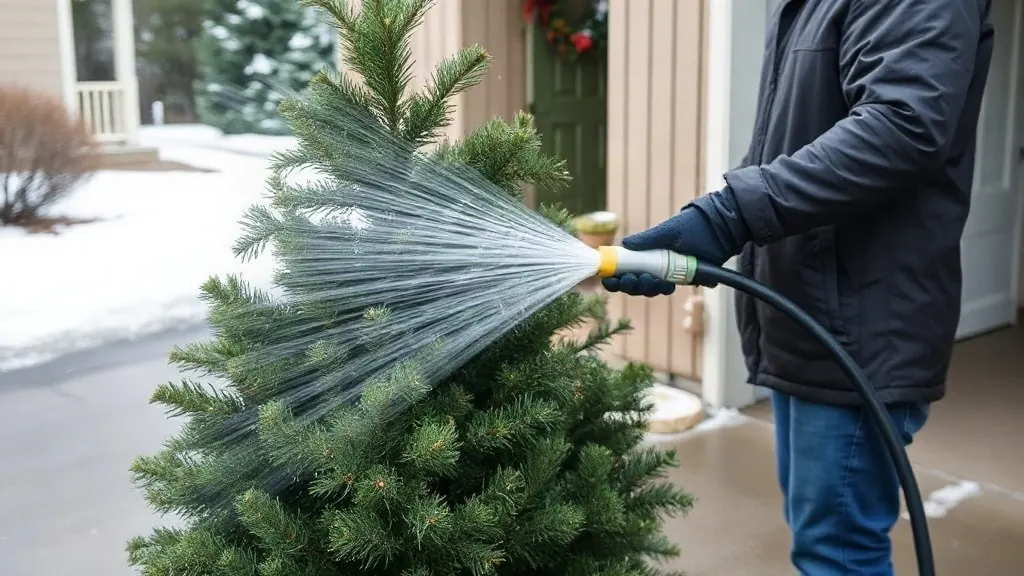
- Rinse it. Spray the tree with a garden hose. UCLA Health also suggests blowing debris off with an air compressor.
- Let it dry completely. UCLA Health says to dry the tree thoroughly before bringing it in. A wet tree in a warm room is the setting mold likes.
- Wear long sleeves and gloves. If your reaction is a rash, Cleveland Clinic and UCLA Health suggest covering your arms, and UCLA Health suggests letting someone else carry and decorate the tree.
- Skip the bleach. Some guides suggest wiping the trunk with bleach. EPA does not recommend routine use of biocides such as chlorine bleach for mold and notes that dead mold can still cause allergic reactions. Water and drying do the job.
- Clean the decorations. Unwrap ornaments outdoors and wipe or vacuum them. Cleveland Clinic suggests wearing a mask while you do it.
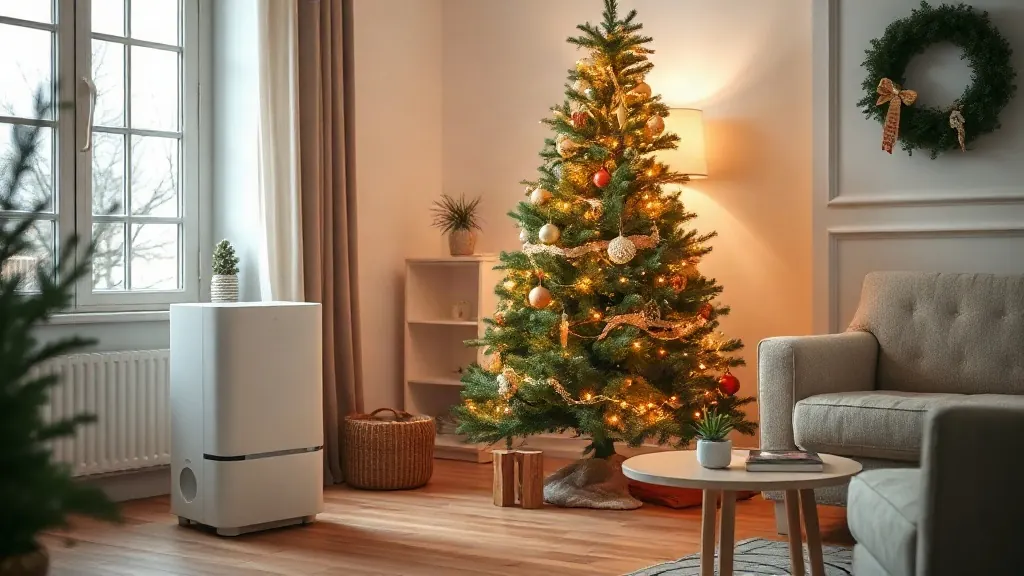
- Run a HEPA air purifier in the same room. Size it for the room (see the next section) and keep it a few feet from the tree, not behind it.
- Shorten the stay. Cleveland Clinic says mold keeps growing after the tree comes inside, and the Upstate team noted that the longer a tree stays in a warm house, the more spores it releases. Put it up later and take it down sooner if you react.
- Change clothes or shower after handling the tree, as Cleveland Clinic and Allergy UK advise, so sap and spores don’t follow you to bed.
Tip: Over-the-counter antihistamines, steroid nasal sprays and antihistamine eye drops are the usual first treatments named by Ohio State and Cleveland Clinic. Check with your doctor or pharmacist first if you take prescription medicine, have asthma, or have glaucoma or cataracts.
Does an air purifier help with Christmas tree allergies?
An air purifier helps with the airborne part of the problem: mold spores, pollen and dust in the air. It does nothing for sap on your skin, and it does not stop mold growing on the tree. EPA says air cleaners can remove airborne mold spores and fragments but will not get rid of the mold source. The Upstate team, Cleveland Clinic and UCLA Health all suggest running one near the tree.
What makes it work is size. AHAM’s rule of thumb is a smoke CADR of at least two-thirds of the room’s floor area in square feet, with an 8 ft ceiling. A true HEPA filter, by the US Department of Energy definition, captures at least 99.97% of particles at 0.3 µm. The pollen AHAM uses to rate CADR is 5 to 11 µm, far larger than that.
| Room with the tree | Floor area | Smoke CADR needed (AHAM 2/3 rule) |
|---|---|---|
| Small den, 10 x 12 ft | 120 sq ft | 80 or more |
| Living room, 12 x 18 ft | 216 sq ft | 144 or more |
| Living room, 15 x 20 ft | 300 sq ft | 200 or more |
| Open plan, 20 x 25 ft | 500 sq ft | 334 or more |
For a different room size or a higher ceiling, use our air purifier size calculator. Our best air purifier for allergies guide compares HEPA models with AHAM-verified CADR, and the best air purifier for asthma guide covers models without ozone-producing ionizers. Placement matters too: where to put an air purifier explains why a unit tucked in a corner behind the tree moves less air through the room.
Storing an artificial tree so it doesn’t cause allergies
For an artificial tree, most of the allergy prevention happens in January, when it goes back into storage.
- Clean it before packing. Wipe or vacuum the branches. UCLA Health suggests doing this every year.
- Seal it. Cleveland Clinic and UCLA Health advise an airtight container or sealed box for the tree and the trimmings.
- Store it dry. EPA recommends keeping indoor humidity below 60%, ideally 30% to 50%. Damp basements, garages and attics regularly exceed that. If you can’t keep the storage space dry, a closet inside the heated house is the safer place. Our guide to how to check humidity in your house shows how to measure it.
- Unpack it outdoors or in the garage, and give it a shake or rinse before it comes in.
Dust is the main trigger from an artificial tree, so the same habits that cut dust in the rest of the house help too. See why your house is so dusty and dust mites and humidity for the year-round version.
When is it not the tree?
If symptoms start around the holidays but the tree came in clean, look at the other usual suspects. Cleveland Clinic names flocking (fake snow), wood fires and scented candles. Allergy UK and Cleveland Clinic also list pesticide residue and insect droppings carried in on the tree. Holly, poinsettias and cinnamon brooms are on Cleveland Clinic’s skip list too.
A simple test: if your symptoms ease within a day or two of the tree leaving the house, the tree was likely part of it. If they don’t, talk to your doctor or an allergist. Allergy testing can show whether mold, dust mites or something else is the cause, and Ohio State notes that allergy shots are an option when over-the-counter treatment isn’t enough.
Frequently asked questions
Can you be allergic to a Christmas tree?
Yes, but true allergy to the tree itself is uncommon. Most reactions come from mold, dust and pollen carried on the tree, or from contact with its sap. In a Canadian study of 1,657 allergic patients, 7% had respiratory or skin reactions to conifers.
Are real Christmas trees bad for allergies?
They can be for people who already have allergies or asthma. Cut trees can carry mold, and the sap can irritate skin. People without known allergies are unlikely to notice anything. Rinsing the tree, keeping it up for a shorter time and running a HEPA air purifier in the room all reduce exposure.
Can a fake Christmas tree cause allergies?
Yes. An artificial tree has no sap or tree mold of its own, but it collects dust in storage, and a tree kept in a damp basement, garage or attic can grow mold. Wipe or rinse it before setting it up and store it sealed in a dry place.
What is the best Christmas tree for allergies?
A clean artificial tree is the lowest-risk choice. Among real trees, allergy clinics point to fir, spruce or Leyland cypress, which UCLA Health describes as a sterile hybrid that produces no pollen. No real tree is free of mold or sap.
How long does Christmas tree syndrome last?
Usually only while you are exposed. In the 1970 study most patients reacted within 24 hours, and 15% reacted after several days. If symptoms continue after the tree is gone, or you have trouble breathing, talk to your doctor.
Should I wash my Christmas tree?
If anyone in the home has allergies, yes. Shake it, rinse it with a garden hose outdoors and let it dry fully before bringing it in. Skip bleach: EPA does not recommend routine bleach use for mold, and dead mold can still cause allergic reactions.
Related guides
Guides
Dust Mites and Humidity: Why Keeping It Below 50% Matters
Dust mites live on moisture from the air. Keeping indoor humidity below 50% is the best-supported way to cut their numbers; here's how to get there.
6 min read
Guides
Why Is My House So Dusty? Causes and Fixes That Work
Most house dust blows in, gets tracked in or is shed indoors. Here is where yours likely comes from and the fixes in the order that pays off most.
8 min read
Guides
Air Purifier vs Dehumidifier: Particles vs Moisture, and Which One You Need
An air purifier filters particles; a dehumidifier pulls moisture out of the air. Here's which one helps with mold, allergies and damp basements, and when you need both.
6 min read
Guides
How to Reduce Humidity in Your House: 10 Steps That Work
Measure first, then vent moisture outdoors, run the AC or a dehumidifier and cut indoor moisture sources until humidity stays between 30% and 50%.
7 min read