Best Air Purifiers for 3D Printers in 2026: HEPA, Carbon and Enclosures
Four HEPA and carbon purifiers for a room with a 3D printer, and the NIOSH-backed steps that matter more: an enclosure, venting and a cooler nozzle.
By Clean Air Guides editorial teamUpdated 8 min read
Our picks at a glance
- Top pickCheck price
Best overall
HyperHEPA H12/13 filtration plus a 5 lb carbon and alumina cartridge, with no ionizer.
- HyperHEPA H12/13
- 5 lb carbon + alumina
- Mechanical (CARB)
- Check price
Most carbon for ABS and resin smells
Austin Air HealthMate Plus HM450
About 15 lb of carbon, potassium-iodide-treated carbon and zeolite around a medical-grade HEPA stage.
- ~15 lb sorbent blend
- 60 sq ft HEPA media
- No ionizer
- Check price
Best for a makerspace or large hobby room
ENERGY STAR lists 376 cfm smoke CADR for about 583 sq ft, at 66 W, with 0.00 ppb ozone.
- CADR 376 smoke (ENERGY STAR)
- 583 sq ft
- Mechanical (CARB)
- Check price
Best for a small print room
Coway Airmega Mighty2 AP-1512N
A 240 cfm smoke CADR from Coway in a compact, mechanical-only unit rated at 19 to 50 dB.
- CADR 240 smoke (Coway)
- About 360 sq ft
- No ionizer
Prices change often; Amazon shows the current price. As an Amazon Associate, Clean Air Guides earns from qualifying purchases.
An air purifier for a 3D printer needs two filters: true HEPA for the ultrafine particles that melting plastic gives off, and a real carbon stage for the VOCs and smell. Our pick is the IQAir HealthPro Plus XE, which pairs HyperHEPA filtration with a 5 lb carbon cartridge. If odor from ABS, ASA or resin is your main complaint, the Austin Air HealthMate Plus HM450 carries about three times the sorbent.
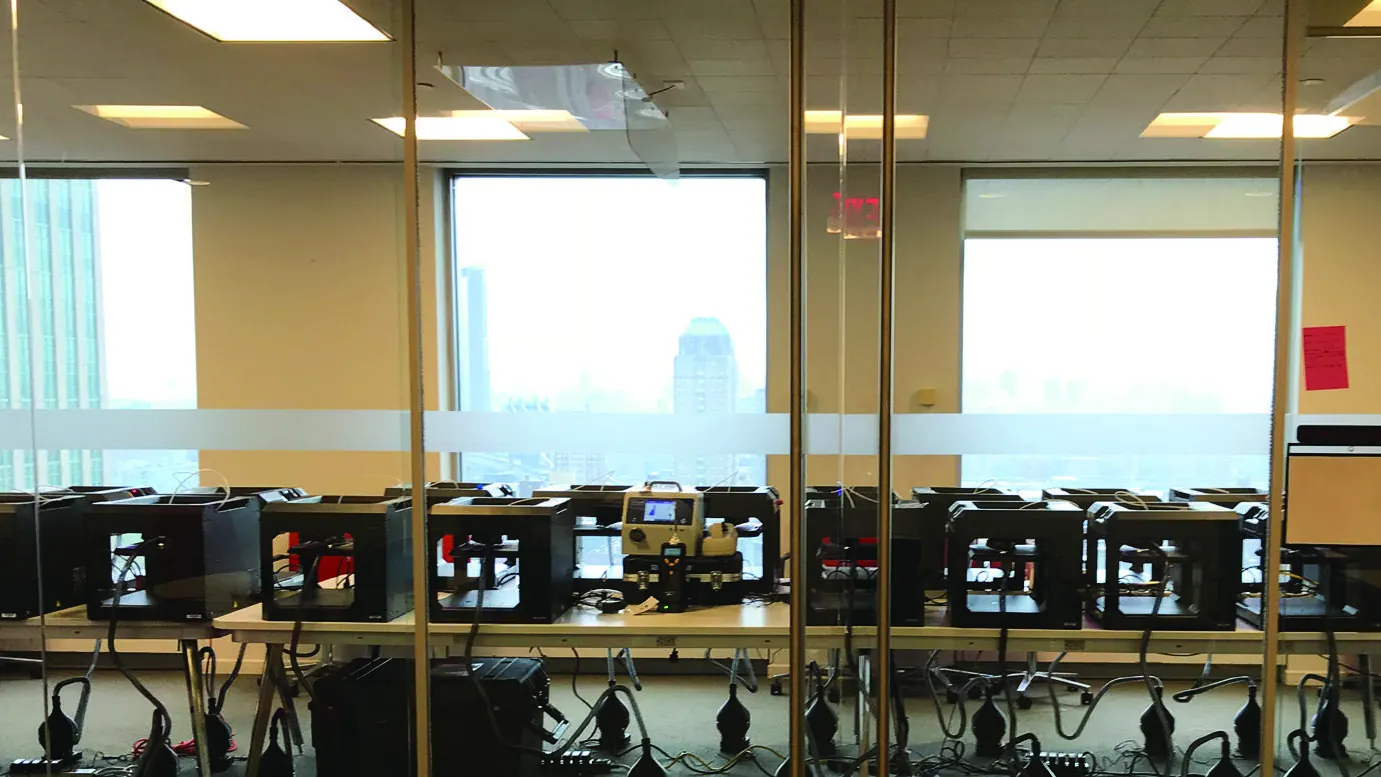
A room purifier is the last line of defense, though. NIOSH’s guide to safe 3D printing puts an enclosure or exhaust at the printer, a lower-emission filament and a separate room ahead of it.
What a 3D printer puts in the air
NIOSH’s 2023 guide for makerspaces, schools, libraries and small businesses sums up the research:
- Ultrafine particles and VOCs. Polymer filaments release ultrafine particles (smaller than 100 nanometers) and volatile and semi-volatile organic compounds when heated. NIOSH says exposure to both together has been associated with respiratory effects such as asthma, cough and eye, nose and throat irritation, and with cardiovascular effects such as high blood pressure.
- It depends on what and how you print. Filament type, color and brand, and the extruder temperature all change emission rates. In one chamber study, higher nozzle temperatures gave larger emissions.
- ABS emits more particles than PLA. NIOSH says researchers have found ABS produces higher airborne ultrafine particle concentrations than PLA, and suggests substituting PLA where it suits the part.
- Resin printers aren’t cleaner. Vat photopolymerization (SLA and DLP) printers released particles and organic vapors at levels similar to or above other 3D printing processes in a NIOSH-cited study, and parts are usually washed afterward in a solvent bath, often isopropyl alcohol. NIOSH notes that many solvents used around printers are flammable.
We don’t have exposure numbers for a typical home setup, and NIOSH notes that chamber results don’t predict room levels well, because room size and ventilation change them so much. That’s why the advice below is about controls, not a “safe” number.
Do this before you buy a purifier
NIOSH ranks controls the usual way: change the material first, then contain the emissions at the source, then manage how people use the room. In our view these steps matter more than which purifier you buy:
- Use an enclosure. Studies NIOSH cites found a filtered enclosing hood over a printer cut particle emissions by 97% to 99%, and a retrofitted enclosure cut them by 97%, rising to 99% when it was exhausted outdoors through a HEPA filter.
- Vent outdoors if you can. NIOSH says ventilated enclosures, fume hoods or local exhaust at the printer are more efficient than diluting the whole room. Air can also be filtered and returned to the room, but only if the filter has been checked to make sure contaminants aren’t released back.
- Print cooler and choose the filament. NIOSH suggests the lowest nozzle temperature that gives a good result, and PLA over ABS where possible.
- Wait before opening the door. UK research cited by NIOSH used a “clearance time” of about 20 minutes after printing before opening the enclosure.
- Keep your distance. NIOSH recommends a separately ventilated room you enter only when needed, remote monitoring instead of standing over the print, and no food or drink in the area.
- Clean the right way. Wet-wipe surfaces and use a HEPA vacuum. NIOSH says not to dry sweep or use compressed air.
Our rule for homes: don’t print in a room where anyone sleeps.
Our air purifier picks for 3D printing
We don’t test purifiers. The figures here come from ENERGY STAR, the CARB certification list and manufacturer pages, and our research method explains how we weigh them. For a print room we looked for:
- True HEPA. EPA says 0.3 µm is the hardest size for a HEPA filter to catch; smaller particles, including the ultrafine range, are captured more efficiently.
- A carbon stage with a published weight where possible, since EPA notes thin carbon layers saturate quickly.
- No ionizer, ozone or “plasma.” EPA lists ionizers and plasma among technologies that can produce ozone or other byproducts. All four picks are CARB-listed as mechanical.
One limit to keep in mind: CADR’s smoke test covers particles of about 0.1 to 1 µm, so no CADR directly measures the sub-0.1 µm particles printers emit. We use it as the best available comparison for HEPA units.
| Model | Particle rating | Carbon | Noise (maker) | Max power |
|---|---|---|---|---|
| IQAir HealthPro Plus XE | 40-300 cfm airflow (no CADR) | 5 lb carbon + alumina | 27-59 dB(A) | 134 W |
| Austin Air HealthMate Plus HM450 | 250 cfm airflow (no CADR) | ~15 lb sorbent blend | <50-65 dB | 147 W at startup |
| Coway Airmega 400 | 376 smoke CADR (ENERGY STAR) | Honeycomb carbon, weight not published | 22-52 dB(A) | 66 W |
| Coway Mighty2 AP-1512N | 240 smoke CADR (Coway) | Carbon in Max2 filter, weight not published | 19-50 dB | 56 W |
IQAir HealthPro Plus XE
Best for: a home office, spare room or workshop with one or two printers and mixed filaments.
The HealthPro Plus puts a PreMax pre-filter, a V5-Cell gas cartridge with 5 lb of granular activated carbon and potassium-permanganate-impregnated alumina, and a HyperHEPA H12/13 final filter in series. IQAir rates it at 99.97% or better at 0.3 µm and claims capture down to 0.003 µm; that last figure is IQAir’s own. Six speeds run from 40 to 300 cfm and 27 to 59 dB(A). The XE version has Wi-Fi and a PM2.5 sensor. CARB lists it as mechanical, with no ionizer.
The trade-off: it’s around $1,200, weighs 35 lb and has no AHAM CADR. IQAir’s “up to 1,125 sq ft” assumes only about 2 air changes per hour, so don’t compare it with AHAM room sizes. The V5-Cell is around $100 and lasts about 24 months by IQAir’s table, though its FAQ says 12 to 24 months.
Our pick: Best overallIQAir HealthPro PlusSee today's price, ratings and delivery options
Check priceAustin Air HealthMate Plus HM450
Best for: strong smells from ABS, ASA or resin printing, and people sensitive to chemical odors.
Austin Air says the HealthMate Plus filter holds up to 15 lb of activated carbon, potassium-iodide-impregnated carbon and zeolite combined, and markets it for VOCs and benzene among other gases. Behind that sits 60 sq ft of medical-grade HEPA media. Its FAQ lists 250 cfm on high. There’s no ionizer, CARB lists it as mechanical, and the filter is rated for up to 5 years.
The trade-off: Austin Air publishes no CADR or room size and no test data for printer emissions or styrene specifically, so the case rests on sorbent weight. Noise is “less than 50 to 65 decibels,” and it draws 147 W at startup. It’s around $900, with a replacement filter around $445.
Our pick: Most carbon for ABS and resin smellsAustin Air HealthMate PlusSee today's price, ratings and delivery options
Check priceCoway Airmega 400
Best for: a makerspace corner, garage workshop or large hobby room with several printers.
ENERGY STAR lists 376 cfm smoke CADR, about 583 sq ft, at 66 W, with 0.00 ppb ozone. Each side has a washable pre-filter and a Max2 filter that combines HEPA with a honeycomb activated-carbon layer. It has a particle sensor with Auto mode; the 400S adds Wi-Fi and the app. CARB lists both as mechanical.
The trade-off: Coway publishes no carbon weight, so for heavy VOCs we’d lean on the two picks above. Its manual says not to use or store combustible gases or flammable materials near it, so keep it away from your IPA wash station. It’s around $650 for the 400, and a two-filter set is around $129.
Our pick: Best for a makerspace or large hobby roomCoway Airmega 400SSee today's price, ratings and delivery options
Check priceCoway Airmega Mighty2 AP-1512N
Best for: a small print room or closet-sized office with a single PLA printer.
Coway rates the Mighty2 at 240 cfm smoke CADR. Coway doesn’t publish an AHAM-style room size, but by AHAM’s two-thirds rule that’s about 360 sq ft (our calculation). It has a washable pre-filter, a Max2 filter that combines HEPA with activated carbon, a laser particle sensor and a 19 to 50 dB range. Unlike the original Mighty, it has no ionizer; CARB lists it as mechanical.
The trade-off: the CADR is Coway’s own figure, not AHAM’s, and there’s no carbon weight. For ABS or resin, we’d want more carbon than this. It’s around $270.
Our pick: Best for a small print roomCoway Airmega Mighty2See today's price, ratings and delivery options
Check priceEnclosure filters: what the printer makers offer
Some printer makers build filtration into the enclosure, which is where NIOSH says control works best. Two examples, with what their makers actually publish:
- Prusa’s Advanced Filtration System for the Original Prusa Enclosure combines a HEPA filter Prusa rates at 99.9% efficiency (no particle size given) with activated carbon granules and a high-pressure blower. Prusa aims it at ASA and other high-emission materials and estimates the filter life at 600 hours or more.
- Bambu Lab’s Activated Carbon Air Filter for the X1 series and P1S filters enclosure air before it’s expelled and is meant to absorb VOCs. Bambu lists a working life of about 1,440 hours of printing. It’s carbon only; Bambu lists no HEPA stage.
Neither maker publishes a carbon weight or independent emissions data. We’d count them as a useful start and still ventilate the room.
How much clean air a print room needs
NIOSH cites a university study that recommended at least 6 air changes per hour in makerspaces, and/or a portable HEPA filter, to lower ultrafine particles during printing. Another study it cites found 3 air changes per hour wasn’t enough for regular or long printing sessions.
For a 10 x 12 ft room with an 8 ft ceiling (960 cubic feet), 6 air changes per hour takes 96 cfm of clean air (our calculation). The Mighty2’s 240 cfm CADR would give that room about 15 air changes an hour at top speed. Our air changes per hour calculator does the math for your room, and the air purifier size calculator checks a model against AHAM’s rule.
What an air purifier can’t do for 3D printing
It can’t stop emissions at the nozzle, and the carbon in any purifier fills up: EPA’s tests found even deep carbon filters can reach VOC breakthrough quickly. It does nothing for burns, moving parts or spilled resin, and it isn’t a reason to stand over the printer. Our guides to HEPA vs carbon filters and the best air purifier for VOCs explain the gas side in more detail. If your printer lives in the garage, see our garage air purifier guide for the cold, damp and fume limits that apply there.
Frequently asked questions
Do 3D printers release harmful fumes?
NIOSH says heated filament can release ultrafine particles and VOCs, and that exposure to both together has been linked to respiratory and cardiovascular effects. How much depends on the filament, its color and brand, and the nozzle temperature.
Is PLA safer than ABS?
For particles, the research NIOSH cites points that way: ABS gives higher ultrafine particle concentrations than PLA. NIOSH suggests switching to PLA where it suits the part and the printer. PLA still emits, so the other controls still apply.
Will a HEPA air purifier remove 3D printer fumes?
HEPA captures particles, including ultrafine ones, but not gases. For VOCs and odor you need a purifier with a substantial carbon stage, and NIOSH ranks an enclosure or local exhaust at the printer above room air cleaning.
Is it safe to keep a 3D printer in my bedroom?
We wouldn't. NIOSH recommends keeping printers in a separately ventilated room you enter only when needed and keeping as much distance between printers and people as possible. Print in a room where nobody sleeps.
Do I need an enclosure or an air purifier?
An enclosure first, if you can. Studies NIOSH cites found filtered or ventilated enclosures cut particle emissions by 97% to 99%. A room purifier then cleans what escapes when you open the door.
Related guides
Air Purifiers
Best Air Purifiers for VOCs and Formaldehyde in 2026: Heavy-Carbon Picks
Four purifiers with published carbon weights from 3.6 to about 15 lb, and why ventilation and source control still come first for chemical fumes.
9 min read
Air Purifiers
Best Garage Air Purifiers in 2026: Workshop Dust, Fumes and Odors
Five air cleaners for garage workshops, sized for big, tall rooms, plus the one job no purifier can do: protect you from car exhaust.
10 min read
Air Purifiers
Best Air Purifiers of 2026: Research-Backed Picks for Every Room
Seven current air purifiers for every room and budget, chosen on verified CADR, HEPA filtration, ozone status, noise and filter cost.
14 min read

Air Purifiers
Best Air Purifiers for Hair and Nail Salons in 2026: What Actually Helps
Why ventilated tables and exhaust come first in a salon, what OSHA recommends, and four heavy-carbon or high-CADR purifiers to back them up.
8 min read