Best Garage Air Purifiers in 2026: Workshop Dust, Fumes and Odors
Five air cleaners for garage workshops, sized for big, tall rooms, plus the one job no purifier can do: protect you from car exhaust.
By Clean Air Guides editorial teamUpdated 10 min read
Our picks at a glance
- Top pickCheck price
Best for woodworking dust
A ceiling-hung shop filter that moves up to 400 cfm through 5-micron and 1-micron filters, built for wood dust.
- 300-400 cfm airflow (WEN)
- 1 + 5 micron filters
- Ceiling-mountable
- Check price
Best for a big two-car garage
AHAM's maximum verified smoke CADR of 600, enough for about 930 sq ft, with no ionizer.
- CADR 600 smoke (AHAM)
- 930 sq ft (AHAM)
- Mechanical (CARB)
- Check price
Best for an attached or finished garage
Its manual is the only one we read that gives an operating range, 14 to 104°F, and AHAM verifies it for 606 sq ft.
- CADR 394 smoke (AHAM)
- 14-104°F (manual)
- PM2.5 sensor
- Check price
Best for paint and solvent odors
About 15 lb of carbon and zeolite behind a medical-grade HEPA stage, with no ionizer.
- ~15 lb carbon + zeolite
- 250 cfm airflow (maker)
- No ionizer
- Check price
Most gas media
12 lb of carbon and impregnated alumina in four cartridges, for a garage where chemical smells are the main problem.
- 12 lb gas-phase media
- 40-275 cfm airflow (maker)
- Mechanical (CARB)
Prices change often; Amazon shows the current price. As an Amazon Associate, Clean Air Guides earns from qualifying purchases.
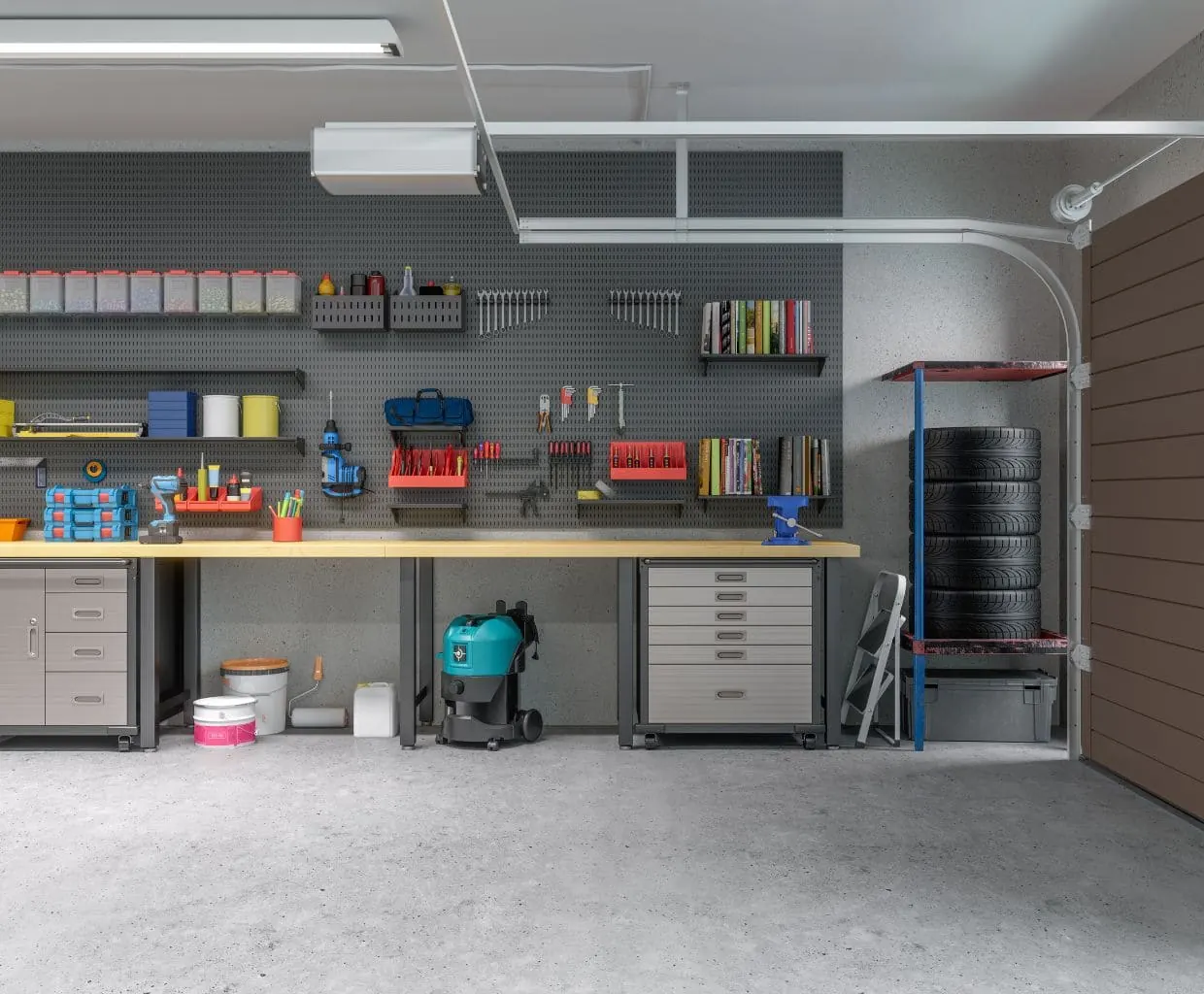
A garage air purifier can help with two things: fine dust from sanding and sawing, and the lingering smell of paint, solvents and gasoline. For a woodworking garage, we’d hang a WEN 3410 shop filter from the ceiling and add a HEPA purifier such as the Medify MA-112 PRO for the finer particles. For odors, you need heavy carbon, like the Austin Air HealthMate HM400.
What no purifier can do is make car exhaust safe. Carbon monoxide is a gas, and the fix is a CO alarm and never idling the car inside, not a filter. We cover that first.
Car exhaust and carbon monoxide come first
EPA lists automobile exhaust from attached garages as one of the indoor sources of carbon monoxide (CO), an odorless, colorless, toxic gas. Its advice on reducing exposure includes one line that matters more than anything else in this guide: do not idle the car inside the garage. Opening the big door doesn’t make it safe, and neither does a purifier.
- HEPA doesn’t touch gases. EPA says air cleaners built only for particles, HEPA included, can’t control gaseous pollutants, and no rating system like CADR exists for gas removal. None of the sources we use rate any home purifier for CO.
- Install CO alarms. EPA passes on CPSC’s recommendation of CO alarms on each level of the home, outside each sleeping area.
- Never run a generator in the garage. EPA warns that deadly CO levels can build up quickly in garages and sheds and linger for hours after a portable generator shuts off. CPSC adds that open doors and windows don’t make it safe.
Important: If your CO alarm sounds, get everyone outside and call for help. Don’t stay to air out the garage.
Our garage air purifier picks
We don’t test purifiers. The figures below come from the AHAM Verifide directory, ENERGY STAR, the CARB certification list, manufacturer pages and owner’s manuals, which we read for garage-relevant limits such as fumes, temperature and humidity. Our research method explains how we weigh them. We looked for:
- Enough clean air for a large, often tall room. Garages are usually bigger than the rooms purifiers are rated for.
- Carbon weight for odors, since thin carbon layers saturate quickly (EPA).
- No ionizer or ozone. Every pick is a mechanical filter unit.
- What the manual allows. Several makers rule out flammable vapors, high humidity or heavy dust.
| Model | Particle rating | Carbon | Max power | Best for |
|---|---|---|---|---|
| WEN 3410 | 300-400 cfm airflow (no CADR) | Optional carbon filters | Not published (1 A) | Wood dust |
| Medify MA-112 PRO | 600 smoke CADR (AHAM) | Carbon pellets, weight not published | 160 W | Large garages |
| Levoit Core 600S-P | 394 smoke CADR (AHAM) | Carbon pellets, weight not published | 65.6-67.3 W (AHAM) | Attached garages |
| Austin Air HealthMate HM400 | 250 cfm airflow (no CADR) | ~15 lb carbon + zeolite | 147 W at startup | Paint and solvent odors |
| IQAir GC MultiGas XE | 40-275 cfm airflow (no CADR) | 12 lb carbon + alumina | 134 W | Heavy chemical odors |
WEN 3410
Best for: woodworkers who make fine dust at the bench, table saw or sander.
This is a workshop air filtration unit, not a household purifier. WEN rates it at 300, 350 or 400 cfm across three speeds and says it circulates the air in a 400 sq ft room up to 7.5 times per hour. Air passes a 5-micron outer filter and a 1-micron inner filter; WEN also sells activated-carbon versions of both filters for its 400 cfm systems. It comes with eyebolts and chains for hanging, a remote that works up to 26 ft away and a timer. WEN lists 50 to 60 dB and 31 lb.
The manual is specific about placement: the bottom of the unit at least 7 ft above the floor, hung only from structure that can hold at least 100 lb (not drywall or a drop ceiling), and at least 3 ft from corners and from heating, cooling or air vents.
The trade-off: a 1-micron filter isn’t HEPA, and the unit has no CADR, so its airflow isn’t comparable with the purifiers below. WEN’s manual says it’s designed for wood and other non-metallic dust and shouldn’t be used where there are poisonous gases, fumes or other chemical risks. It also says the filter doesn’t replace a dust mask or dust collection at the tool. We’d treat it as the first stage in a dusty shop, not the only one.
Our pick: Best for woodworking dustWEN 3410See today's price, ratings and delivery options
Check priceMedify MA-112 PRO
Best for: a two-car garage or large workshop where you want HEPA filtration for fine particles.
AHAM lists a smoke CADR of 600 cfm, the top of its verified range, which works out to about 930 sq ft at an 8 ft ceiling. That’s enough headroom for a 20 x 20 ft garage with a high ceiling. It uses a pre-filter, H13 HEPA material and a carbon-pellet layer, with four speeds rated at 24.6 to 58.1 dBA. CARB lists it as mechanical, so there’s no ionizer.
The trade-off: running cost. Medify rates it at 160 W, and the filter set (around $140) lasts about 3,000 hours, or 4 to 5 months of steady use. Medify doesn’t publish a carbon weight, so it’s a particle machine first. The unit is around $600.
Our pick: Best for a big two-car garageMedify MA-112 PROSee today's price, ratings and delivery options
Check priceLevoit Core 600S-P
Best for: an attached or partly finished garage used as a gym, hobby room or workshop.
AHAM lists a 394 cfm smoke CADR, good for about 606 sq ft. It has a laser PM2.5 sensor with Auto mode and app control, so it can ramp up while you’re sanding and drop back after. AHAM measured 65.6 to 67.3 W at top speed. Our Levoit Core 600S review covers it in detail.
What makes it a garage pick is the manual. Levoit’s Core 600S manual lists operating conditions of 14 to 104°F and humidity below 85%, the only operating range in the manuals we read for these picks. It also tells you not to use the purifier outdoors, in excessively humid areas, or where combustible gases, vapors, metallic dust, aerosol spray products or industrial oil fumes are present.
The trade-off: those same rules mean it’s not for a garage where you spray paint, grind metal or work with solvents. Levoit publishes no carbon weight. CARB lists one model code (LAP-C601S-WUSR) as an electronic air cleaner, although Levoit advertises no ionizer. It’s around $300.
Our pick: Best for an attached or finished garageLevoit Core 600SSee today's price, ratings and delivery options
Check priceAustin Air HealthMate HM400
Best for: lingering odors from paint, stain, gasoline cans and other garage chemicals after the work is done.
Austin Air says the filter holds about 15 lb of activated carbon and zeolite (the weight is for the whole blend), wrapped around 60 sq ft of medical-grade HEPA media. Its FAQ gives 250 cfm on high and 125 cfm on medium. There’s no ionizer, and CARB lists it as mechanical. The filter is rated for up to 5 years, and there are no sensors or app, just a three-speed dial.
The trade-off: Austin’s owner’s manual says the filter isn’t guaranteed if it has been exposed to chemicals not normally found in households, including fumes from fresh painting. So don’t park it next to the spray can: ventilate during the job and run it afterward. It has no AHAM CADR, draws 147 W at startup, runs at “less than 50 to 65 decibels,” and costs around $850, with filters around $395.
Our pick: Best for paint and solvent odorsAustin Air HealthMate HM400See today's price, ratings and delivery options
Check priceIQAir GC MultiGas XE
Best for: a garage where chemical smells, not dust, are the main complaint and budget is less of a concern.
IQAir lists 12 lb of gas-phase media, granular activated carbon plus impregnated alumina, in four cartridges behind an H11 HyperHEPA pre-filter. Airflow runs from 40 to 275 cfm across six speeds, at 27 to 58 dB(A) by IQAir’s figures. CARB lists it as mechanical. The XE version adds Wi-Fi and a PM2.5 sensor.
The trade-off: price and weight. It’s around $1,600, the cartridge set is around $429, and the unit weighs 44 lb. IQAir’s own pages disagree on cartridge life (about 2.5 years in one place, 6 to 18 months in its FAQ), and there’s no CADR. For a dusty garage, its particle side is weaker than the Medify’s.
Our pick: Most gas mediaIQAir GC MultiGasSee today's price, ratings and delivery options
Check priceHow to size a garage air purifier
AHAM’s rule of thumb is a smoke CADR of at least two-thirds of the floor area, which assumes an 8 ft ceiling. AHAM says to choose a unit rated for a larger room when the ceiling is higher, which is common in garages.
- 20 x 20 ft garage, 8 ft ceiling (400 sq ft): at least 267 cfm smoke CADR.
- Same garage, 10 ft ceiling: scale by 10 ÷ 8, so treat it as 500 sq ft and aim for about 333 cfm (our calculation).
Our air purifier size calculator does this for any room, and the CFM calculator works out how much airflow a target number of air changes needs. Remember that a shop filter’s airflow isn’t a CADR: CADR measures clean air delivered, after the filter’s efficiency is counted.
A big purifier running for hours adds up. At 160 W for 8 hours a day and EIA’s July 2026 average of 18.31 cents per kWh, the Medify would cost about $86 a year in electricity (our calculation). The air purifier electricity cost calculator runs the numbers for your hours and rate.
Fumes, cold and damp: what the manuals say
A garage is harder on a purifier than a bedroom, and the manuals say so:
- Flammable vapors. Coway’s Airmega 400 manual says not to use or store combustible gases or flammable materials near the purifier, and not to spray insecticides or air fresheners at the intake. Levoit’s says not to use the Core 600S where combustible gases, vapors or spray products are present. A purifier is an electric motor; keep it away from fuel, solvent and spray work.
- Dust and humidity. Coway also says not to install its purifier in places with a lot of humidity or dust. That’s one reason we didn’t pick it here, although it suits cleaner rooms.
- Cold. Levoit’s 14°F minimum is the only published floor we found in the manuals we read. EPA notes that carbon adsorbs gases better at lower temperature and humidity, so a cool garage isn’t bad for carbon, but condensation is bad for electronics. Levoit says to avoid rooms with major temperature swings for that reason.
- Carbon has limits. EPA says carbon handles most hydrocarbons well but isn’t especially effective against formaldehyde or ammonia, and that even deep carbon beds can reach breakthrough quickly. Our guide to the best air purifier for VOCs goes deeper.
Keep garage air out of the house
If your garage is attached, the bigger risk is what flows into your living space. EPA’s Indoor airPLUS construction specification for new homes sets out the steps, and in our view most of them are worth doing in an existing home too:
- Air-seal the shared walls and ceiling between the garage and the house.
- Weatherstrip every connecting door so it’s substantially air-tight, and add an automatic door closer.
- Exhaust the garage. Indoor airPLUS calls for a fan of at least 70 cfm vented directly outdoors in some homes, running continuously or on a motion sensor and for at least an hour after the garage is empty. EPA recommends one whenever people use the garage for work or hobbies over long periods.
- Keep the furnace out. The spec allows no air-handling equipment or ductwork in the garage, since leaky ducts can pull garage air into the house.
For a basement workshop instead, see our basement air purifier guide, which deals with mold and humidity. If you run a 3D printer out in the garage, our guide to the best air purifier for a 3D printer covers enclosures and ultrafine particles.
What a garage air purifier can’t do
It can’t remove carbon monoxide, it can’t make it safe to spray paint or use solvents in a closed garage, and it can’t keep up with dust blowing straight off a saw. EPA says no air cleaner removes all pollutants, and filtration doesn’t replace controlling sources and ventilating. In a garage that means dust collection at the tool, the big door or an exhaust fan open while you work, and a purifier to clean up what’s left.
Frequently asked questions
Can an air purifier remove car exhaust from a garage?
It can't protect you from it. Exhaust contains carbon monoxide, a gas that HEPA filters don't capture and no purifier is rated to remove. EPA's advice is simple: don't idle a car inside the garage, and put CO alarms on every level of the home outside sleeping areas.
Is it OK to run an air purifier in a cold garage?
Check the manual. Levoit's Core 600S manual lists an operating range of 14 to 104°F and humidity below 85%. Most makers we checked don't publish a range, so in an unheated or damp garage, unplug it when conditions fall outside what the manual allows.
Can I run an air purifier while spray painting in the garage?
Not near the spray. Levoit's and Coway's manuals say not to use their purifiers where combustible gases, vapors or spray products are present, and WEN says its shop filter is for dust, not fumes. Ventilate to the outdoors while painting and run a carbon purifier afterward for leftover odor.
What size air purifier do I need for a garage?
Use AHAM's rule: a smoke CADR of at least two-thirds of the floor area, for an 8 ft ceiling. A 20 x 20 ft garage needs at least 267 cfm; with a 10 ft ceiling, aim for about 333 cfm.
Is a shop air filter the same as an air purifier?
No. A workshop unit like the WEN 3410 moves a lot of air through 5-micron and 1-micron filters to catch wood dust, but it isn't HEPA and has no CADR. A HEPA purifier catches finer particles, and only carbon models do anything for odors.
Related guides
Air Purifiers
Best Air Purifiers for VOCs and Formaldehyde in 2026: Heavy-Carbon Picks
Four purifiers with published carbon weights from 3.6 to about 15 lb, and why ventilation and source control still come first for chemical fumes.
9 min read
Air Purifiers
Best Air Purifiers for 3D Printers in 2026: HEPA, Carbon and Enclosures
Four HEPA and carbon purifiers for a room with a 3D printer, and the NIOSH-backed steps that matter more: an enclosure, venting and a cooler nozzle.
8 min read
Air Purifiers
Best Air Purifiers of 2026: Research-Backed Picks for Every Room
Seven current air purifiers for every room and budget, chosen on verified CADR, HEPA filtration, ozone status, noise and filter cost.
14 min read
Air Purifiers
Best Basement Air Purifiers in 2026: Musty Smells, Mold and Radon Facts
Five basement air purifiers sized for open floor plans, plus what to do first about humidity, mold and radon, which no purifier removes.
9 min read