MERV 8 vs MERV 11 vs MERV 13: What Each Filter Catches and Which to Buy
MERV 8, 11 and 13 side by side: EPA's minimum capture for each particle size, sample airflow resistance, cost per filter and which rating suits your home.
By Clean Air Guides editorial teamUpdated 10 min read
In this article
MERV 13 is the rating to buy if your HVAC system can handle it, because it’s the only one of the three with a meaningful requirement for the fine particles in smoke. MERV 11 is the middle step for systems that can’t, and MERV 8 suits lint and larger dust or a system that needs the lowest airflow resistance.
- MERV 8 vs MERV 11: MERV 11 adds a fine-particle requirement (at least 20% of 0.3 to 1 µm) that MERV 8 doesn’t have, for somewhat more airflow resistance.
- MERV 11 vs MERV 13: MERV 13 must catch at least 50% of 0.3 to 1 µm particles, 2.5 times MERV 11’s minimum, and it’s EPA’s recommended rating.
- MERV 8 vs MERV 13: MERV 13 catches far more of the smallest particles, but sample data shows about twice the resistance in a 1-inch filter, so check your system first.
MERV 8, 11 and 13 at a glance
MERV (Minimum Efficiency Reporting Value) comes from ASHRAE Standard 52.2. It grades a filter on the minimum share of particles it removes in three size bands between 0.3 and 10 µm. These are the minimums EPA publishes on its MERV page:
| Rating | 0.3 to 1 µm (E1) | 1 to 3 µm (E2) | 3 to 10 µm (E3) | Typical use |
|---|---|---|---|---|
| MERV 8 | No requirement | At least 20% | At least 70% | Lint and larger dust; systems that need low resistance |
| MERV 11 | At least 20% | At least 65% | At least 85% | A step up when MERV 13 is too much for the fan |
| MERV 13 | At least 50% | At least 85% | At least 90% | EPA’s recommended minimum; smoke and fine particles |
Source: EPA, “What is a MERV rating?” (updated January 14, 2026). The MERV 11 and 13 values match the National Air Filtration Association’s guide to ASHRAE 52.2-2025.
For scale, the smoke particles AHAM uses to rate portable air purifiers measure about 0.1 to 1 µm, and its test pollen measures 5 to 11 µm. So the E1 column is the one that matters for smoke. Our MERV rating chart adds MERV 14 to 16.
These are minimums, so a real filter can do better: 3M lists 62%, 87% and 95% for its MERV 13 Filtrete MPR 1900.
Airflow and cost compared
Higher MERV usually means more resistance to airflow, measured as pressure drop in inches of water (in. w.g. and in. w.c. are the same unit). Few makers publish it for 1-inch filters, so the table uses Filterbuy’s sample figures, all at the same airflow:
| Rating | Sample pressure drop, 20x25x1 at 1,000 cfm | Sample pressure drop, 20x25x4 at 1,000 cfm | Price per filter (16x25x1, 6-pack) |
|---|---|---|---|
| MERV 8 | 0.10 in. w.g. | 0.05 in. w.g. | Around $7 (Filterbuy) |
| MERV 11 | 0.15 in. w.g. | 0.08 in. w.g. | Not in our research |
| MERV 13 | 0.22 in. w.g. | 0.11 in. w.g. | Around $10 (Filterbuy) |
Pressure drop: Filterbuy’s “sample initial pressure drop” from its own lab, for new filters. Filterbuy says actual values vary by manufacturer. Prices: filterbuy.com, read November 2026.
Two things stand out. A 1-inch MERV 13 has a little more than twice the sample resistance of a 1-inch MERV 8. And a 4-inch MERV 13 (0.11) sits close to a 1-inch MERV 8 (0.10), which is why depth is the usual way to get high MERV without the airflow penalty.
MERV 8 vs MERV 11
The difference between MERV 8 and MERV 11 is the fine-particle range. MERV 8 has no requirement at all for 0.3 to 1 µm particles, while MERV 11 must catch at least 20% of them. MERV 11 also has to do much better in the middle band: at least 65% of 1 to 3 µm particles, against 20% for MERV 8.
The cost is resistance. In Filterbuy’s sample data, a 20x25x1 filter rises from 0.10 in. w.g. at MERV 8 to 0.15 at MERV 11. Even MERV 8 isn’t free: in a Department of Energy study, new MERV 8 filters had 2.7 to 4.7 times the pressure drop of a basic MERV 2 fiberglass filter and cut airflow about 7% on systems with standard PSC motors.
Choose MERV 8 if a technician or your furnace manual says to keep resistance low, or your main goal is catching lint and larger dust before it reaches the blower.
Choose MERV 11 if your system can take a bit more resistance but not MERV 13. In 3M’s lineup, the Filtrete MPR 1000 is MERV 11, and it’s on the Asthma & Allergy Friendly certified list in the May 2026 guide.
We’d treat MERV 11 as the better default of the two for most homes, because MERV 8 has no requirement in the smoke-sized range.
MERV 11 vs MERV 13
This is the comparison that matters most, because the jump in fine-particle capture is the largest. The minimum for 0.3 to 1 µm particles goes from 20% at MERV 11 to 50% at MERV 13.
MERV 13 is also the rating EPA recommends. EPA’s guide says to choose at least MERV 13, “or as high a rating as your system fan and filter slot can accommodate,” and suggests asking an HVAC professional if you aren’t sure.
The resistance step is smaller. Filterbuy’s sample figures go from 0.15 in. w.g. at MERV 11 to 0.22 at MERV 13 for a 20x25x1 filter, about half again as much. EPA says most systems can take MERV 13 “provided that the filter is replaced frequently.”
Choose MERV 13 if your system can handle it, and especially if you deal with wildfire smoke or want the most fine-particle capture from a standard filter slot.
Choose MERV 11 if your manual or a technician says MERV 13 is too restrictive, or you notice weaker airflow at the vents after trying MERV 13.
Our view: if your system takes MERV 13 without trouble, MERV 11 is a compromise you don’t need.
MERV 8 vs MERV 13
MERV 8 vs MERV 13 is the widest gap of the three. MERV 13 must catch at least 50% of 0.3 to 1 µm particles, where MERV 8 has no requirement. In the 1 to 3 µm band, the minimum goes from 20% to 85%, and in the 3 to 10 µm band from 70% to 90%.
The airflow gap is the widest too. In Filterbuy’s samples, a 20x25x1 MERV 13 shows 0.22 in. w.g. against 0.10 for MERV 8. The Department of Energy says most home HVAC systems run efficiently when the total pressure drop across the whole system is no higher than 0.4 or 0.5 in. of water, so a filter near 0.25 can take half of that budget, and resistance rises as the filter loads. That research dates from 2014, so treat it as a reason to check your system, not to avoid MERV 13.
On price, the gap is small. Filterbuy sells 16x25x1 filters at around $7 for MERV 8 and around $10 for MERV 13 in a six-pack. At four filters a year, that’s roughly $12 a year more for MERV 13 (our math).
Choose MERV 13 unless your system can’t take it. If a 1-inch MERV 13 is too much, ask a technician about a deeper filter before stepping down to MERV 8. The Department of Energy says a slot built for a 1-inch filter has to be modified by a technician to take a deeper one.
Which one for your home
| Situation | Rating we’d pick | Why |
|---|---|---|
| Wildfire smoke | MERV 13 or higher | EPA’s smoke advice; smoke particles overlap the 0.3 to 1 µm range, where MERV 13 must catch at least 50% |
| Allergies | MERV 13, or a certified MERV 11 | EPA’s general MERV 13 advice; the Filtrete MPR 1000 (MERV 11) is allergy-certified if MERV 13 is too much |
| Pets | MERV 11 to 13, changed more often | Dander is a particle; 3M and Filterbuy both advise changing sooner with pets |
| Lint and visible dust | MERV 8 to 11 | Larger particles; every rating here must catch at least 70% of 3 to 10 µm |
| Older or struggling HVAC system | MERV 8 or 11 until a technician checks | EPA says not all fans can handle high-efficiency filters |
Wildfire smoke. EPA advises MERV 13 or higher, with the fan switched from Auto to On, a snug fit, and a filter you check often and change when it gets dirty or starts to smell. A furnace filter only cleans while the fan runs, so for the room you use most, EPA recommends a portable air cleaner too; our best air purifier for wildfire smoke guide covers units for that job.
Allergies. No agency sets an allergy-specific MERV. A furnace filter can reduce airborne allergens while the fan runs, but it won’t treat symptoms, so talk to your doctor. For the bedroom, we’d add a HEPA purifier; see our best air purifier for allergies.
Pets. Filterbuy suggests changing its MERV 13 filter every 60 days with pets or allergies instead of every 3 months. A particle filter won’t remove pet odors, which are gases: EPA says home HVAC filters are usually designed for particles, not gases. Our best air purifier for pets guide covers units with carbon.
Older HVAC system. Age alone doesn’t set the limit; the blower and the filter slot do. EPA’s technical summary says existing systems may lack the fan capacity for higher-resistance filters, and lost airflow can raise the risk of component failure. With a standard PSC motor, the Department of Energy says reduced airflow can freeze air conditioner coils.
EPA’s MERV 13 advice and the “highest your system can handle” caveat
EPA’s recommendation has two halves: at least MERV 13, or the highest rating your system fan and filter slot can accommodate. It doesn’t say to force MERV 13 into every system.
To find out where your system stands:
- Check the manual for your furnace or air handler. EPA’s technical summary says to look at the HVAC maker’s information.
- Ask an HVAC technician to measure system performance with the filter you want in place. EPA says a professional can confirm whether the system can take the added pressure drop.
- Watch after a swap: weaker airflow at the vents, ice on the air conditioner coil, or a filter that bows. 3M says poor airflow from a clogged filter can cause frozen coils and overheated motors.
EPA says the concern is smaller with filters that have extensive pleating, more thickness or electrostatically charged media. That’s why the deeper filters in a media cabinet are the usual fix for a system that can’t take a 1-inch MERV 13. Our best whole house air purifiers guide compares those cabinets.
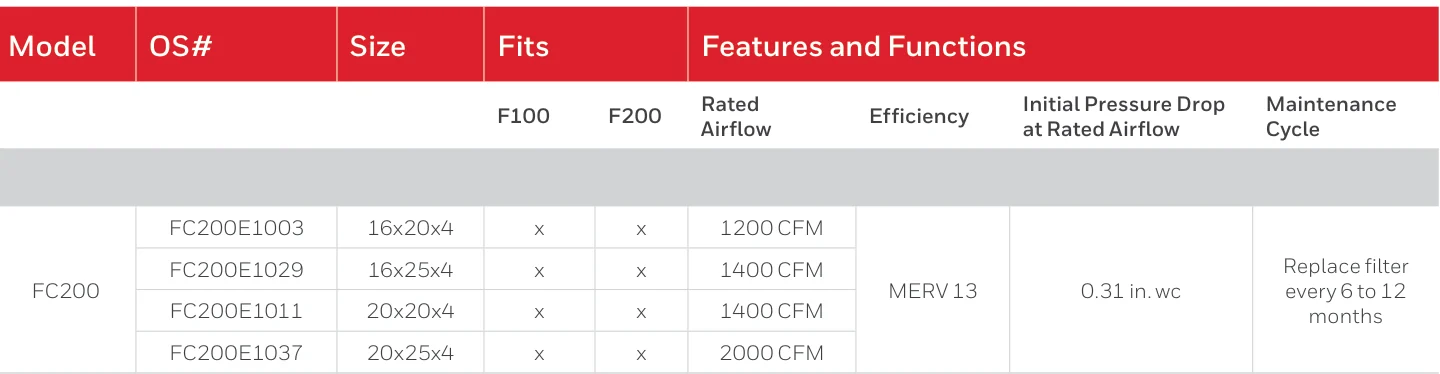
Compare pressure drop within one brand. Resideo (Honeywell Home) says makers may measure at different airflows, so apples-to-apples comparisons are difficult. Its 4-inch MERV 13 FC200E lists 0.31 in. w.c. at 1,200 to 2,000 cfm, not Filterbuy’s 1,000 cfm.
Tip: Fit matters as much as the number. EPA says air that leaks around a poorly fitted filter greatly reduces how well filtration works. In our view, a snug MERV 11 beats a loose MERV 13.
How often to change MERV 8, 11 and 13 filters
EPA says manufacturers typically recommend replacing furnace filters every 60 to 90 days, sooner if a filter looks heavily soiled, and that applies to all three ratings. ENERGY STAR advises inspecting the filter monthly. Our guide on how often to change an air filter has the full schedule by filter depth.
What to buy first
For most homes with a standard 1-inch slot, we’d start with a MERV 13 filter and watch airflow for the first few weeks. Our best furnace filter guide compares six options, from the Filtrete MPR 1900 (MERV 13 with published capture figures) to a low-resistance Filterbuy MERV 8 for systems that need it.
Frequently asked questions
Is MERV 11 or MERV 13 better?
MERV 13 captures more: EPA lists a minimum of 50% for 0.3 to 1 µm particles, against 20% for MERV 11. MERV 13 is also EPA's recommended minimum, as long as your system fan and filter slot can handle it.
Is MERV 8 good enough for a home?
For lint and larger dust, often yes. MERV 8 has no requirement for the 0.3 to 1 µm range that smoke falls in, so EPA's advice to use at least MERV 13 applies if your system can take it.
Is MERV 13 too high for my furnace?
Usually not. EPA says most systems can take MERV 13 if the filter is replaced frequently, but not every fan can handle the extra resistance. Check your furnace manual or ask an HVAC technician to measure airflow.
What MERV rating is best for wildfire smoke?
EPA advises HVAC filters rated MERV 13 or higher if your system can take them, with the fan set to On instead of Auto. EPA also recommends a portable air cleaner for the room you use most.
What MPR rating equals MERV 11?
3M lists the Filtrete MPR 1000 as MERV 11. On 3M's product pages, MPR 700 is MERV 8, and MPR 1900 and 2200 are MERV 13.
Related guides
Guides
Furnace Filter Buying Guide (2026): MERV, Size and 6 Picks
Six furnace filters chosen on published ratings and airflow data, plus how to tell if MERV 13 is too much for your system and how to buy the right size.
16 min read

Guides
MERV Rating Chart: What MERV 11, 13 and 16 Filters Actually Capture
A MERV rating chart built from ASHRAE 52.2 minimums, plus how MERV compares with HEPA and MPR, which rating suits smoke, allergies and pets, and when your HVAC can't take it.
7 min read
Guides
How Often to Change Your Air Filter: Furnace and HVAC Filter Schedule by Type
How often to change a furnace or HVAC filter: 1-inch filters every 1 to 3 months, deep media filters every 6 to 12 months, with manufacturer schedules and the signs to change sooner.
6 min read

Guides
Why Is My House So Dusty? Causes and Fixes That Work
Most house dust blows in, gets tracked in or is shed indoors. Here is where yours likely comes from and the fixes in the order that pays off most.
8 min read