Whole House Air Purifier Guide (2026): MERV 13 Cabinets, Filters and Portables
Five ways to clean the air in every room: in-duct media cabinets, an electronic air cleaner, a MERV 13 furnace filter and a large portable, compared.
By Clean Air Guides editorial teamUpdated 11 min read
Our picks at a glance
- Top pickCheck price
Best media air cleaner
AprilAire U243 and U223 Whole-House Air Purifiers
AprilAire's current media cabinets, replacing the 2410 and 2210, with a 3-inch MERV 13 filter and no power or ozone.
- MERV 13 (3F413 / 3F213)
- Replaces 2410 / 2210
- Pro install
- Check price
Best MERV 13 cabinet from Honeywell Home
Honeywell Home F200 MERV 13 Media Air Cleaner
A 4-inch MERV 13 cabinet in four sizes rated from 1,200 to 2,000 cfm.
- MERV 13 (FC200E)
- 1,200-2,000 cfm by size
- Pro install
- Check price
Highest-efficiency in-duct option
AprilAire Model 5000 Electronic Air Purifier
Charged media that AprilAire rates as equivalent to MERV 15, CARB certified, but it does emit some ozone.
- 'MERV 15-equivalent' (AprilAire)
- Up to 60 W
- CARB certified
- Check price
Best no-install upgrade
A 1-inch drop-in furnace filter that 3M maps to MERV 13, if your system can take the extra resistance.
- MERV 13 (3M chart)
- 1-inch drop-in
- No install
- Check price
Best large portable (no ducts)
A 435 smoke CADR for open floors, ENERGY STAR certified, for homes without forced air.
- CADR 435 smoke
- 674 sq ft
- ENERGY STAR
Prices change often; Amazon shows the current price. As an Amazon Associate, Clean Air Guides earns from qualifying purchases.
In this article
- How a whole house air purifier works with your HVAC system
- What MERV 13 means
- Three limits to understand first
- How we chose
- Whole house air purifier options compared
- Whole house air purifier options: the five picks
- AprilAire U243 and U223
- Honeywell Home F200
- AprilAire Model 5000
- Filtrete MPR 1900
- Blueair Blue Pure 211i Max
- UV lights, PCO and ionizing add-ons
- Whole house air purifier installation and running costs
- Whole home air purifier vs several portable air purifiers
- What a whole-house air purifier can’t do
A whole house air purifier is a filter or air cleaner built into your forced-air heating and cooling system, so it cleans the air in every room the ducts reach. For most homes with ducts, the one to buy is a MERV 13 filter in a deep media cabinet installed in the return duct, such as AprilAire’s U243 or Honeywell Home’s F200. It uses no power of its own and makes no ozone. The catches: it only works while the system fan runs, it needs professional installation, and your blower has to handle the extra resistance. If you have no ducts, one or more large portable purifiers are the realistic alternative; see our best air purifier picks for single rooms.
How a whole house air purifier works with your HVAC system
A whole-house air cleaner sits in your HVAC system, so every time the blower runs, the house’s air passes through it. There are three main types:
- Better furnace filters. A drop-in 1-inch filter with a higher MERV rating. Cheapest, no installation, but thin filters add more airflow resistance.
- Media air cleaners (media cabinets). A housing installed in the return duct that holds a 3- to 4-inch-deep pleated filter. More media area means lower resistance and longer filter life.
- Electronic and add-on devices. Electrically charged media, UV lamps, PCO and ionizing units. Some improve particle capture, but several can create ozone.
A whole-house humidifier is a separate furnace-mounted device; see our best whole house humidifier guide.
What MERV 13 means
For the full scale and what each rating captures, see our MERV rating chart.
MERV comes from ASHRAE Standard 52.2 and runs from 1 to 16. It’s based on how well a filter captures three particle size ranges, and only MERV 11 and up have a requirement for the smallest range (0.3 to 1 µm):
| MERV | 0.3-1 µm | 1-3 µm | 3-10 µm |
|---|---|---|---|
| 11 | 20% | 65% | 85% |
| 12 | 35% | 80% | 90% |
| 13 | 50% | 85% | 90% |
| 16 | 95% | 95% | 95% |
EPA recommends HVAC filters rated at least MERV 13, or as high as your system fan and filter slot can handle, and suggests checking with an HVAC technician. For comparison, EPA says HEPA filters in home purifiers are generally comparable to MERV 16.
Three limits to understand first
- The fan has to run. Furnace and HVAC filters only clean air while the system fan is on. During wildfire smoke, EPA advises switching the fan to “On” rather than “Auto”.
- Airflow matters. EPA’s technical summary warns that high-efficiency filters can reduce airflow in systems not designed for them. That’s why a pro should check your blower before you jump to MERV 13 or higher.
- Fit matters. Air that leaks around a poorly fitted filter or through leaky return ducts bypasses filtration, which EPA says greatly reduces effectiveness.
EPA’s technical summary says central systems in most homes run less than 20 to 25% of the time on average. As a result, it says most MERV 13 to 16 furnace filters are likely almost as effective as HEPA filters for most indoor particle sizes. In our view, how long the fan runs matters as much as which filter you buy.
Whole-house systems also have no CADR, so you can’t compare them number-for-number with portable purifiers.
How we chose
We don’t test HVAC equipment. Specs come from AprilAire, Resideo (Honeywell Home) and 3M documents, the CARB certified list and EPA guidance, checked in October 2026. We favored MERV 13 or better, current models (AprilAire is replacing its 2410 and 2210 with the U243 and U223), published airflow or pressure-drop data, and no added ozone where possible.
Whole house air purifier options compared
| Option | Filter rating | Installation | Media change (maker) | Ozone |
|---|---|---|---|---|
| AprilAire U243 / U223 | MERV 13 (3-inch) | Professional | Not published for U-series (4-inch 413: yearly) | None (mechanical) |
| Honeywell Home F200 | MERV 13 (4-inch FC200E) | Professional | 6-12 months | None (mechanical) |
| AprilAire Model 5000 | “MERV 15-equivalent” (AprilAire) | Professional + outlet | Yearly | CARB certified, not zero |
| Filtrete MPR 1900 | MERV 13 (1-inch) | None | Not verified | None (mechanical) |
| Blueair Blue Pure 211i Max | Portable, CADR 435 smoke | None | Up to 9 months | 2 ppb (ENERGY STAR) |
Whole house air purifier options: the five picks
AprilAire U243 and U223
Best for: most forced-air homes that want MERV 13 without a thin, restrictive filter. This is our pick for most homes with ducts.
AprilAire’s media air purifiers are the classic whole-house choice, and in 2026 the lineup is changing: the U243 “Replaces AprilAire 2410” and the U223 replaces the 2210, according to AprilAire’s own pages. The new cabinets take 3-inch filters, the 3F413 (U243) and 3F213 (U223), both MERV 13. The cabinet itself has no motor, uses no power and makes no ozone; the only sound is your HVAC blower.
For context, the outgoing 2410 held a 4-inch MERV 13 filter with 28.3 sq ft of media, was rated for up to 2,000 cfm, and AprilAire’s spec sheet listed resistance from 0.05 in. w.c. at 600 cfm to 0.27 in. w.c. at 2,000 cfm. Its 413 filter is rated for a year and costs around $65; AprilAire calls it “sunsetting”. If you already own a 2410 or 2210, check filter compatibility before buying replacement media. AprilAire also sold MERV 11, MERV 13 with carbon and MERV 16 media for the older cabinets.
The trade-off: AprilAire sells and installs these through its dealers and doesn’t publish a unit price. We didn’t find published airflow, pressure-drop or replacement-interval data for the U-series yet. Professional installation is recommended; ask the installer to confirm your blower can handle MERV 13.
Our pick: Best media air cleanerAprilAire U243See today's price, ratings and delivery options
Check priceHoneywell Home F200
Best for: a MERV 13 media cabinet from an installer who works with Honeywell Home (Resideo).
The F200 holds a 4-inch FC200E MERV 13 filter. Resideo lists 63% capture at 0.3-1.0 µm, 90% at 1-3 µm and 97% at 3-10 µm, and an initial pressure drop of about 0.30 in. w.c. at 500 feet per minute. It comes in four sizes (16x20, 16x25, 20x20 and 20x25), rated from 1,200 to 2,000 cfm depending on the cabinet. Resideo says to replace the filter every 6-12 months. The older F200F2010 has been replaced by the F200F2025.
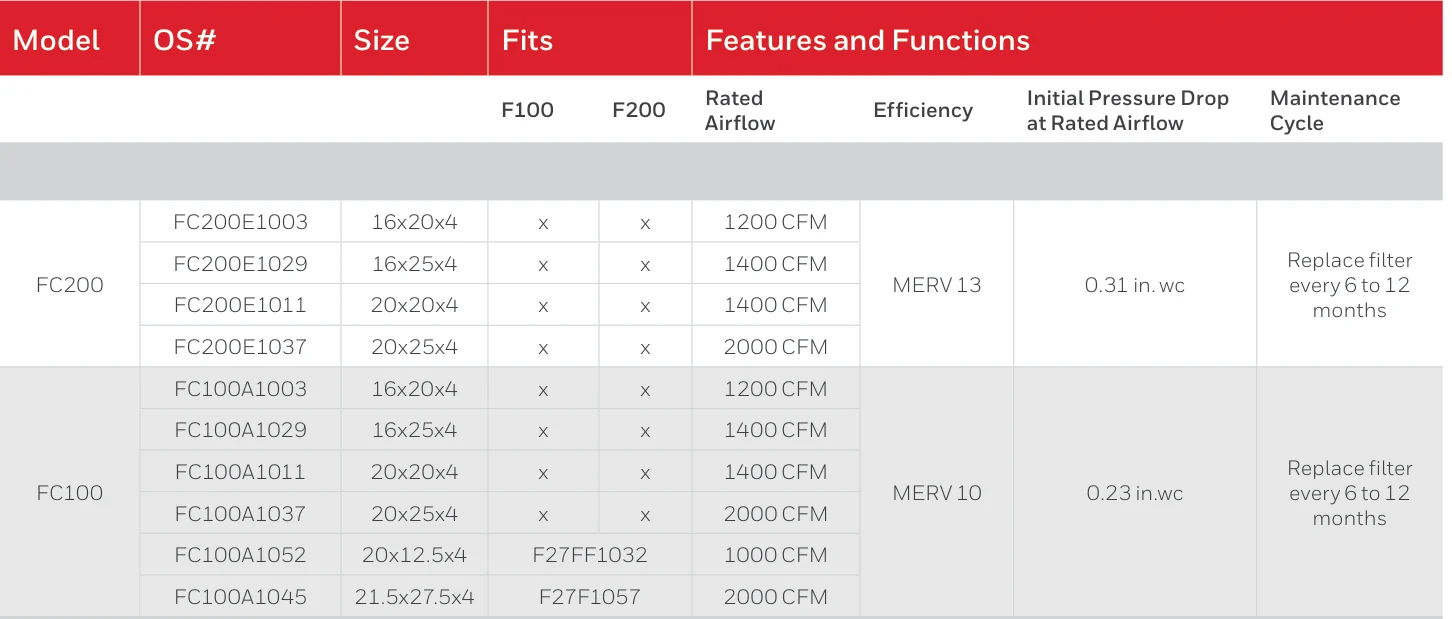
The trade-off: its pressure drop is higher than the F100’s (0.30 vs 0.23 in. w.c.), so your installer should check blower capacity. Honeywell Home says pricing requires a pro. If you already have an F100 cabinet, Resideo says it also accepts the FC200E MERV 13 filter, which upgrades it from its standard MERV 10-11 media.
Our pick: Best MERV 13 cabinet from Honeywell HomeHoneywell Home F200See today's price, ratings and delivery options
Check priceAprilAire Model 5000
Best for: the highest particle capture you can get from a duct-mounted unit, if you accept a small amount of ozone.
The Model 5000 uses ionizing wires to charge particles, which are then captured on disposable #501 media (16x25x6 nominal, 72.3 sq ft of media). AprilAire rates the 501 media at MERV 10 on its own but “equivalent to MERV 15” inside the 5000, and its shop page claims 89% capture at 0.3-1.0 µm. It’s rated for up to 2,000 cfm, needs a 120 V outlet and draws no more than 60 W, per AprilAire’s spec sheet. The media is changed once a year (around $54).
The trade-off: it’s an electronic air cleaner. It is CARB certified (2022), which means it meets the 0.050 ppm ozone limit, not that it makes no ozone. The ionizing wires and electrode need wiping at the annual service, and the spec sheet we found dates from 2005. We’d choose a mechanical MERV 13 cabinet unless your installer has a specific reason for the 5000.
Our pick: Highest-efficiency in-duct optionAprilAire Model 5000See today's price, ratings and delivery options
Check priceFiltrete MPR 1900
Best for: renters and anyone who wants MERV 13 without installing anything. We’d start here before paying for a cabinet.
The MPR 1900 is a 1-inch electrostatically charged pleated filter that drops into a standard furnace slot. 3M’s MPR-to-MERV chart maps it to MERV 13 (62% at E1, 87% at E2, 95% at E3). The MPR 2200 is also MERV 13. Watch the numbers: the MPR 1500 is only MERV 12.
The trade-off: a 1-inch MERV 13 filter adds more resistance than a deep media cabinet, and 3M publishes no pressure drop figure. It says to change this filter at least every 90 days. Our best furnace filter guide compares it with other drop-in options. EPA’s advice applies directly: use MERV 13 “or as high a rating as your system fan and filter slot can accommodate”, and consult an HVAC technician. If airflow drops or the system struggles, step back down.
Our pick: Best no-install upgradeFiltrete MPR 1900See today's price, ratings and delivery options
Check priceBlueair Blue Pure 211i Max
Best for: homes with radiators, mini-splits or no ductwork at all.
When there’s no forced-air system to add a filter to, a large portable purifier per main living area is the practical option. Blueair lists a smoke CADR of 435, dust 452 and pollen 450, for 674 sq ft (ENERGY STAR’s record shows 443/457/450 and 687 sq ft). It draws 46 W at most, is ENERGY STAR certified at 259 kWh a year, and has a washable fabric pre-filter and Wi-Fi.
The trade-off: one portable covers one open area, not the whole house. Its HEPASilent electrostatic charging can’t be switched off, and ENERGY STAR measured 2 ppb of ozone. The standard filter has light carbon; Blueair’s SmokeBlock version has more. Filters last up to 9 months and cost around $70. For a mechanical-only alternative, see the Coway Airmega 400 in our basement air purifier guide.
Our Blueair 211i Max review covers this model in more depth.
Our pick: Best large portable (no ducts)Blueair Blue Pure 211i MaxSee today's price, ratings and delivery options
Check priceUV lights, PCO and ionizing add-ons
HVAC contractors often offer UV lamps, photocatalytic oxidation (PCO) cells or ionizing devices as add-ons. EPA’s technical summary is cautious about all of them:
- UV lamps emitting at 254 nm and below can create ozone unless coated to block it, and home UV units don’t deliver enough dose to reliably deactivate most airborne microbes.
- PCO and plasma devices can form harmful byproducts, including ozone and formaldehyde.
- Ionizers and electrostatic devices may produce ozone and don’t remove gases or odors.
California now requires in-duct electronic air cleaners to be CARB certified at no more than 0.050 ppm of ozone; amendments effective October 1, 2020 gave them 24 months to comply. Mechanical media filters fall outside that certification because they don’t produce ozone. In our view, a MERV 13 media filter should come first, and any add-on should be CARB certified. Our air scrubber vs air purifier guide covers the PCO units sold as “air scrubbers”, and our article on air purifier side effects explains the ozone risk.
Whole house air purifier installation and running costs
A whole house air purifier costs you in two ways: the installation and the electricity to run the blower longer. EPA’s technical summary says existing systems may need ductwork changes to fit a thicker filter, sometimes a more powerful fan, and a professional airflow check, because simply installing a high-efficiency filter is no guarantee it will work as intended.
Running cost. EPA puts a typical residential blower at about 250 to 600 W, around 450 W on average. At $0.12 per kWh, running it all year costs about $475, versus roughly $95 at a typical 20% runtime. Check your own numbers with our air purifier electricity cost calculator.
Whole home air purifier vs several portable air purifiers
A whole home air purifier wins when you have forced air and want every room covered; several portables win when you have no ducts or need only a few rooms clean. EPA notes that two or more well-placed portable air cleaners can be as effective as HVAC filtration and may cost less than running the central fan continuously.
A whole-house filter makes sense when you have forced air, want to filter every room at once, and are willing to run the fan more. It also catches everyday dust as it circulates; see why is my house so dusty for the other causes.
Portables make sense when you have no ducts, rent, or need strong filtration in one or two rooms, such as a bedroom during wildfire smoke. A portable’s CADR is measured, so you can size it with the air purifier size calculator. For smoke-heavy rooms, see the best air purifier for smoke.
How many portables equal a whole house? EPA’s sizing chart asks for a smoke CADR of about two-thirds of the floor area (65 cfm per 100 sq ft, 8 ft ceilings). So 2,000 sq ft needs about 1,300 cfm: three Blueair 211i Max units (435 each), and only if the spaces are open to each other. Closed-off rooms each need their own unit. For open-plan areas, see our best air purifier for a large room guide.
Many homes use both. The CDC suggests adding up the air changes from each strategy (HVAC filtration, portable cleaners, open windows) to get the total.
Important: Have a licensed HVAC professional install any media cabinet or electronic air cleaner. EPA suggests checking with an HVAC technician before moving to a higher-MERV filter, because filters that are too restrictive for your system can reduce airflow.
What a whole-house air purifier can’t do
Filters only work on what reaches them. EPA says no air cleaner removes all pollutants in a home, and particle filters don’t remove gases or odors. Whole-house filtration also does nothing for radon, which EPA says to address by testing and, at 4 pCi/L or more, mitigation. Source control and ventilation still come first.
Frequently asked questions
Are whole-house air purifiers worth it?
If you have forced-air heating or cooling, a MERV 13 filter or media cabinet is usually the cheapest way to filter every room, and EPA recommends at least MERV 13 if your system can handle it. The catch is that it only filters while the system fan runs.
What MERV rating is best for a home?
EPA recommends MERV 13 or the highest rating your system fan and filter slot can handle. MERV 13 must capture at least 50% of 0.3 to 1 µm particles, while MERV 11 needs only 20%. Ask an HVAC technician before going higher.
Is Filtrete MPR 1500 MERV 13?
No. 3M's MPR-to-MERV chart maps MPR 1500 to MERV 12. MPR 1900 and MPR 2200 are MERV 13.
Should I leave my HVAC fan on with a whole-house filter?
Furnace and HVAC filters only clean air while the fan runs. During wildfire smoke, EPA advises setting the fan to On rather than Auto so the air keeps passing through the filter.
Do whole-house UV lights or ionizers produce ozone?
They can. EPA says UV lamps emitting at 254 nm and below can create ozone unless coated, and that ionizers, electrostatic and plasma devices may emit it. California requires in-duct electronic air cleaners to be CARB certified at no more than 0.050 ppm.
How much does a whole home air purifier cost to run?
Mostly the electricity to run your HVAC blower longer. EPA estimates that a typical 450 W blower costs about $475 a year running nonstop at $0.12 per kWh, versus about $95 at a typical 20% runtime.
How often should a whole-house air filter be changed?
It depends on the filter. EPA says manufacturers typically recommend 60 to 90 days for furnace filters, while AprilAire rates its 4-inch MERV 13 media for a year and Honeywell its FC200E for 6 to 12 months.
Related guides
Air Purifiers
Best Air Purifiers for Large Rooms in 2026: Verified CADR for 500+ sq ft
Six air purifiers with enough verified clean air for living rooms and open plans of 500 sq ft or more, plus how to size one and when two units beat one.
12 min read
Air Purifiers
Best Filterless Air Purifiers in 2026: Ionizers, Ozone and Safer Options
What a filterless air purifier really is, why EPA warns about ozone, and the few CARB-certified options worth a look, plus a HEPA alternative.
10 min read
Air Purifiers
Best Air Purifiers of 2026: Research-Backed Picks for Every Room
Seven current air purifiers for every room and budget, chosen on verified CADR, HEPA filtration, ozone status, noise and filter cost.
19 min read
Air Purifiers
Best Air Purifiers for Dust in 2026: Fine Dust, Big Rooms and Pre-Filters
Six current air purifiers for dusty homes, picked on verified dust CADR, HEPA filters, cleanable pre-filters and real room sizes, plus what else to do about dust.
9 min read