Best Commercial Air Purifiers in 2026: Sizing for Shops, Restaurants, Gyms and Waiting Rooms
How to size air purifiers for a business by room volume and air changes, when one big unit beats several, and five high-CADR picks with verified specs.
By Clean Air Guides editorial teamUpdated 11 min read
Our picks at a glance
- Top pickCheck price
Best for large open spaces
AHAM-verified at 600 cfm, the top of AHAM's rating scale, with a mechanical-only design and no ionizer.
- CADR 600 smoke (AHAM)
- 930 sq ft (AHAM)
- No ionizer
- Check price
Best value for small shops
AHAM-verified 394 cfm for about half the price of the bigger units, so two or three can cover a small store.
- CADR 394 smoke (AHAM)
- 606 sq ft (AHAM)
- 65.6–67.3 W (AHAM)
- Check price
Best for waiting rooms and lobbies
Blueair Blue Signature (Large)
455 cfm smoke CADR on as little as 3.5 W, in a low cabinet that doubles as a side table.
- CADR 455 smoke (Blueair)
- 705 sq ft
- 3.5–42 W
- Check price
Best mechanical-only pick
CARB lists it as mechanical and ENERGY STAR measured 0.00 ppb ozone, with two filter sets working at once.
- CADR 376 smoke (ENERGY STAR)
- 583 sq ft (ENERGY STAR)
- 0.00 ppb ozone
- Check price
Best for odors in shops and dining rooms
With the Advanced (Fresh) filter it pairs a 370 cfm smoke CADR with 3.6 lb of activated carbon.
- CADR 370 smoke (ENERGY STAR)
- 3.6 lb carbon (Fresh filter)
- Ionizer can be switched off
Prices change often; Amazon shows the current price. As an Amazon Associate, Clean Air Guides earns from qualifying purchases.
A commercial air purifier has to be sized by room volume, not by the square footage printed on the box. Most shops, dining rooms and gyms are bigger and taller than the rooms those ratings assume, so you’ll usually need two or more units. For large open spaces we’d pick the Medify MA-112 PRO, which is AHAM-verified at 600 cfm, the top of AHAM’s rating scale. For a small shop on a budget, two or three Levoit Core 600S-P units go further, and for a waiting room the Blueair Blue Signature is quiet and efficient.
Run a purifier as well as ventilation, not instead of it. EPA’s advice for offices, schools and commercial buildings is to upgrade the HVAC filter as far as the system allows, then add portable air cleaners where ventilation is hard to improve.
How we chose
We don’t test purifiers. Every figure comes from the AHAM Verifide directory, the ENERGY STAR certified list, the CARB certification list or the manufacturer. For a business we looked for:
- High smoke CADR. Fewer, larger units are easier to place and maintain. All five picks deliver at least 370 cfm.
- A verified number. AHAM or ENERGY STAR figures where they exist, and the maker’s figure only where it matches them.
- Running cost. Shops run purifiers 10 or 12 hours a day, so watts and filter life matter more than at home.
- Ozone. Every pick is CARB-certified. Two use electrostatic charging or an optional ionizer, and we flag them.
We left out purifiers sold as “commercial” that publish no CADR, and ceiling-mounted systems, which need an installer and specs we couldn’t verify.
Commercial purifiers compared
| Model | Smoke CADR | Room size (8 ft ceiling) | Noise (maker) | Max power |
|---|---|---|---|---|
| Medify MA-112 PRO | 600 (AHAM) | 930 sq ft (AHAM) | 24.6–58.1 dBA | 160 W |
| Levoit Core 600S-P | 394 (AHAM) | 606 sq ft | 26–55 dB | 65.6–67.3 W (AHAM) |
| Blueair Blue Signature (Large) | 455 (Blueair, ENERGY STAR) | 705 sq ft | 23–55 dB | 42 W |
| Coway Airmega 400 | 376 (ENERGY STAR) | 583 sq ft | 22–52 dB | 66 W |
| Alen BreatheSmart 75i | 370 (ENERGY STAR) | 574 sq ft | 25–51 dBA | 55 W |
The best commercial air purifiers
Medify MA-112 PRO
Best for: gyms, open-plan stores, restaurant dining rooms and other large spaces.
AHAM lists 600 cfm smoke and dust CADR and 450 pollen, for about 930 sq ft. That’s the top of AHAM’s rating scale: Medify’s own factory figures are higher, but it notes AHAM verifies only up to 600 cfm. CARB lists it as mechanical, and there’s no ionizer. The filter combines H13 HEPA material with a carbon composite layer, and it has four speeds, a sleep mode, a timer and a child lock, which helps in a public space.
The trade-off: it’s loud and power-hungry at full speed. Medify rates it at 58.1 dBA on speed 4 and 41.7 dBA on speed 2, and at 160 W. The filter set lasts about 3,000 hours (Medify says four to five months), which is the highest running cost here. Medify mentions no sensor or app. It lists at around $595.
Our pick: Best for large open spacesMedify MA-112 PROSee today's price, ratings and delivery options
Check priceLevoit Core 600S-P
Best for: small shops, studios and offices where you’d rather spread out two or three cheaper units.
AHAM lists 394 cfm smoke, 398 dust and 433 pollen CADR, for about 606 to 611 sq ft, and it’s ENERGY STAR certified. At around $300 it’s the cheapest per cfm of our picks. A laser PM2.5 sensor runs Auto mode, and the VeSync app adds schedules, so you can run it hard before opening and quietly during business hours.
The trade-off: AHAM measured 65.6 to 67.3 W at top speed, more than Levoit’s 49 W rating. The Original filter costs around $60 and lasts 6 to 12 months. CARB lists one variant (-WUSR) as an electronic air cleaner although Levoit advertises no ionizer.
Our pick: Best value for small shopsLevoit Core 600SSee today's price, ratings and delivery options
Check priceBlueair Blue Signature (Large)
Best for: waiting rooms, reception areas and lobbies, where looks and low noise matter.
Blueair lists 455 cfm smoke, 434 dust and 450 pollen CADR for the Large SP4i, matching its ENERGY STAR record, for 705 sq ft. It draws 3.5 to 42 W, the lowest of our picks, and ENERGY STAR estimates 235 kWh a year. Blueair rates it at 23 to 55 dB. The low cabinet doubles as a side table, and it has Wi-Fi, Auto and Night modes and a display that wakes when someone walks up.
The trade-off: it uses HEPASilent electrostatic charging with no published way to switch it off. CARB classes it as electronic, and ENERGY STAR measured 3 ppb of ozone, well under CARB’s 50 ppb limit. If you want no charging at all, pick the Coway Airmega 400. The Large costs around $450, and its filter around $100 for up to a year.
Our pick: Best for waiting rooms and lobbiesBlueair Blue SignatureSee today's price, ratings and delivery options
Check priceCoway Airmega 400
Best for: businesses that want a purely mechanical purifier, for example a clinic waiting room or a shop with staff who are sensitive to ozone.
ENERGY STAR lists 376 cfm smoke, 384 dust and 409 pollen CADR, for 583 sq ft, and 0.00 ppb of ozone. CARB lists it as mechanical, and there’s no ionizer. It pulls air through both sides, each with a washable pre-filter and a combined carbon and HEPA filter. Coway rates it at 22 to 52 dB and 66 W. The 400S version adds Wi-Fi, an app and schedules.
The trade-off: Coway’s own page lists lower CADRs (328 smoke) than ENERGY STAR, so size with some margin. It’s expensive per cfm, at around $650 (400) or $750 (400S), and the two-filter set costs around $130. Coway gives a one-year life in its spec table and 6 to 12 months in its product copy.
Our pick: Best mechanical-only pickCoway Airmega 400See today's price, ratings and delivery options
Check priceAlen BreatheSmart 75i
Best for: boutiques, pet stores and dining rooms where odor is part of the problem.
ENERGY STAR lists 370 cfm smoke, 351 dust and 431 pollen CADR, for 574 sq ft. The key is the filter: Alen says the Advanced (Fresh) filter holds 3.6 lb of activated carbon. Most purifiers don’t publish a carbon weight at all. Alen rates it at 25 to 51 dBA and 55 W. It has Wi-Fi, an app and Auto mode.
The trade-off: the unit ships with the Essential or Ultimate filter, so buy the Fresh filter for odors. That filter costs around $130 and lasts 7 to 10 months. The ionizer is optional; we’d leave it off. It’s expensive, at around $800 to $870 on alen.com. Our salon air purifier guide covers heavier carbon units for chemical fumes.
Our pick: Best for odors in shops and dining roomsAlen BreatheSmart 75iSee today's price, ratings and delivery options
Check priceHow to size a commercial air purifier
The room sizes on purifier boxes assume an 8 ft ceiling and about 4.8 air changes per hour. Business spaces rarely have 8 ft ceilings, so work from volume instead:
Clean air needed (cfm) = length x width x ceiling height x air changes per hour ÷ 60
CDC suggests aiming for 5 or more air changes per hour of clean air in occupied spaces, counting outdoor ventilation, HVAC filtration and air cleaners together, and calls it a rough guide that doesn’t guarantee safe air. The examples below assume the purifiers have to supply all 5 air changes, which is the worst case. Our air purifier size calculator does the math for your room.
| Space (example) | Size and ceiling | Volume | Clean air for 5 ACH | What gets you there |
|---|---|---|---|---|
| Waiting room | 15 x 20 ft, 9 ft | 2,700 cu ft | 225 cfm | One Blue Signature (Large): about 10 ACH |
| Small shop | 25 x 40 ft, 10 ft | 10,000 cu ft | 833 cfm | Two Medify MA-112 PRO: 7.2 ACH; three Core 600S-P: 7.1 ACH |
| Restaurant dining room | 40 x 50 ft, 10 ft | 20,000 cu ft | 1,667 cfm | Three Medify MA-112 PRO: 5.4 ACH |
| Gym | 50 x 60 ft, 12 ft | 36,000 cu ft | 3,000 cfm | Five Medify MA-112 PRO: 5.0 ACH |
| Church or hall | 50 x 80 ft, 24 ft | 96,000 cu ft | 8,000 cfm | 14 Medify units: HVAC filtration is the better route |
Already have a purifier in mind? Our air changes per hour calculator shows what a given CADR, or several units, deliver in your space, and lets you add the air your HVAC system already moves.
One large unit or several?
We’d buy several in most rooms. No AHAM-verified portable purifier is rated above 600 cfm, so anything bigger than a waiting room needs more than one anyway. Spread them out: one near the entrance, one near where people gather, with open space around each intake. Several units also let you run each on a quieter speed. One large unit makes sense in a small room, where a single filter change is simpler for staff.
Why size up
CADR is measured at top speed. EPA notes that the CADR at lower, quieter speeds often isn’t published and can be much lower. With customers in the room you’ll want a middle speed, so buy more CADR than the table says.
High ceilings
Ceiling height scales the clean air you need directly. A 16 ft ceiling needs twice the cfm of an 8 ft one, and a 24 ft sanctuary three times as much. Past a point, the HVAC system is the better tool: it already moves large volumes of air through a filter.
Noise with customers present
Every dB rating here comes from the maker, usually without a measuring distance, so treat them as a rough guide. At top speed our picks are rated from about 51 to 58 dB, which customers will hear in a quiet shop or waiting room. Running two units on a middle speed is usually quieter than one on high. Use schedules where the purifier has an app: high before opening and after closing, lower during business hours.
Ventilation and HVAC filters come first
EPA’s advice for commercial buildings is to upgrade the HVAC filter to the highest efficiency the system can handle, check that it fits without gaps, and get an HVAC professional to set it up. Portable air cleaners then supplement the system, especially in areas that are hard to ventilate. EPA also says air cleaning doesn’t replace source control or ventilation. Our MERV rating chart explains filter grades.
A purifier doesn’t replace a kitchen hood. Cooking smoke, grease and gases should be captured at the stove and exhausted outdoors. A purifier in the dining room can help with what escapes.
Portable or in-duct? HVAC filtration treats the whole building without using floor space, but it only filters while the fan runs and needs a contractor. Portables go where the problem is.
Important: EPA says not to use ozone generators in occupied spaces. It calls bipolar ionization an emerging technology that can create ozone and other byproducts, and recommends a device certified to UL 2998 (zero ozone emissions) if you choose one.
Running cost for a business
At 12 hours a day, every day (4,380 hours a year), at top speed and the US average residential price of 18.31 cents per kWh in July 2026 (EIA), per unit:
| Model | Watts at top speed | kWh per year | Electricity per year | Filters |
|---|---|---|---|---|
| Blueair Blue Signature (Large) | 42 W | 184 | About $34 | Around $100, up to 1 year |
| Alen BreatheSmart 75i | 55 W | 241 | About $44 | Around $130, 7–10 months (Fresh) |
| Coway Airmega 400 | 66 W | 289 | About $53 | Around $130 a set, 6–12 months |
| Levoit Core 600S-P | 67.3 W (AHAM) | 295 | About $54 | Around $60, 6–12 months |
| Medify MA-112 PRO | 160 W | 701 | About $128 | Around $140 per 3,000 hours |
Business electricity rates differ from residential ones, so put your own rate into the air purifier electricity cost calculator. Lower speeds cost less. On the Medify, filters run to about $200 a year at these hours, more than the electricity.
Common business types
- Shops and boutiques: two or three mid-size units spread along the floor. Add carbon (Alen Fresh filter) if products or customers bring odors.
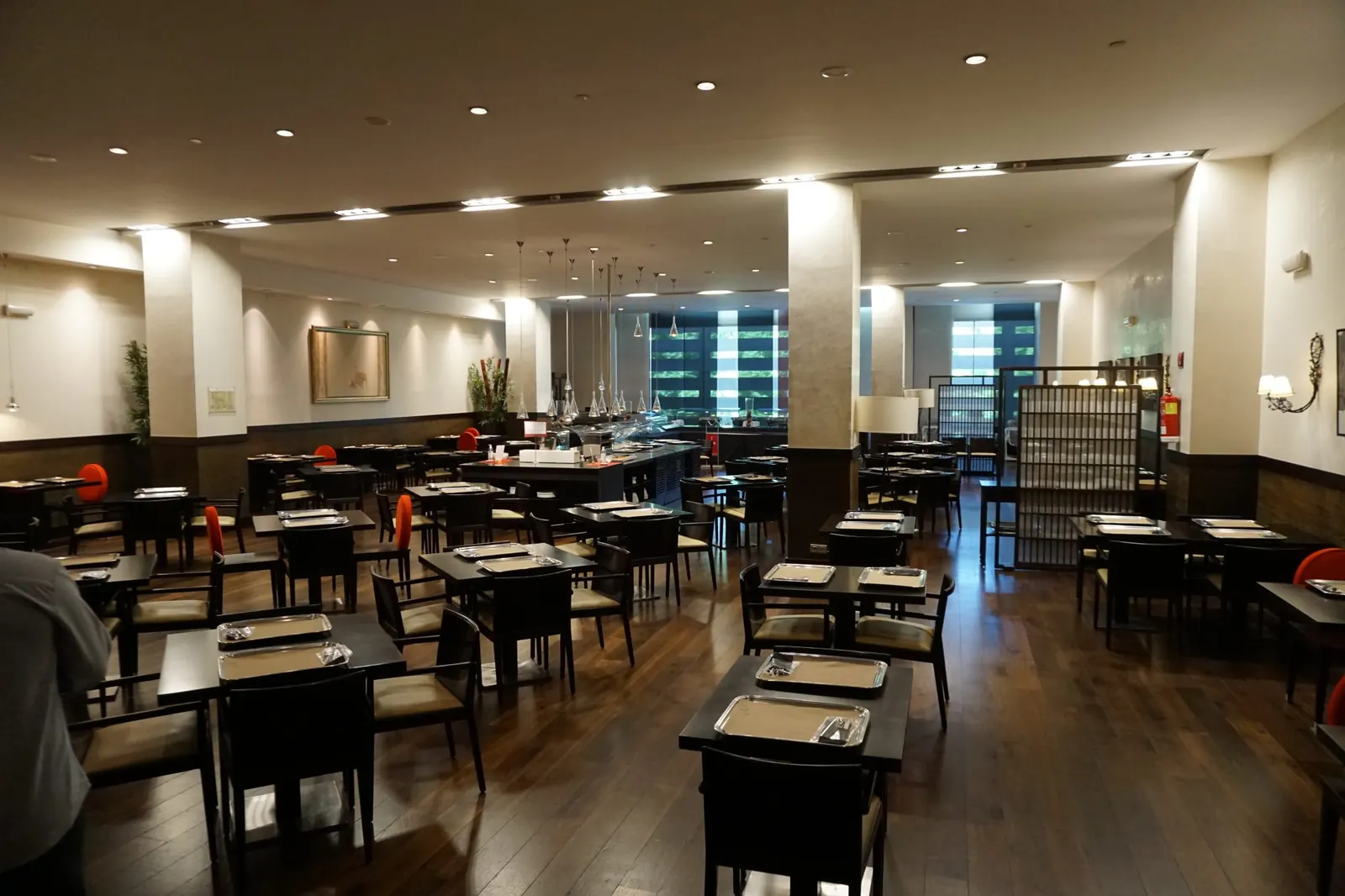
- Restaurants and cafes: a vented kitchen hood first, then high-CADR units in the dining room, away from the kitchen door so they don’t pull smoke across the room.
- Gyms and studios: large volumes and lots of people; the Medify’s 600 cfm keeps the unit count down.
- Waiting rooms and clinics: one quiet unit sized for the room, ideally mechanical-only (Coway Airmega 400). Point airflow so it doesn’t blow from one seat straight to the next, as EPA suggests.
- Churches and halls: tall ceilings make portables expensive; talk to an HVAC contractor about filtration first.
What a commercial air purifier can’t do
A purifier filters the air already in the room. It doesn’t bring in fresh air, lower CO2 or humidity, or remove carbon monoxide. HEPA filters catch particles such as dust, pollen and smoke, while gases and odors need a lot of carbon, and even then a purifier can’t keep up with a strong source. Fix the source and the ventilation first, then size the purifiers for what’s left.
Frequently asked questions
What size air purifier do I need for a business?
Work from room volume. Multiply length, width and ceiling height, then multiply by the air changes you want and divide by 60. A 25 x 40 ft shop with a 10 ft ceiling needs about 833 cfm of clean air for 5 air changes per hour.
Is one big commercial air purifier better than several small ones?
In our view, usually several. No AHAM-verified portable purifier is rated above 600 cfm, and two or three units placed where people gather can each run on a quieter speed. One large unit is easier to look after, so it suits small rooms.
Can an air purifier replace ventilation in a store or restaurant?
No. EPA says air cleaning helps alongside source control and ventilation but is not a substitute for either, and that portable units should supplement the building's HVAC ventilation and filtration.
Do air purifiers work in rooms with high ceilings?
They work, but you need more of them. Room sizes on the box assume an 8 ft ceiling, so a 16 ft ceiling doubles the clean air you need. For tall spaces such as churches and gyms, better HVAC filtration is often the more practical step.
Will an air purifier get rid of kitchen smoke in a restaurant?
Not on its own. Cooking smoke, grease and gases belong to an exhaust hood that vents outdoors. A purifier can help in the dining room with what drifts out of the kitchen.
Are ionizers or ozone air purifiers safe for businesses?
EPA says not to use ozone generators in occupied spaces and calls bipolar ionization an emerging technology that can produce ozone. If you pick a device with ionization, EPA recommends one certified to UL 2998 for zero ozone emissions.
Related guides
Air Purifiers
Best Air Purifiers for Large Rooms in 2026: Verified CADR for 500+ sq ft
Six air purifiers with enough verified clean air for living rooms and open plans of 500 sq ft or more, plus how to size one and when two units beat one.
12 min read

Air Purifiers
Best Air Purifiers for Classrooms in 2026: Sizing, Noise and No-Ionizer Picks
How many purifiers a typical classroom needs, how loud they can be while you teach, and five mechanical-filter picks a teacher or a school can buy.
9 min read
Air Purifiers
Best Air Purifiers of 2026: Research-Backed Picks for Every Room
Seven current air purifiers for every room and budget, chosen on verified CADR, HEPA filtration, ozone status, noise and filter cost.
14 min read
Air Purifiers
Best Air Purifiers for a Bedroom in 2026: Quiet, Dark and Sized to Run All Night
Five bedroom air purifiers with published sleep-mode noise, light and display options, verified CADR for bedroom sizes and what a night of running costs.
11 min read