Best Air Purifiers for a Baby Room in 2026: Quiet, No Ozone, Nursery-Safe
Four quiet, CARB-certified air purifiers for a nursery, with published noise levels, ionizer status, sleep and light settings, and safe-placement tips.
By Clean Air Guides editorial teamUpdated 12 min read
Our picks at a glance
- Top pickCheck price
Best overall
Coway Airmega Mighty2 AP-1512N
The lowest published noise floor here, no ionizer and a Sleep mode.
- 19-50 dB
- No ionizer
- CADR 240 smoke (Coway)
- Check price
Best sleep mode
Its manual says Sleep mode drops to a near-silent speed and turns off both the indicator light and PlasmaWave.
- 23.5 dB minimum
- Ionizer can be switched off
- 392 sq ft
- Check price
Best budget pick
AHAM-listed for 215 sq ft, no advertised ionizer and a display you can turn off.
- 24-54.5 dB
- CADR 139 smoke (AHAM)
- Display off
- Check price
Best wall-mounted option
Can be mounted on the wall, out of a toddler's reach, with a published low of 20.3 dBA.
- 20.3-51.0 dBA
- Wall-mountable
- Ionizer can be switched off
Prices change often; Amazon shows the current price. As an Amazon Associate, Clean Air Guides earns from qualifying purchases.
In this article
- How we chose
- Nursery purifiers compared
- What do the picks cost per year?
- The best air purifiers for a baby room
- Best overall: Coway Airmega Mighty2 AP-1512N
- Best sleep mode: Winix 5520
- Best budget pick: Levoit Core 300-P
- Best wall-mounted option: Rabbit Air A3
- Models we considered and left out
- Size it for the nursery
- Safe placement in a baby’s room
- Ozone, ionizers and fragrance
- Humidity and the nursery
- What an air purifier can’t do
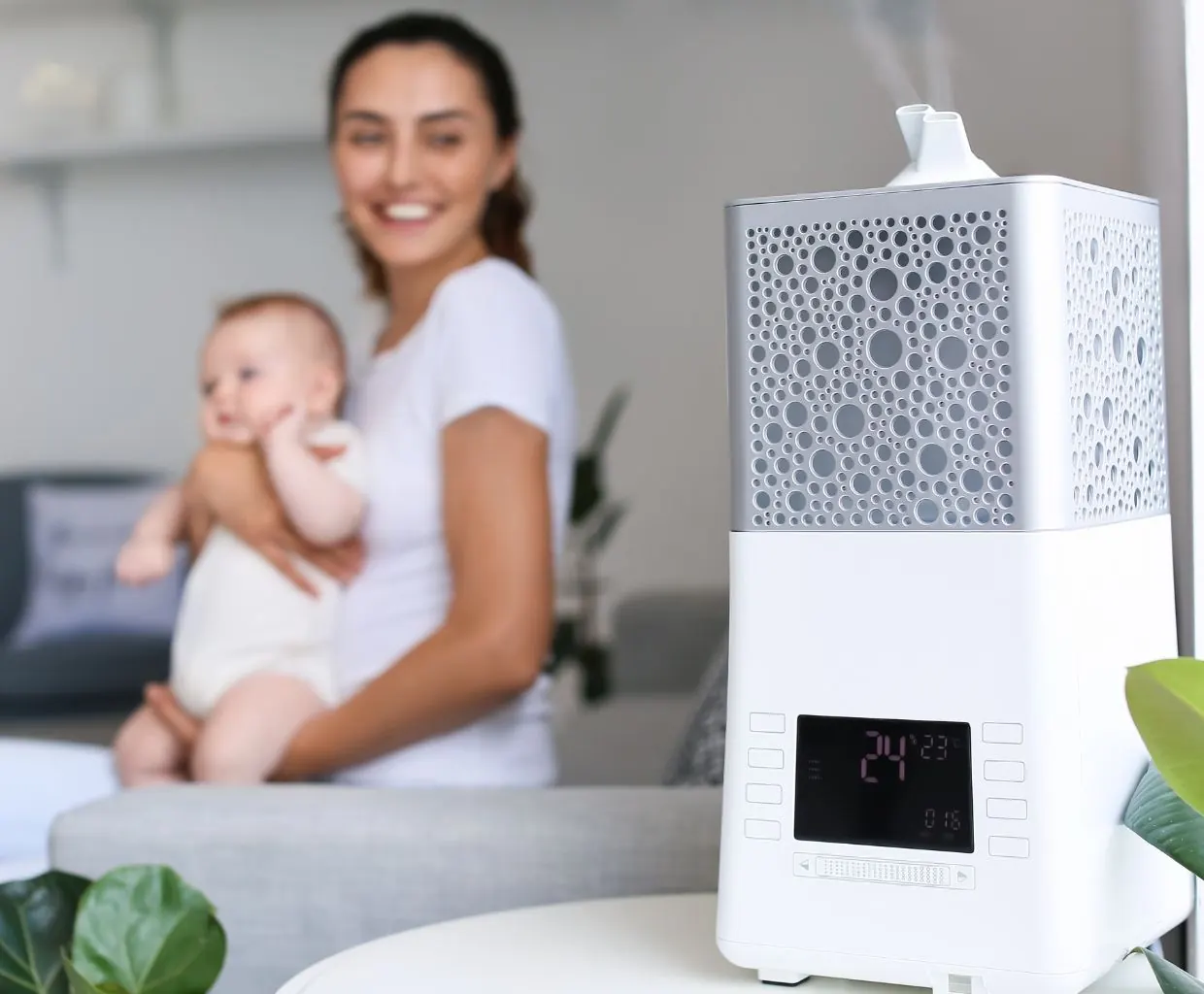
The best air purifier for a baby room is quiet on its lowest speed, doesn’t run an ionizer (or lets you switch it off), is CARB-certified and has a sleep mode or a light you can turn off. Our pick is the Coway Airmega Mighty2 AP-1512N: Coway rates it at 19 to 50 dB, it has no ionizer, and its CADR is roughly three times what a 10 x 12 ft nursery needs. Place it out of reach with the cord tucked away, and ask your pediatrician if your baby has breathing problems.
How we chose
We don’t test purifiers. These picks come from manufacturer pages and manuals, the AHAM Verifide directory and the CARB certified list, checked in October 2026 (see how we research). For a nursery we required:
- A published noise figure. We only quote decibels the maker publishes. EPA notes that noise depends on fan speed and that about 50 dB is roughly a modern refrigerator.
- No ionizer, or one you can switch off. EPA says ionizers and electrostatic cleaners may emit ozone, a lung irritant.
- CARB certification. California certifies every air cleaner sold there at 0.050 ppm of ozone or less. That isn’t zero, which is why the ionizer rule comes first.
- A sleep mode or a light-off option, documented by the maker.
- Enough CADR for a bedroom-size room on a low, quiet speed.
That ruled out some popular models; the left-out table after the picks lists them with the reason for each.
Nursery purifiers compared
| Model | Noise (maker) | Ionizer | Smoke CADR / room size | Night features |
|---|---|---|---|---|
| Coway Mighty2 AP-1512N | 19-50 dB | None | 240 (Coway) / about 372 sq ft* | Sleep mode |
| Winix 5520 | 23.5 dB min | PlasmaWave, switchable | 253 / 392 sq ft (AHAM) | Sleep mode turns off LED and PlasmaWave |
| Levoit Core 300-P | 24-54.5 dB | None advertised | 139 / 215 sq ft (AHAM) | Sleep mode, display off |
| Rabbit Air A3 | 20.3-51.0 dBA | Switchable | 257 (Rabbit Air) / about 398 sq ft* | Light sensor |
*Our math using AHAM’s formula (smoke CADR × 1.55). Coway publishes only a 1-air-change figure, and Rabbit Air rates the A3 at 535 sq ft on a 4-air-change basis.
What do the picks cost per year?
Filters use the maker’s price and replacement interval. Electricity uses the top-speed watts for 8 hours a day at the July 2026 US average of 18.31 cents per kWh (EIA): watts × 8 × 365 ÷ 1,000 × $0.1831. These are our calculations; a nursery purifier on a low speed overnight uses less.
| Model | Filters per year | Electricity, 8 h a day | Total per year |
|---|---|---|---|
| Coway Mighty2 AP-1512N | Around $70 to $80 (one set, rated up to 1 year) | About $30 (56 W, Coway) | About $100 to $110 |
| Winix 5520 | Around $50 to $80 (one Filter Q a year) | About $35 (65 W, Winix) | About $85 to $115 |
| Levoit Core 300-P | About $45 to $80 (a $30 to $40 filter every 6 to 8 months, Levoit manual) | About $29 (53.3 W, AHAM) | About $74 to $109 |
| Rabbit Air A3 | About $58 (a $116 kit every 2 years at 12 h a day or less) | About $32 (60 W max, Rabbit Air) | About $90 |
The best air purifiers for a baby room
Best overall: Coway Airmega Mighty2 AP-1512N
Buy it if:
- You want no ionizer at all in the nursery.
- Low noise matters most: Coway publishes a 19 dB low and Quiet Mark certification.
- You’d like a washable pre-filter and one main filter rated for up to a year.
Skip it if:
- You want a CADR verified by AHAM; this one is Coway’s own.
- You need the display to go fully dark; Coway doesn’t say whether it can.
The Mighty2 is Coway’s March 2026 update of the AP-1512HH. Coway rates it at 19 to 50 dB and says it is Quiet Mark certified. CARB lists it as a mechanical air cleaner, and the product page describes no ionizer. A washable pre-filter sits in front of a combined carbon and HEPA “Max2” filter rated for up to a year. A laser particle sensor runs Smart mode, and there are Sleep, Eco and Turbo modes plus a 1 to 12 hour timer. Manufacturer CADR is 240 for smoke.
The trade-off: Coway isn’t in the AHAM directory, so the CADR is Coway’s own, and Coway doesn’t say whether the display can be fully switched off. It’s around $270. The older AP-1512HH is cheaper but has an ionizer; its manual says the IONIZER button turns it off, and holding that button for 3 seconds turns off the air-quality light.
Cost per year (our calculation): electricity is about $30 at 8 hours a day on top speed (56 W), plus one filter set a year at around $70 to $80 on Coway’s site, for about $100 to $110.
Our pick: Best overallCoway Mighty2See today's price, ratings and delivery options
Check priceBest sleep mode: Winix 5520
Buy it if:
- You want a dark, quiet room at night without fiddling with settings.
- You want an AHAM-verified CADR (253 smoke, 392 sq ft) and a True HEPA filter.
Skip it if:
- You’d rather have no ionizer in the unit at all, even one you can switch off.
- You want to know how loud it gets on high; Winix publishes only the minimum.
Winix’s manual is unusually clear on night use: in Sleep mode the fan drops below Low to a speed Winix calls “nearly silent”, the air-quality light switches off, and PlasmaWave is disabled. Winix publishes a 23.5 dB minimum. CADR is 253 for smoke for a 392 sq ft room, figures the AHAM directory confirmed in November 2026, so a nursery is well covered on low speeds. Filtration is a washable pre-filter, a carbon-pellet filter and True HEPA, replaced as Filter Q about once a year (around $50 to $80; Winix’s store showed both prices in October and November 2026).
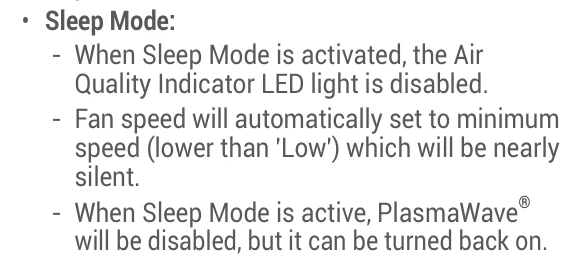
The trade-off: PlasmaWave is an ionizing stage, and CARB lists the 5520 as electronic. It’s off in Sleep mode and has its own off button, but remember to check it if you use other modes. Winix doesn’t publish the maximum noise. It’s around $260 at Winix’s store (it was on sale for around $200 in October 2026).
Cost per year (our calculation): about $85 to $115, from one Filter Q at around $50 to $80 plus about $35 of electricity at 8 hours a day on top speed (65 W). AHAM’s annual energy figure of 323 kWh would cost about $59.
Our pick: Best sleep modeWinix 5520See today's price, ratings and delivery options
Check priceBest budget pick: Levoit Core 300-P
Buy it if:
- It’s for a small nursery and the budget is under $100.
- You want a sleep mode, a timer and a display you can turn off.
Skip it if:
- You want an air-quality sensor or Auto mode.
- You want a filter labeled true HEPA.
AHAM lists SKU LAP-C302-WUSR, which appears to be the Core 300-P, at 139 smoke CADR and 215 sq ft, so a 120 sq ft nursery needs well under its top speed. Levoit rates it at 24 to 54.5 dB, with a sleep mode, a 2 to 8 hour timer and a display-off option. Levoit advertises it as “Ozone Free” with no ionizer, and CARB certifies the “Core 300” as mechanical.
The trade-off: CARB lists one Core 300 SKU code as electronic even though Levoit mentions no ionizer, and AHAM lists the filter as “HEPA-Type”. Levoit’s manual says to replace the filter every 6 to 8 months; filters are around $30 to $40. It has no sensor or Auto mode. It’s around $90 to $100.
Cost per year (our calculation): about $29 of electricity at 8 hours a day on top speed (AHAM’s 53.3 W). Filters are around $30 to $40 each, every 6 to 8 months per Levoit’s manual, so about $45 to $80 more, for about $74 to $109.
Our pick: Best budget pickLevoit Core 300-PSee today's price, ratings and delivery options
Check priceBest wall-mounted option: Rabbit Air A3
Buy it if:
- You want the purifier off the floor and away from a crawling or climbing child.
- You want a published low of 20.3 dBA, a light sensor and an app.
Skip it if:
- The budget is tight: it’s around $750.
- You want a mechanical-only unit; CARB lists it as electronic because of its ionizer.
The A3 can be mounted on a wall, which is the simplest way to keep little hands away from it. Rabbit Air publishes 20.3 to 51.0 dBA across five speeds, and its negative-ion generator can be switched off. Manufacturer CADR is 257 for smoke. Filtration is a washable pre-filter, a medium filter, granular activated carbon, a HEPA filter and one customized filter (Germ Defense, Pet Allergy, Odor Remover or Toxin Absorber). A light sensor, particle and odor sensors, Wi-Fi and an app are included.
The trade-off: Rabbit Air isn’t in the AHAM directory, and CARB lists the A3 as electronic because of its ionizer, so switch the ionizer off in a nursery. A wall-mounted unit still needs a cord to an outlet. The filter kit is around $116 a year at 24/7 use, and the unit is around $750.
Cost per year (our calculation): about $90 at 8 hours a day: about $58 in filters (Rabbit Air says a kit lasts up to 2 years at 12 hours a day) plus about $32 of electricity at its 60 W maximum. Run around the clock, it’s about $116 in filters plus about $96 in electricity.
Our pick: Best wall-mounted optionRabbit Air A3See today's price, ratings and delivery options
Check priceModels we considered and left out
Each of these came up in our research. Here’s the one reason it isn’t a pick, and where that reason comes from.
| Model | Why it’s not a pick | Source |
|---|---|---|
| Blueair Blue Pure 311i Max | HEPASilent electrostatic charging can’t be disabled, and ENERGY STAR measured 2 ppb of ozone | Blueair, ENERGY STAR, CARB (electronic) |
| Honeywell AirGenius 5 (HFD320) | Always-on ionizer with no documented off switch | Honeywell manual, CARB |
| Coway AP-1512HH Mighty | Has an ionizer (switchable); the Mighty2 that replaces it has none | Coway manual, CARB (electronic) |
| Levoit Core Mini-P | Rated for only 53 sq ft, too small for most nurseries | ENERGY STAR, Levoit |
| Levoit Core Mini-P with Night Light | Same 53 sq ft rating, and we couldn’t confirm that the night light turns off | AHAM, Levoit |
Size it for the nursery
AHAM’s rule of thumb is a smoke CADR of at least two-thirds of the floor area, assuming an 8 ft ceiling. AHAM’s own example is a 10 x 12 ft room (120 sq ft), which needs at least 80 cfm. Every pick here clears that easily, which is the point: CADR is measured on the top fan speed, and EPA says lower speeds filter less air. A unit with a CADR well above the minimum can run on its quiet setting and still do the job. Our air purifier size calculator works for vaulted ceilings and odd room shapes.
Safe placement in a baby’s room
No manual we read gives a distance from a crib, so these points combine what the manuals say with common sense:
- Clearance. Coway’s AP-1512HH manual asks for at least 20 cm (about 8 inches) from walls and nearby objects and 30 to 60 cm (about 1 to 2 ft) of open space above. Winix asks for 12 to 18 inches from walls. EPA says to keep air cleaners away from curtains and anything that blocks airflow.
- Out of reach. Coway’s manual says not to let children hang on or climb the unit, and Winix’s says children should be supervised so they don’t play with it. We’d place it across the room from the crib, where it can’t be reached or pulled in.
- Cords. Coway says not to run the cord under carpets or rugs and to keep it away from traffic areas where it could be tripped over. Use a wall outlet near the unit rather than a long extension.
- Drafts. EPA suggests redirecting the airflow if it causes an uncomfortable draft. Don’t aim the outlet at the crib.
- Stable and dry. Both manuals call for a flat, stable surface and warn against moisture, so keep a humidifier’s mist away from the purifier.
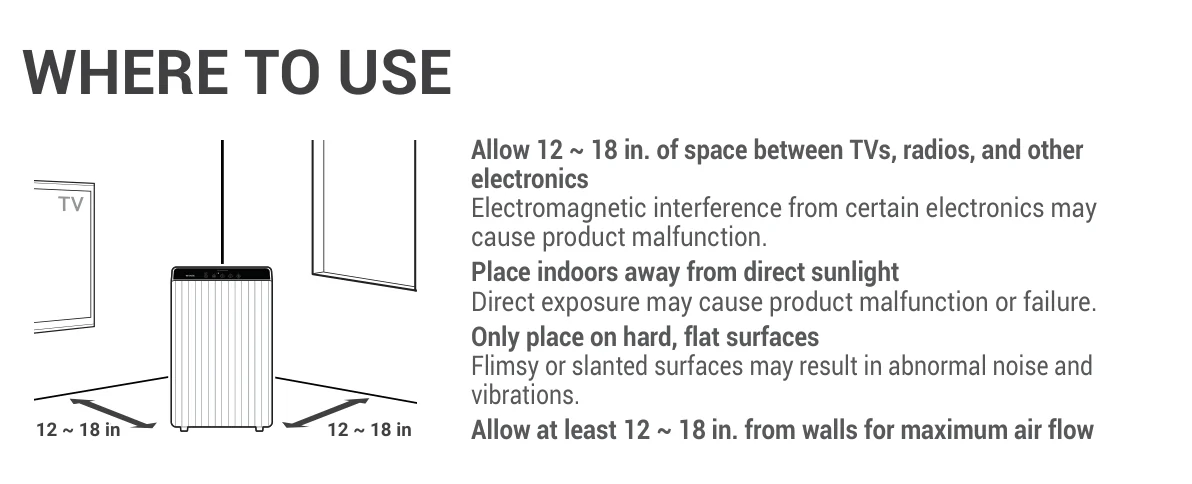
For more on clearance and where in the room it works best, see where to put an air purifier.
Ozone, ionizers and fragrance
EPA advises against air cleaners that intentionally produce ozone and says no federal agency has approved ozone generators for occupied spaces. Ionizers, electrostatic precipitators, some UV lights and plasma units may emit ozone too. Our guide to air purifier side effects covers this in more depth. We’d also skip aroma pads and fragrance add-ons in a nursery; an air purifier’s job is to remove things from the air, not add them.
Humidity and the nursery
A purifier doesn’t change humidity. EPA recommends keeping indoor humidity below 60%, ideally 30% to 50%. If you add a humidifier for dry winter air, see our best humidifier for baby picks (cool mist only), read our guide to ideal indoor humidity and clean it often, as our humidifier cleaning guide explains. A dirty tank can spread microbes into the room.
What an air purifier can’t do
EPA says studies with portable HEPA cleaners found improvements in some allergy and asthma symptoms, but not always major ones and not in all symptoms. A purifier won’t remove gases without enough carbon, won’t fix dampness or mold, and doesn’t replace ventilation or source control, such as not smoking indoors. If your baby has asthma, allergies or other breathing concerns, talk to your pediatrician about what will actually help.
Frequently asked questions
Is it safe to use an air purifier in a baby's room?
A mechanical HEPA-type purifier that's CARB-certified, placed out of reach with its cord secured, is a common choice for a nursery. Avoid ozone generators and keep any ionizer switched off. If your baby has breathing problems, ask your pediatrician first.
Should I turn off the ionizer in a nursery?
We'd keep it off. EPA says ionizers and electrostatic air cleaners may emit ozone, a lung irritant, and CARB certification limits ozone to 0.050 ppm rather than zero. The Coway Mighty2 and Levoit Core 300-P don't advertise one; the Winix 5520 and Rabbit Air A3 let you switch theirs off.
What size air purifier does a nursery need?
Use AHAM's two-thirds rule: smoke CADR at least two-thirds of the floor area with an 8 ft ceiling. A 10 x 12 ft nursery (120 sq ft) needs at least 80 cfm. Buying more than the minimum lets you run it on a quieter speed.
How far should an air purifier be from the crib?
No manual we read gives a crib distance. Manuals do ask for clearance from walls (8 to 18 inches for the Coway and Winix models we checked) and say to keep cords out of traffic paths. We'd put it across the room, out of reach and not blowing at the crib.
How loud is too loud for a baby room?
There's no official number for purifiers. EPA notes that about 50 dB is roughly a modern refrigerator. All four picks publish a low setting between 19 and 24 dB, which is why we'd size up and run them on low.
Update log
- : Added Coway Mighty2 filter price and Levoit's 6 to 8 month filter interval to the cost figures
- : Added award headings, buy and skip notes, cost per year and a left-out list; the Winix 5520's CADR is now confirmed in the AHAM directory, and its price and Filter Q price were updated from Winix's store
Related guides
Air Purifiers
Best Air Purifiers for a Bedroom in 2026: Quiet, Dark and Sized to Run All Night
Five bedroom air purifiers with published sleep-mode noise, light and display options, verified CADR for bedroom sizes and what a night of running costs.
15 min read
Air Purifiers
Quietest Air Purifiers: Published Decibels, Sleep Modes and the CADR Trade-Off
Five air purifiers with the lowest published noise figures, what their decibel ratings do and don't tell you, and how to stay quiet without losing clean air.
16 min read
Air Purifiers
Best Air Purifiers for Allergies in 2026: Pollen, Dust Mites and Dander
Six current air purifiers for pollen, dust mite and dander allergies, picked on verified pollen CADR, HEPA-grade filters, room size and ionizer status.
15 min read
Air Purifiers
Best Air Purifiers of 2026: Research-Backed Picks for Every Room
Seven current air purifiers for every room and budget, chosen on verified CADR, HEPA filtration, ozone status, noise and filter cost.
27 min read
Air Purifiers
Best Place to Put an Air Purifier: Placement Rules From EPA and the Manuals
Put it in the room you use most, with 8 to 18 inches of clearance, away from heat, moisture and curtains, and size it for the space the door opens onto.
7 min read